Overheard at my local Gordon Biersch restaurant a few days ago:
as far as us is concerned, …
Strikingly ungrammatical for me. But I think I’ve figured out where it comes from.
Overheard at my local Gordon Biersch restaurant a few days ago:
as far as us is concerned, …
Strikingly ungrammatical for me. But I think I’ve figured out where it comes from.
While searching for something else entirely, I came across a large number of instances of anarthrous US/U.S., like this one:
With a population at 1,330,044,605, as estimated by CIA (July 2008 estimated), China leads all nations by it human capital. China boasts a literacy rate of 90% though official figures as to accessibility to Internet are not available. As far as U.S is concerned, it has a very high rate of accessibility to Internet. The entire U.S society is now logged on to Internet by one way or the other. A life without Internet in the U.S is unimaginable and any disruption of the free flow of information would pose a grave political and commercial consequences. (link)
This from commenter Srinath Fernando; the examples seem to be very heavily from South Asian speakers.
(Note also the consistent use of anarthrous Internet.)
An inventory of some materials (mostly from Language Log) on arthrous and anarthrous nominals (with and without the definite article, respectively) in English:
Dingburgers savor NPR names:
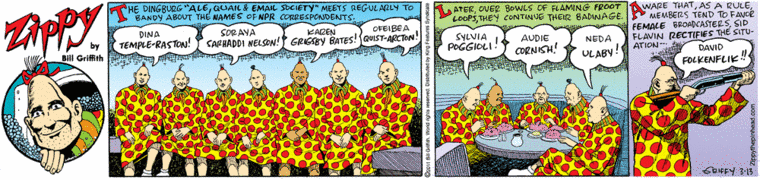
Someone named Arnold Melchior Zwicky can scarcely mock other people’s names. In fact, if you have an “ordinary” name, I’m probably going to have trouble remembering it.
(Earlier posting on NPR names here.)
From a presentation at Friday’s Stanford SemFest:
whatever else information ‘whatever other information’
spoken by Marisa Tice. Now it might have been an inadvertent error, but there are enough other occurrences to suggest that for some people (if not actually for Middy), else has picked up more of the syntax of other than it has in my variety.
Today’s Bizarro:

An ingenious proposal, based on homosexual (slang homo) and the ‘sound’ element –phone. But note that the student would have had to hear the “two words that sound … but are really …” definition of homophone to produce his answer.
(In the real world, errors involving homophone and homophobe, with substitutions in both directions, are moderately common.)
[I spent yesterday getting together a handout for my Stanford Sematics Fest paper (today):
Categories and Labels: LGBPPTQQQEIOAAAF2/SGL …
(abstract here, discussion of the giant initialism here). Here’s a section of the handout that pursues a theme from my posting “Labels: homosexual” (here) on associations and connotations of labels. (I will eventually post a link to the whole handout.)]
People in the public eye, especially celebrities and political figures, are often subject to linguistic scorn, either by quotations that take on a memic life of their own (Bushisms from George W. Bush, Cruisiana from Tom Cruise) or by morphological formations (portmanteaus and derivatives) that allude to these public figures (Reaganaut/Reagonaut).
Scornful portmanteaus are scarcely new: see feminazi (feminist + Nazi) from the political right, Repuglican (repugnant + Republican) from the political left. But certain figures are attractors for them. Barack Obama, for instance; beyond a small number of examples like BarackBerry (Barack + BlackBerry), there are endless Obamamanteaus (I wish I could say I’d invented this one, and there aren’t a lot of citations, but I surely didn’t get in there first), a few of them collected in Mark Liberman’s Language Log posting “Lexical Obamanations” (here) and Ben Zimmer’s comment on it.
But now Charlie Sheen has come along and opened up a whole new world, of Sheenisms or Sheenonyms or Sheen-guistics (respectively, an ordinary derivative, a compound-like word with Sheeno- as a combining form, and a portmanteau), and of course of words for talking about Sheen and his bizarre public rants.
It’s Shrove Tuesday, Mardi Gras ‘Fat Tuesday”, or (as it’s known in my Pennsylvania Dutch homeland) Fasnacht Day. Time for pre-Lenten excesses, like the rites of Carnival, pancakes, and doughnuts (the Shrove Tuesday food of my people).
From the NYT Week in Review of January 30, in a piece by Scott Shane on change and technology: “Technology helps ignite change (as in Tunisia). Except when it bolsters oppression (as in Iran).”
Widney Brown, senior director of international law and policy at Amnesty International, said the popular networking services, like most technologies, are politically neutral.
“There’s nothing deterministic about these tools — Gutenberg’s press, or fax machines or Facebook,” Ms. Brown said. “They can be used to promote human rights or to undermine human rights.”
This is the point of [Evgeny] Morozov, 26, a visiting scholar at Stanford. In “The Net Delusion,” he presents an answer to the “cyberutopians” who assume that the Internet inevitably fuels democracy. He coined the term “spinternet” to capture the spin applied to the Web by governments that are beginning to master it.
In China, Mr. Morozov said, thousands of commentators are trained and paid — hence their nickname, the 50-Cent Party — to post pro-government comments on the Web and steer online opinion away from criticism of the Communist Party. In Venezuela, President Hugo Chávez, after first denouncing hostile Twitter comments as “terrorism,” created his own Twitter feed — an entertaining mix of politics and self-promotion that now has 1.2 million followers.
In Russia, Mr. Morozov noted, Prime Minister Vladimir V. Putin has managed to co-opt several prominent new-media entrepreneurs, including Konstantin Rykov, whose many Web sites now skew strongly pro-Putin and whose anti-Georgia documentary about the Russia-Georgia war of 2008 went viral on the Web.
Mr. Morozov acknowledges that social networking “definitely helps protesters to mobilize.”
“But is it making protest more likely? I don’t think so.”
The big point is about technology and political change. But the little linguistic point is the portmanteau spinternet (spin + internet) ‘(political) spinning via the internet’.