The Curious Pages website (see here on Munro Leaf) led me to the 1938 Gay Mother Goose (“with drawings by Françoise”, apparently a successor to a 1936 Romney Gay Mother Goose. The cover:
Archive for March, 2011
Gay Mother Goose
March 26, 2011Grammar ain’t fun
March 26, 2011From Laura Staum Casasanto, a link to the Curious Pages blog (“recommended inappropriate books for kids; recommended reading for cool kids and young rebels”) and its posting on Munro Leaf’s Grammar Can Be Fun (1934):

This title by Ferdinand author Munro Leaf makes grammar so fun that you pass out or die.
(Note adjective fun in this comment.)
The character on the cover is in fact ain’t, who/which Leaf deprecates:

[The characterization of ain’t as “lazy” has always seemed to me to be a deflection of a social judgment onto a moral one — as if the millions of English speakers who naturally have this usage are aiming for isn’t (or whatever) but settle for ain’t instead as “easier”, so that the somewhat longer variants “aren’t worth the trouble” (the way so many millions of lazy dolts, shame on you all, aim for do not but settle for the easier don’t instead). (Look, don’t get me wrong; I understand that ain’t is non-standard. But anything that isn’t formal standard written English isn’t some sort of jumbled ignorant lazy crap. Far from it.)]
Leaf goes on to disparage (among other things) uh-huh and un-un (his spellings); gimme, gonna, and wanna; and I feel good/bad. The fun is in the graphics, but the messages are sternly directive and they ain’t no fun at all.
Leaf produced a long series of X Can Be Fun books, clearly intended to induce little kids into enjoying things they were inclined not to like:. For X =
Manners, Reading, Brushing Your Teeth [my absolute favorite]. Geography, Safety, Science, Metric [a close second], History, Health, Arithmetic [Broccoli and Spinach are unaccountably missing]
and no doubt more. (Not that many of these subjects cannot be presented as sources of great enjoyment — my 7-year-old grand-daughter spent a while this morning playing an algebra game on her mother’s iPad, for goodness sake — but Leaf’s texts have a lot of “swallow your cod-liver oil, it’s good for you, and that’s really important” in them.)
Leaf also wrote equally didactic Watchbird material (“This is a Watchbird watching a Sneaky” — you can fill in the rest) and a number of books on manners for kids (How to Behave and Why, Speak Politely and Why), plus fiction beyond Ferdinand (1936), which got Leaf into some trouble because of its perceived subversively pacifist message.
Naming your porn company
March 26, 2011Suppose you’re going into the business of providing scenes from gay porn movies on-line. You’ve written the copy that says
Your home for the best adult male movies & scenes. Stream, download & own thousands of XXX scenes from your favorite movies.
Now what do you name the company?
as well
March 25, 2011Over on ADS-L a few days ago, Charlie Doyle reported on a usage that struck him as odd:
I have just read a student essay in which about 10% of the sentences begin with “As well [comma]” — instead of “Moreover” or “Furthermore” or “What is more” or “Also.” Our students (evidently) have been taught to stick in lots of “transitions,” but sentence-initial “As well” strikes me as abnormal. As well, the essay didn’t have much content.
More gaiety from the 1940s
March 25, 2011More from Chris Ambidge, following up on Jell-O the gay dessert:
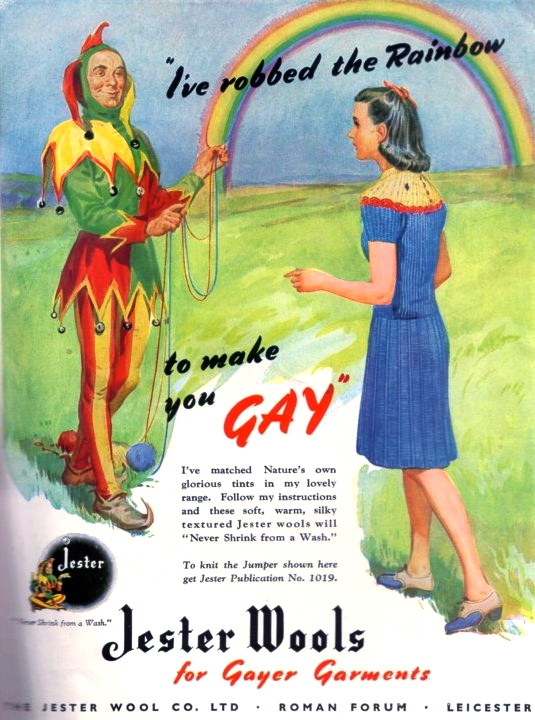
That’s one gay jester! Making people gay with wool from Leicester!
Today’s Bizarro pun
March 25, 2011… on the waning of sexual interest:

The persistence of proper names
March 25, 2011Visit yesterday morning to CUNY 2011, the 24th CUNY Conference on Human Sentence Processing. At Stanford. Some other recent meetings: CUNY 2007 at UCSD, CUNY 2008 at UNC Chapel Hill, CUNY 2009 at UC Davis, CUNY 2010 at NYU (that was, at least, in New York City, though not at CUNY).
Well, yes, it started at the City University of New York and was held there for some years before it went on the road, taking its name with it.
Proper names are like that; they easily become opaque, unmoored from the circumstances that motivated them in the first place. This is obvious for personal and family names: no one expects someone named Rufus to be red-haired, or a family named Baker to be engaged in making bread, cakes, and cookies. They are, as we say, “just names”. So it is with other names: here, as elsewhere, etymology is not destiny and labels are not definitions.
Linguist List (2011)
March 24, 2011It’s that time of the year, and Linguist List is begging for money to keep its services going. Unlike Language Log, Linguist List has a staff (enthusiastic grad students), because it couldn’t possibly do what it does without one. Check out the site, and donate here.
Small donations are very much welcome. If you have currency exchange problems, mail Barbara Partee or me.
Grammar and the Postal Service
March 24, 2011Today’s Zippy, surrealistically silly:

Grammar here seems to take in lexical semantics and some aspects of punctuation. Well, It’s All Grammar, and anyway, this is Zippy.