Archive for 2010

Short shot #52: ten-stone cowboy

August 18, 2010

As my dieting closes in on 11 stone (1 (British) stone = 14 lbs.), I am reminded that my goal, the return to 140 lbs. after nearly a decade away, figured in a cute pun made by Ann Daingerfield Zwicky many years ago, when she quipped that I’d become

a ten-stone cowboy

(playing on the title of the country-pop song “Rhinestone Cowboy”, written by Larry Weiss and famously performed by Glen Campbell).

It’s a distant pun, /tɛn/ for /rajn/, but it works, if you know about the song; otherwise, it’s just mysterious.

(Small phonological note: ten-stone and rhinestone differ prosodically, though both have primary accent on their first syllable and some accent on their second: the second syllable of ten-stone has a heavier accent than the second syllable of rhinestone. There are two schemes for transcribing this difference: either by distinguishing a secondary and a tertiary accent (both distinct from unaccented), 1 2 vs. 1 3; or by transcribing the words as 1 1 vs. 1 2 (positing only one non-primary accent), with the understanding that in 1 1 compound words, the first syllable has a phonetically heavier accent than the second.)

Data points: subj-verb agreement 8/17/10

August 17, 2010

Headline on the front page of the New York Times today:

Exclusive Golf Course Is Also Organic, So a Weed or Two Get In

My first reaction — really, why I noticed the head in the first place — was that I would have written gets (sg.) rather than get (pl.), and I’m still inclined that way, though I’m not willing to say that get is unacceptable or non-standard. I do have a hypothesis about where the plural might have come from.

(more…)

On AZBlogX

August 17, 2010

These are mostly not about language, though linguistic matters sneak in there fairly often anyway, and there are links back to postings on this blog:

8/14/10: Pits ’n’ Tits: five underwear models (link) [on sexualized presentation of the male body in the mass media and in male photography]

8/14/10: Pits ’n’ Tits: the captioned series (link) [XXX-rated images with comic captions accompanying them]

8/15/10: From 10percent 8/15/10 (link) [on a recent e-mail ad from this company]

8/16/10: Hi-def (link) [on men’s underwear in sheer, revealing fabrics]

8/16/10: The triad: jockstrap, locker room, shower room (link) [mostly about jockstraps]

Today’s pun crop

August 15, 2010

Another Bizarro with three puns:

The thing about imperfect puns — those where the punning expression and the one punned on are not phonologically identical, as in all three of these examples — is that the punner can get away with considerable disparity between pun and model if the context (in a formulaic expression of some kind, with visual reinforcement, etc.) is rich enough.

Trolls for scrolls is moderately distant, /t/ for /sk/ — but it’s a rhyme, and rhymes make the pun relationship easy to perceive; the onsets of the accented syllables in the rhyming relation can be pretty much anything.

Wrestler’s for Whistler’s is more distant: /r/ for /(h)w/ in the onset plus /ɛ/ for /ɪ/ as the accented vowel. But there’s support from the formula and the picture.

Goth for Gogh is a snap orthographically, but quite distant phonologically, if you use the most common English pronunciation for Gogh: /aɵ/ for /o/. Or moderately distant if you use a reasonably faithful approximation to Dutch: /gaɵ/ for /xax/, where /x/ is a voiceless velar fricative not ordinarily appearing as a phoneme of English. Only if you use the mixed pronunciation /gax/ for the painter’s name (an alternative given by AHD4 in addition to the other two) does the pun resolve to something really easy, /g/ for /x/ in the offset.

Probably Piraro was thinking about the relationship orthographically, with T for G.

And that’s the Sunday puns.

The House of X formula

August 12, 2010

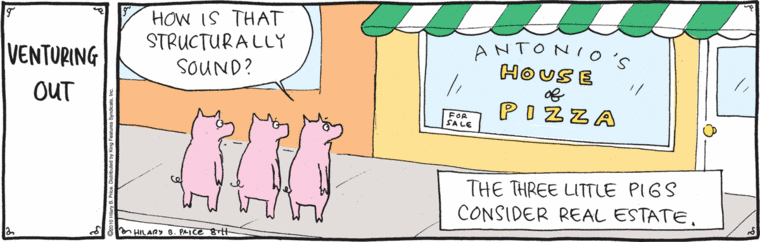
The central exhibit in yesterday’s posting on ambiguity in N of N nominals was

House of Pizza

as the name of a store (which the Three Little Pigs of course misinterpreted).

In a comment, Chris Hansen wrote:

Bob and Ray’s House of Toast comes to mind…

Indeed. Bob and Ray’s invention was a take-off on House of X shop names, a kind of snowclonelet alternative to common nouns of the form

X + -eteria, -ateria, -teria, -eria

(pizzateria, toasteteria, etc.), with the libfix -((V)t)eria that has come up on Language Log and this blog several times. Antonio’s House of Pizza or Antonio’s Pizzateria, take your pick. And to N+N shop names of the form X Shop/Store/Place/Nook/Hut/City/Town/Center… (The Toast Shop, Toast City, etc.)

(more…)

On Blog X

August 11, 2010

Some recent XXX-rated things of linguistic interest or with links to this blog (or just for fun):

8/8/10: Red Ken (link) [dolls and action figures]

8/9/10: Action figures getting some action (link) [dolls and action figures]

8/9/10: Error collage (link) [typos and spelling mistakes]

8/9/10: The bear-eating figure (link) [“eating the bear”]

8/10/10: Tadzio (link) [Death in Venice]

8/11/10: Collages on linguistic subjects (link) [seven of them]

The ambiguity watch: N of N

August 11, 2010

I’ve written a lot about ambiguity in N+N compounds, and will write more, but today’s lesson is on a related set of ambiguities in N of N expressions, illustrated here in a Rhymes With Orange:

It took me a moment to get this one:

House of Pizza, intended like House of Foam (two blocks from my house) and other shop names (with an extended sense of house and with of marking function or source: ‘place where one can get/buy …’); versus

house of bricks, house of sticks, house of straw (as in The Three Little Pigs story), house of cards, etc., conveying ‘house made of …’

There are lots of other possibilities, of course, in House of Rothschild, House of Lords, and more. The House of Lords could, after all, be a place where you could pick up a Lord (for whatever purpose you have in mind), or the proper name of a particular type of house made of Lords (say, by stacking them one on another). Potential ambiguity is everywhere.

The pun watch

August 11, 2010

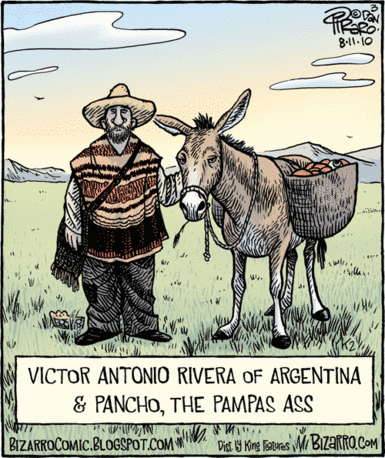
Bizarro‘s latest pun, which is a phonologically perfect one if you have an /a/ in the first syllable of pampas:

Entheta

August 10, 2010

A correspondent has written me (presumably in my role as Zero-Plural Man, possibly because of my recent note on nouning and zero plurals in the case of the noun background ‘movie extras’) a message with the header

A rather famous zero plural

and the one-word body

Entheta

That rang only the most distant of bells for me, but of course I have on-line resources, from which I concluded that entheta is a Hubbardism (as in L. Ron Hubbard), a bit of Scientology-speak. And that it’s not a zero plural of a count noun, but instead a (singular) mass noun.

(more…)

Sarcasm

August 10, 2010

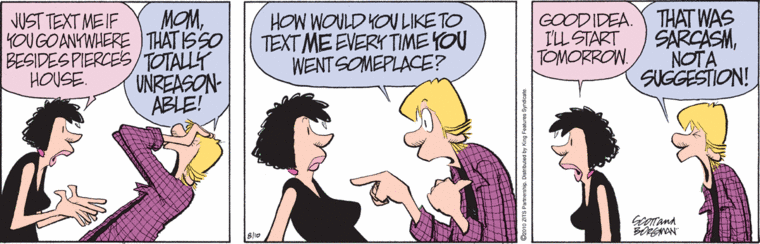
Well, strictly speaking, it was sarcasm in the form of a suggestion:

There’s a collection of why- and how-interrogative forms that, in addition to their literal question-asking meanings, can be conventionally used to make suggestions, and suggestions can be uttered sarcastically to reverse their polarity, as in the following set:

Why don’t you like me?  [literal information question]

Why don’t you have dinner with me? [suggestion, for joint dining]

Why don’t you just jump off the fuckin’ roof, you moron?! [sarcasm, conveying that it would be stupid of you to jump off the roof (or to do something relevantly like jumping off the roof), hence suggesting (strongly) that you shouldn’t do that]

I’ve overloaded the last example with features (including the orthographic device ?! to indicate the very high rising-falling final intonation of an emphatic interrogative that might be intended to convey sarcasm) that point to sarcasm, but in actual life things are very often not so dramatically underlined by linguistic features.

Faced with utterances that could be unclear as to the speaker’s intent, the hearer might just fail to get the sarcasm and interpret an utterance like Jeremy’s as a suggestion. Or, more deviously, the hearer can reject the intent behind the speaker’s sarcasm and affect not to get the sarcasm, by treating the utterance as a simple suggestion. We can’t be sure which route Jeremy’s mother has taken, so the strip might be “about” the cluelessness of parents or “about” their resistance to their kids’ (unreasonable) opinions in opposition to their (of course, entirely reasonable) requirements. Or both.