Archive for 2010

Data points: sentential portmanteaus 8/23/10

August 23, 2010

It came up while I was looking for something entirely different: the hybrid title of a 2006 play by Neil Renken at the No Shame Theatre in Cedar Falls IA, a theater group with only three rules (pieces must be original; under 5 minutes long; and can’t harm the theater space or its occupants):

Are You Happy to See Me or Are You Eating a Banana?

That’s a portmanteau of two smart-assed question formulas, both disjunctive in form and with a banana in the second disjunct:

Are you happy to see me, or is that a banana in your pocket?
Is that your nose, or are you eating a banana?

Conveying, very roughly, ‘you are visibly aroused, I can see your hard-on in your pants’ (or as some anti-nudity laws have it, you are “discernibly turgid”; I’ll post about the legal expression eventually) and ‘your nose is huge’, respectively.

It’s the banana that makes the portmanteau work. Bananas are versatile.

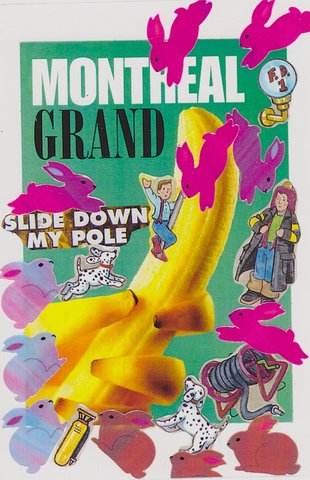
For example, here’s a G-rated collage with a seriously phallic banana, and several other bits of phallicity:

Firefighters have all the fun.

Failure to fact-check

August 23, 2010

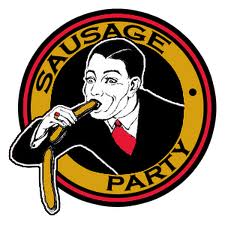
In my posting yesterday on “infinitesimally small values of huge” in a Multiverse strip, I also picked up on the compound sausage party, referring to a gathering that was mostly or entirely male (with a number of further connotations), and I showed an altered logo depicting a man eating sausages:

saying:

The only thing that’s been altered is the text, which was originally the name, in German, of the sausage company that commissioned the ad and then failed to see how it was likely to be taken.

Well, the background color has also been altered: the version I saw a few years ago (in a collection of unintentionally hilarious, mostly phallic, logos), which turns out to be the original, has a red background rather than a black one. And so has the framing, which was a black-edged or borderless red diamond in that version, and is a black-red-black-edged yellow circle in this one.

And the text has indeed been changed, but not from a German company name.

(more…)

Dating by cliché

August 23, 2010

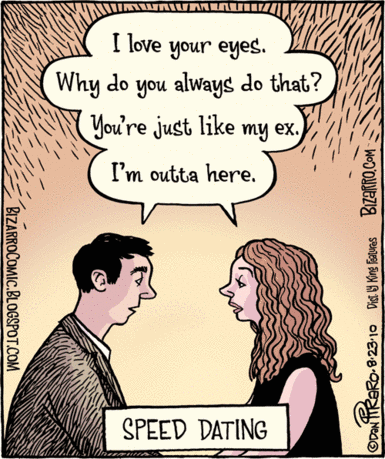
Today’s Bizarro:

Dan Piraro has chosen to have all four clichés attributed to both parties in the event. Maybe we’re supposed to see the exchange as alternating between the man and the woman, or maybe we can mix and match.

[Bonus observation: the synthetic compound speed-dating (however punctuated) has of course given rise to a two-part back-formed verb speed-date. Lots of hits for to speed-date and speed-dated, both intransitive and transitive.]

for Mod values of Adj

August 22, 2010

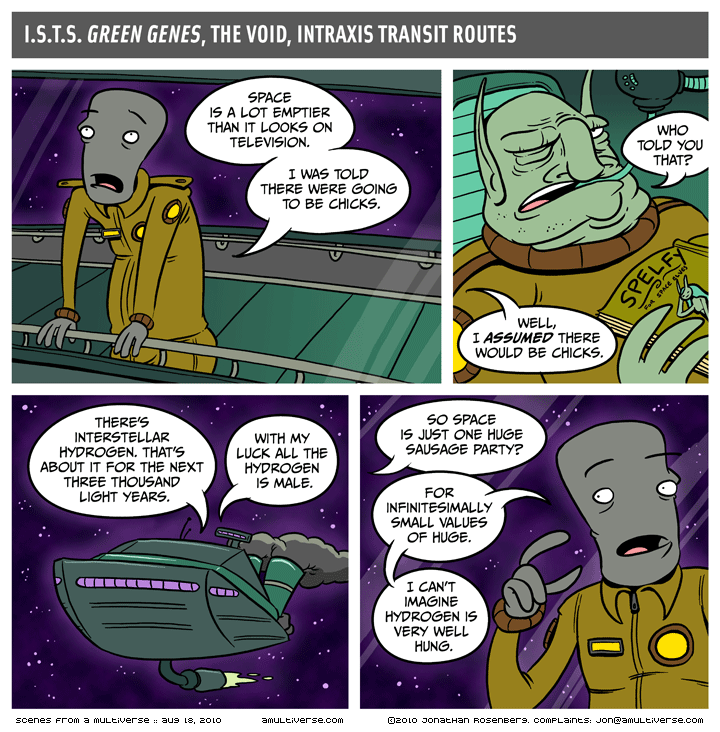
At the last minute, a weekend cartoon. From Scenes from a Multiverse:

Two points. First, “for infinitesimally small values of huge”. (Later, “sausage party”.)

(more…)

Sidetracking the golden goose

August 22, 2010

From James Gavin’s 8/8/10 review of Little Girl Blue: The Life of Karen Carpenter (by Randy L. Schmidt), NYT Book Review:

Each of her love affairs foundered, and someone [notably her brother or her mother] was always there to discourage any relationship that might sidetrack the golden goose.

The Golden Goose is a fairy tale collected by the Brothers Grimm, in which the goose in question has feathers of pure gold, and anyone who tries to pluck one is instantly stuck to the bird (further complications ensue, and there’s a backstory).

It’s hard to see Karen Carpenter as metaphorically such a golden goose, though she could undoubtedly have been described as a (metaphorical) cash cow, or as a goose (or hen) who regularly laid a (metaphorical) golden egg (as in the Aesop fable), through her singing.

That is, you could sidetrack a golden-egg-laying goose (divert it from performing its valuable function), most spectacularly by killing it, in the hope of getting at its presumed internal store of gold. Of course you could also kill a golden goose in the hope of getting its golden feathers, but sidetracking or diversion wouldn’t keep it from having golden feathers or cause it to lose them.

Still, the two formulaic expressions are similar enough that they can be blended, to yield kill the golden goose, which is a good deal shorter than kill the goose that laid/lays the golden egg(s). Or kill the golden goose could be seen not as formal blending or a shortening of the longer formula by displacement of the word golden, but as a conceptual displacement of the property of goldenness from the goose’s eggs to the goose itself (a kind of hypallage).

In any case, though it’s not in OED2, the shorter version seems to have gained currency in English, as in this quote (one out of a large number), where the connection to the golden-egg-laying goose is explicit:

Don’t Kill the Golden Goose!
It’s a well known fact that dead geese cannot lay golden eggs! (link)

No doubt there are people out there complaining about such usages as misquotations. And probably people who visualize the goose that laid the golden eggs as itself golden (well, that makes sense, doesn’t it?).

Return to rainbow flagwear

August 21, 2010

A little while back, I looked at some rainbow flags, specifically gay rainbow flags.

(Rainbow images are, of course, used in many different contexts to convey many different messages, often of inclusiveness, sometimes delight or joy, and much more. Like linguistic features, visual symbols are “just stuff”, without a single intrinsic social meaning, and are capable of being used for any number of sociocultural purposes, some of them with “natural” associations to the stuff, some of them with conventional associations set up by accidents of history, many with a bit of each in their past — points I’ll return to when I finally get to writing up my thoughts on “gay colors”.)

You can be “flying the gay flag” by wearing underwear in a rainbow pattern (stripes reproducing those on the gay flag), dressing your teddy bear in a rainbow sweater, sporting buttons or displaying stickers with rainbow stripes on them, and so on.

But it turns out there are several versions of the gay rainbow, in rainbow flags and objects that allude to these flags, differing (at least) in how many discrete stripes there are (the actual rainbow is continuous, but cultural objects with “rainbows” on them have distinct stripes, arranged in some kind of pattern), what the colors of the stripes are, what pattern they’re arranged in (parallel strips arranged horizontally or vertically, in arcs, or in circles, or strips in fans), and what sequence the strips come in: going top to bottom, left to right, outside in, which colors — the “hot” ones like red and orange, or the “cool” ones like blue and purple — come first. (As far as I know, the sequencing of the strips is always one that accords with a natural ordering, by frequency or wavelength, though “mixed” orderings are in principle possible.) For stripes arranged vertically, as in actual rainbow flags, or in arcs or circles, the custom is very heavily to go from hot to cool, but stripes arranged horizontally, as in parallel strips or fans, can go either way.

In any case, all of this started here with a set of ad shots for FreeMen rainbow underwear in an Undergear catalog.

(more…)
Exuberant morphology

August 20, 2010

After I posted a link to Gay Pimp’s (Jonny McGovern‘s) “Soccer Practice” video on my X blog (here; note that this is X-rated territory), an appreciative friend sent along a link to Cazwell’s video “Ice Cream Truck” (Luke Cazwell, né Lucas Cazuela). Two outrageous fags doing white rap in a street-black style to a gay-disco beat. Tremendously unsubtle, campy, and also gay-affirming and often joyous.

Cazwell managed to get one of his videos (available for viewing here, with music that is, like McGovern’s, easily available on CD), “All Over Your Face” — yes, it means just what you think it does — banned from the LOGO channel. It has the memorable lyrics:

I masturbated till my K-Y faded [unnh] … I’m exhausticated

Exhausticated is the point at hand — a piece of “exuberant morphology”, playing on exhausted and exploiting that extra morphological material to go beyond it (as well as to make the line scan): if you’re exhausticated, you’re thoroughly exhausted.

(more…)

Data points: referent finding 8/20/10

August 20, 2010

From the NYT Science Times of August 17 (John Markoff, “Step 1: Post Elusive Proof. Step 2: Watch Fireworks.”):

“The difference between the alchemists and the chemists was that the printing press was used to coordinate peer review,” [NYU professor Clay Shirky] said. “The printing press didn’t cause the scientific revolution, but it wouldn’t have been possible without it.”

Among the reader’s tasks is to find the referents for the two it‘s in

(1) … it wouldn’t have been possible without it

There are two candidates in the text for each it: the printing press and the scientific revolution.

(more…)

The Library Train to Sauk Centre

August 19, 2010

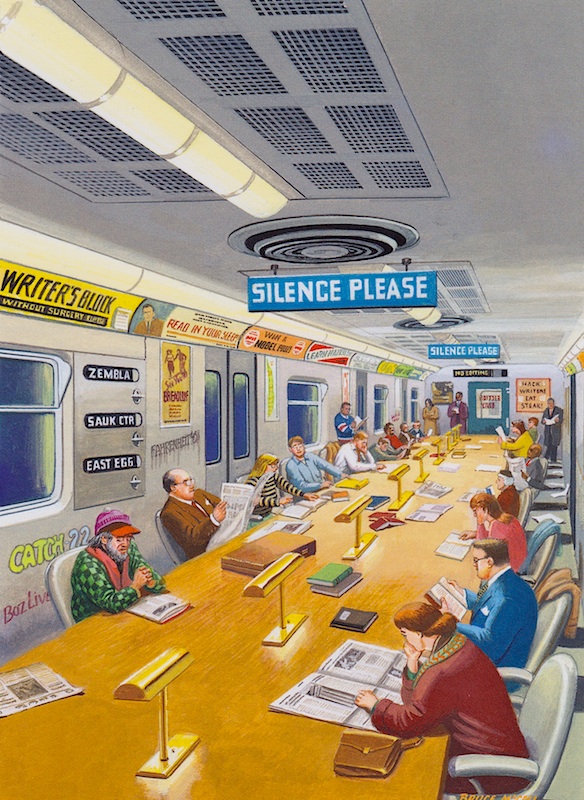
Bruce McCall’s fantasy train:

This bears a family resemblance to the Reading Room of the New York Public Library, but with different lamps and with various amendments. And without the computer connections.

The illustration is entitled:

Silence (Screech, Ka-Bang, Yudda-Yudda-Yudda), Please

[Added 8/23/10: Note that Sauk Centre is the name of the real Minnesota town that corresponds to the fictional Gopher Prairie of Sinclair Lewis’s Main Street. It’s left as an exercise to the reader to identify the other two destinations.]

Data points: verbing 8/18/10

August 18, 2010

Jon Lighter just wrote to ADS-L:

Reading this reminded me of the many times I read it in freshman themes in the 1980s and probably ’70s:

2010 WikiAnswers (link):
Who quoted The more you sweat in peace the less you bleed in war?
* *sun tzu*.*

Here we have the noun quote, a clipping of the noun quotation or a nouning of the verb quote, verbed to yield quote ‘originate  (a notable quote/quotation)’. Both more compact and more direct than “first said” or “originated the quote”.

Though it does introduce a possibly troublesome (in these days of plagiarism anxieties) ambiguity between originating and relaying a quote.