Every so often, Zippy and Zerbina get into a groove of repeating phrases. This time it’s Zerbina, stuck on the remarkable phrase “post-prandial sneeze disorder”:
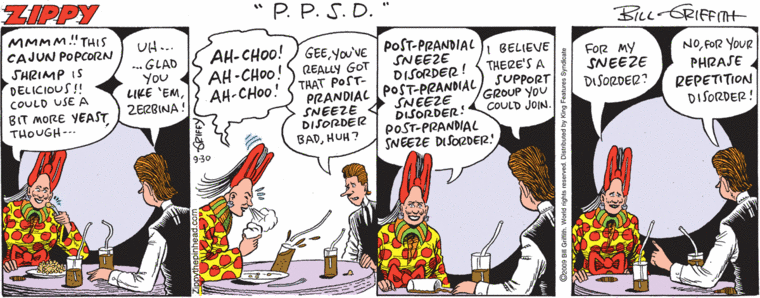
Every so often, Zippy and Zerbina get into a groove of repeating phrases. This time it’s Zerbina, stuck on the remarkable phrase “post-prandial sneeze disorder”:
Ned Deily reports coming across this sign in a San Francisco store window:
THIS PREMISE
IS UNDER 24 HR.
VIDEO SURVEILLANCE
Yes, this premise is, rather than these premises are. The result is something that looks like an instance of the logical term premise (so that Deily posted a photo of the sign on Facebook under the heading “department of rhetorical security”), rather than the ‘house or building’ word.
The ways of plurals in English are intricate indeed, and premise(s) exhibits several of these intricacies.
In the latest (September 26) University South News (Palo Alto CA), Eileen Meyer has collected mis-steps in the Palo Alto Weekly‘s “Town Square” column:
[about city salaries] “…do not believe their exuberant salaries are justified.”
I shutter to think what you would do if you …
Eat to you’re heart’s greasy contempt.
I BOYCOTT TARGET for being greety
… make our voices known to the City Council and undue the damage that has already been done
Some of these are old friends: exuberant for extravagant is in the Eggcorn Database here, shutter for shudder here, undue for undo in the entry here for the opposite substitution. Contempt for content and greety for greedy are new to me; I don’t see a semantic motivation for the substutions, but both are phonologically motivated.
Greasy in heart’s greasy contempt is something of a puzzle, especially without any context. There are some occurrences on the web of greasy contempt, but they all seem to be about contempt, not being contented. Maybe greasy was intended literally, as a reference to greasy food, or maybe it was another substitution for greedy.
That leaves YOU’RE for YOUR — an extremely common spelling error.
This is very old news, but I just came across the topic for the first time in the pages of Funny Times (October 2009), in Chuck Shepherd’s “News of the Weird”:
Donaldism — Donald Duck may be a lovable icon of comic mishap to American youngsters, but in Germany, he is wise and complicated and retains followers well past their childhoods. Using licensed Disney storyline and art, the legendary translator Erika Fuchs created an erudite Donald, who often “quotes from German literature, speaks in grammatically complex sentences, and is prone to philosophical musings,” according to a Wall Street Journal dispatch.
Not just Germany (see the detailed Wikipedia page), though the 32nd annual convention of the German Organization for Non-Commercial Followers of Pure Donaldism (the German name has the acronym DONALD) was held recently in Stuttgart.
The roots of donaldism are in Norway (Jon Gisle’s 1973 book Donaldismen), but it has spread, mostly to northern European countries; there are donaldist fanzines in Denmark, Finland, Germany, Norway, and Sweden, plus the U.S.
Having stumbled into a discussion of the synthetic compounds shirt-lifting and shirt-lifter (in several senses) and the back-formed verb to shirt-lift historically derived from them, I was moved to explore some other possible sexual back-formations. Given cock-sucking and cock-sucker, had people invented a back-formed verb to cock-suck (however spelled)?
The answer is: yes, big time.
A little silliness for the weekend.
My e-mail from commercial “gay supplies sites” has recently brought me several more instances of homoerotic photos of shirt-lifting (in the more or less literal sense of the word, in which shirts are lifted), one of which (from 10percent.com, below) has a listing of lines of t-shirts carried by the company.

Among these is the deliciously named Swish Embassy — a name that clearly codes the audience the company is aiming for. From the website:
Swish Embassy is a Gay-owned and operated casual apparel company started in 2008. The inspiration for starting Swish Embassy was the observation that there should more options for fun, suggestive, relevant and appropriately fitted wear for gay men than the oversaturated chains that cater to Tweens rather than Queens.
The t-shirt slogans shy away from representing male genitalia, but they’re often frank in their language. Some of the shirts are indirect (nudge-nudge-wink-wink) in their approach: one with an image of a rooster, conveying cock. Then they get progressively more direct:
i like it dirty
I ♥ [image of a caulking gun, again conveying cock]
SOFA KING GREAT
Dimitry’s GREEK-STYLE Deli, with an image of a chef tending the vertical spit on which gyros are cooked, with the caption Eat the meat!
EATIN GOOD IN THE GAYBORHOOD, with a hot dog in a bun
LET’S COMPARE BATS, with crossed baseball bats
Cockylicious & Addictive, with a gold rooster
BUTT PIRATE, with a pirate’s head
No gag reflex
I’ve got more than enough to reach the back of your throat!
Does my cock look fat in these jeans?
FURRY FUCKER
There’s more, including more ordinary puns, visual puns, and allusions to sexual content.
[Language Log has touched several times (for instance, here and here) on playful word formation with -Vlicious, seen above in cockylicious, which (as far as I can tell) wasn’t covered in these postings, though bootylicious and hunkalicious were. Lots and lots of webhits for cockylicious, and a fair number for cockalicious too.]
Now, I’m not at all opposed to politically provocative t-shirts and the like, and have been known to wear such apparel on occasion. Some of the t-shirts above are merely sexually suggestive, but some amount to sexual advertisements and boasts, and these I would be very reluctant to display in public.
Chris Ambidge wrote recently to say that he had found a cache of Miss Manners columns and gorged on them, adding:
In one I read a tale of someone caught in automated-voice-recognition Hades of some airline’s “customer service” line getting very frustrated and not speaking to a live person, or getting his questions answered. Eventually in frustration he screamed “fuck you!”* [*Miss Manners did not, of course, spell it out, but it was quite clear.] into the phone — and was almost immediately connected to a supervisor, who solved his problem. He told this story to the letter-writer, who … in a frustrating loop with a different company’s phonelines tried it — and lo! it worked. Miss Manners hoped that it could be replaced by “customer service agent please”, and hoped readers would not act on the hint provided in the letter.
Civility, please!
Commenter Amy on Ben Zimmer’s first “WTF” posting pointed readers to Maude Spekes & Sybilla Grogan’s book Jabberfucky, described on Amazon.com as follows:
A parody of poetry anthologies, Jabberfucky is a romp of bawdlerized versions of best-loved poems. If you love word games, poetry, or vulgarity, Jabberfucky is sure to delight.
Yes, bawdlerized ‘made bawdy’, a play on bowdlerized. (I posted some time ago on a series of bawdlerized postcards, in which photos of signs were altered by replacing innocent words with FUCK or FUCKING.)
There are a few other occurrences of bawdlerize to be found on the web —
[about the movie of A Bridge to Terabithia] Will Hollywood find a way to bawdlerize a simple but moving children’s novel? We’ll see. (link)
and the word is sometimes suggested as a conscious invention —
[Barbara Walraff in The Atlantic] A number of other readers sent in examples of vulgarized lyrics (thanks so much, folks!), thereby earning themselves the right to be called by whatever a name would be for people who do this, which was a related word fugitive being sought. A few readers suggested bawdlerize and bawdlerizer … (link)
[a suggested “twisted definition”] bawdlerize – To gratuitously insert obscenities and lewd descriptions into classical literature in order to spice it up for modern schoolchildren. (link)
But most of the occurrences are eggcornic replacements for bowdlerize:
Therefore, I advise along with Donna that you read the stories yourself and then bawdlerize as necessary before sharing them with your class or children. They are truly great stories and legends, but not everything in them is appropriate for children. (link)
I’ve seen the beautiful 70mm print [of Lawrence of Arabia] owned by the Seattle Cinerama Theater; I’ve seen the pan-and-scanned, adbridged and bawdlerized version distributed on VHS; and I’ve seen the widescreen version on DVD in current circulation. (link)
I noticed several years ago, when I was reading a children’s book of mythology, that the writer intentionally bawdlerized the stories for modern sensibilities. (link)
and there’s even:
Let’s dig up Mr. Bawdler (who ‘bawdlerized’ that old offender Shakespeare) and have him start re-educating the Brits … (link)
(That would be Dr. Thomas Bowdler, of expurgated Shakespeare fame.)
You can see where the re-shaping came from, since bowdlerizing is associated with bawdiness. Of course, bowdlerizing is removing bawdiness (and other potentially offensive content), so the formation in -ize isn’t entirely satisfactory from the semantic point of view, but it at least gets bawd- into the picture.
Jonathan Lundell notes “belittle the offense” in this report on an English court case:
An English judge, Judge Anthony Pitts, has shocked police and prosecutors by expressly permitting prep school music teacher Helen Goddard, 26, to continue her relationship with a 15-year-old student after she is released from prison. [Goddard] received a 15-month sentence for her lesbian affair with the 15-year-old student.
Pitts did not belittle the offense, saying that “[t]his case is so serious an immediate sentence of imprisonment is inevitable.”
Lundell found “belittle the offense” a bit strange (as do I), but you can find some other uses of the phrase in serious discussions of legal cases (putting aside instances of “belittle the offense” in writing about football and the like).
Still, dictionary definitions have a negative tone for belittle that’s not quite appropriate in the Pitts story. OED2 has ‘depreciate, decry the importance of’ for the relevant usage (first cite from 1797, all except one cite for belittling people). NSOED shortens this to ‘depreciate, decry’. NOAD2 adds detail: ‘make (someone or something) seem unimportant’. AHD4 gets more specific still: ‘represent or speak of as contemptibly small or unimportant; disparage’.
This is all on the strong side for the Pitts story, where the intended sense is something more like ‘play down, treat lightly, minimize the gravity of’. So the use of belittle in the Pitts story represents a small amelioration in the meaning of the verb, one that Lundell and I haven’t made and that lexicographers haven’t yet recognized.
I get a lot of mail from people saying things like “that’s not the word I would have used” and hoping to get some authoritative opinion from me as a linguist. Usually the best I can say is that small semantic changes happen all the time, and that personal tastes differ.
A footnote to the belittle story: OED2’s first cite for the verb is from 1782, from none other than Thomas Jefferson — but in the sense ‘diminish in size, make small’.
Ad for Chex Mix: “a bag of interesting”. The phrase is even trademarked.
This is an adjective zero-converted into a mass noun — an instance of a larger pattern that Neal Whitman (summarizing earlier discussion) posted about a while back, under the heading “Buckets, Boxes, and Bags”, about
bucket/box/bag of awesome [Adj] / fail [V]
and related expressions conveying high degree (of awesomeness and failing, in these examples; of interestingness, in the Chex Mix case).
The ‘large amount’ or ‘high degree’ component of meaning is contributed by the head noun — bucket, box, or bag in these examples, but others are attested (see the comments on Neal’s posting): bowl, bottle, world, shipment, etc. (often modified by high-amount adjectives like big or giant). The converted words are affectively marked, as positive (interesting, awesome) or negative (fail as above, awful in the following example).
Steve Jobs would call this a bag of awful.
(an allusion to Jobs saying that Blu-Ray is “a bag of hurt”).
A few more words about extended senses of bag, in addition to uses with nounings. There are uses with ordinary partitive complements (of + NP), to sum up a state (cf. bundle):
Jethro had turned into a bag of bad temper. He would be eight next week and his big brother had promised to take him deep sea fishing when he was that old. Now Thomas said he was too small to go! (link)
Apparently she freaked the mediums out and some of them actually demanded she leave. One relayed the message that “she was a bag of bad energy,” and that her aura was telling the spirits to “back off.” (link)
And ‘large amount’ uses with partitives, similar to such uses of bunch, pile, and the like:
At least your wife will have something to show for shopping. She will NOT be acquiring a bag of bad habits, at the end of your bad dream vacation. But you will [in playing golf], I guarantee it. (link)
Finally, there’s an insult that was new to me (and to comedian Louis CK, who riffs on it in this video): “Suck a bag of dicks!” (conveying, roughly, ‘Fuck you!’).
(None of these uses of bag made it into OED2.)