Archive for September, 2009

To the next level

September 10, 2009

Ann Burlingham writes (under the heading “rama-lama-ding-dong”) to report a sighting of diorama-o-rama, with –o(-)rama attached to diorama (there are several variant spellings), and with roughly the meaning ‘a display or exhibit of dioramas’. Lots of hits, many of them for a Dallas art happening and fundraiser (poster below), which includes of course a display of dioramas, but some for people who’ve assembled displays of their own dioramas (sometimes referred to by the clipped version dios).
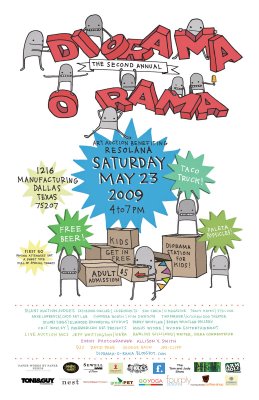
Formations in -((o)r)ama (that is -orama, -rama, -ama) are playful in tone, like formations in -((e)t)eria for names of shops (carpeteria and the like; some discussion here). Michael Quinion’s Ologies and Isms: Word Beginnings and Endings (Oxford, 2002) treats them under the heading -orama; there’s an on-line version of the entry here, with a compact history of the formative, from panorama (ca. 1789) through several waves of fashion in innovation: cyclorama and diorama early on, then later inventions like Futurama, Cinerama, sensorama, Scout-O-Rama, and more. Now it’s been taken to the next level with diorama-o-rama.

[A note on Quinion’s terminology.  He refers to the formatives in his book as “affixes”, but they are in many ways more like the elements of compound words than like ordinary derivational affixes. True, they are bound elements (except for a handful, like ism and ology, that have been liberated into use as independent words as well as word-internal morphemes), but they have an accent of their own and have the semantics of elements of compound words.

The formatives in Quinion’s books have a variety of sources. A great many (like thermo-, pneumo-, and multi-) are derived from technical terminology built on Greek or Latin roots. Others (like -ploitation and, yes, -orama) come from creative recutting of other words.]

Short shot #12: spotted dick

September 9, 2009

Ian Preston relays a story from the British press about the renaming of the suet pudding commonly known as “Spotted Dick” — on the menu of the Flintshire council canteen (in Mold). The BBC story of September 8 is here; additional reports in the Telegraph here and the Sun here.

Staff were reported as making the change — to “Spotted Richard” (alternatively, “Sultana Sponge”) — because customers were making crude innuendos and rude remarks about the traditional name.

Cries of “political correctness” (on the part of official bodies) and the like ensued.

The BBC story had a sidebar about the return, back in 2002, of Spotted Dick to the Gloucestershire hospitals’ menus, after a period of Spotted Richard.

Short shot #11: haul-fail

September 9, 2009

From Virginia Heffernan, “Uploading the Avant-Garde”, NYT Magazine 9/6/09 (p. 15):

But what’s surprising is how little the home-made videos resemble the pro goods. Sure, there are parodies of mainstream clips here and there, but mostly the amateurs are off on their own, hatching new genres. Consider “haul” videos, in which people show off the stuff they recently bought, or the popular “fail” videos, which show all manner of efforts gone wrong. Individual haul and fail videos often attract 100,000 views or more – and no one had even imagined such genres until recently. At the same time, no one at any production company seems to be struggling to serve the haul-fail audiences (or combine them?). And the haul people and fail people evidently don’t feel underserved; they are helping themselves and creating what can only be called an art scene, all around the many, many videos of their genre on YouTube.

The relevant nouning of the verb haul has been around for some time; OED2 has an entry for

fig. The act of ‘drawing’ or making a large profit or valuable acquisition of any kind; concr. the thing or amount thus gained or acquired.

with cites from 1776 (Abigail Adams, “I think we made a fine haul of prizes”) on. But its use as a modifier, in noun-noun compounds like haul video and haul people, might be recent.

Nounings of fail do seem to be recent — and recently very popular in some circles. There’s been a lot of writing about both count uses, as in the top ten fails and fail blog ‘a blog about fails’ (parallel to fail video), and mass uses as well, as in a bucket of fail. See, among other recent items, my posting here, Neal Whitman’s posting here, and Ben Zimmer’s column in the NYT Magazine and his Word Routes column.

Now we get haul and fail together.

not … but instead

September 8, 2009

A few days ago I wrote to a small group of coordination-and-negation enthusiasts with the following but instead example (from my own hand, in e-mail):

I got constant piles of outraged mail about [my] not having a clickable address, but instead one that had to be typed in by hand.

(that is, ‘… but instead having one that had to be typed in by hand’). I was sure that I had written similar things on other occasions, and in fact I saw no problem with it, despite its being formally non-parallel (the second conjunct is missing a verb, though the first conjunct has one).

My correspondents didn’t recall having seen discussions of such not …. but instead examples, but they turn out to be extraordinarily common (and unremarkable). Despite being formally non-parallel, they are entirely grammatical. Some examples might be a bit awkward, but that seems to be a matter of processing difficulties rather than grammaticality.

And in fact these examples are closely related to another case that has gotten a lot of attention in the usage literature: not only … but also. (more…)

Assorted truncations

September 7, 2009

This is a follow-up to/on my last posting, which discussed an example showing both eggcorning and preposition absorption; my take-off point here is the P absorption in “which one you have become accustomed” ‘which one you have become accustomed to’ and the like.

I was reminded of other truncation cases that you might think of as “particle absorption”, as in “was chewed” ‘was chewed out’. I looked at the chew case (and some other Prt absorption examples) in a Language Log posting back in February. And now some rather different cases have come my way: this time the truncations are within nouns based on verbs — nouns of the form V + X, where X is P or Prt. (more…)

grow a custom (to)

September 7, 2009

In a recent posting from an acquaintance:

… had never experienced the full blown resort/spa experience that I’ve so grown a custom.

Two features of interest here: grown a custom for grown accustomed, and the absence of the preposition to (of grown accustomed to). Neither feature is standard, but they’re both old friends on linguablogs. (more…)

Mind the filter!

September 5, 2009

Michael Quinion warns readers of World Wide Words (#655, 9/5/09):

RUDE WORDS  The F-Word may not be the ultimate obscenity that it was once considered, but business e-mail filters still routinely block messages containing it. As next week’s issue will contain a review of Jesse Sheidlower’s The F Word, which will include the word and its compounds a number of times, there is a greater than usual chance that you may not receive it by e-mail. In that case, pop over to the World Wide Words site, where you will find the issue at http://www.worldwidewords.org/nl/zyun.htm.

Sigh.

Solemner and its kin

September 4, 2009

From Arthur Goldwag’s Cults, Conspiracies, and Secret Societies (2009), p. 294:

It reads like a parody of some of the Freemasons’ solemner scriptures (which is precisely what it is) …

I noticed the inflectional comparative solemner (rather than the periphrastic comparative more solemn), because I have a collection of inflectional comparatives and superlatives that have struck some people as inferior to their periphrastic counterparts, or as simply wrong. This one wasn’t in my collection, nor was the superlative solemnest, but I’ll bet there are people out there who are unhappy with them. (more…)

Spectacular spelling fail

September 4, 2009

A Wisconsin highway sign, noted on The Smallest Minority site on July 30:

(under the heading “Guvernment Skools” and filed under “Education”). The company that made the sign quickly fixed it (the instructions to the company had everything spelled correctly).

The spectacular spelling fail — all three words on the main sign are misspelled — is, you will see, attributed to the school system; it’s framed as yet another symptom of the appalling decline in the quality of schooling. (Some of the comments also snipe at Wisconsinites.)

For some people, everything bad in language is the fault of the schools, or of young people, or both, and these opinions seem to be immune to facts. In the case at hand, there’s an obvious alternative hypothesis.

All three errors are letter inversions: IS for SI, IE for EI, EI for IE. This is just too perfect (well, too perfectly wrong). It’s what you see in the spelling of many dyslexics (I’ve had dyslexic students who spelled like this — very bright students, I hasten to add). If that’s the root cause, then we might wonder how a dyslexic came to be making up highway signs.

(Hat tip to Victor Steinbok.)

You will be had it!

September 3, 2009

From a (non-linguist) correspondent, Chris Ambidge:

This [usage] dates to my hometown, Northampton [in the East Midlands of the UK], in the mid 1930’s. There was a group (probably people who patronised a local pub) outing to some distant attractions, & a coach [that is, a bus] had been chartered, leaving at some early hour. A sign was posted @ the pub (& possibly on the door): “The coach for (destination) on (date) will leave at 7:30 am SHARP. If you come late, you will be had it.” That original construction … tickled my dad considerably, and entered the family argot used for emphasis: “If you do/fail to do such-and-such, you will be had it.” It then expanded to also mean (“those flowers really will be had it”) that some item or other was past its best & due for a discard. Which really has nothing to do with tardiness &/or missing the coach. I heard myself saying that about last week’s purple gladioli, & that inspired me to send the locution to a linguist.

Nice example of semantic extension.

I’m posting this in case anyone has experience with the coach-announcement usage of the expression (the family’s extension of it is unlikely to have been duplicated elsewhere; it’s probably one of those family things. — but see below) Please don’t write just to say that you’ve never heard it before and that it sounds strange to you; I assume that’s true of almost everyone.

My current hypothesis is that will be had it is a combination of two things. The first is the colloquial idiom to have had it, glossed by OED2 as follows:

to have no chance whatever of having or doing something; to have had one’s (adverse) fate finally decided, to be defeated; to be dead, to have been killed; to be ruined, broken down, useless; to have had enough

Note the ‘broken down, useless’ sense, and recall the family’s ‘past its due’ use of will be had it. Note also that this idiom is in the perfect, marked by the auxiliary have plus a past participle (had).

That’s thing one. Thing two is a piece of well-known variation in English, the use of auxiliary be rather than have in the perfect. The usage is mostly archaic and dialectal. Here’s OED2 on the subject:

in intr. vbs., forming perfect tenses, in which use it is now largely displaced by have after the pattern of transitive verbs: be being retained only with comegorisesetfallarrivedepartgrow, and the like, when we express the condition or state now attained, rather than the action of reaching it, as ‘the sun is set,’ ‘our guests are gone,’ ‘Babylon is fallen,’ ‘the children are all grown up.’

My suggestion is that the be had it of will be had it marks the perfect, so that will be had it can be glossed ‘will have had it’ (with the ‘have no chance whatever’ sense of to have had it above). Yes, the had of to have had it is transitive, but I believe there are some dialectal occurrences of be-perfects with transitives (as well as intransitives), though I’m away from the relevant sources at the moment.

I’ll pass this posting on to colleagues who are likely to know more about the matter.