Not long after the death of magic realist painter George Tooker comes the death of another major painter in this school. From the NYT yesterday, by William Grimes: “Robert Vickrey, Magic-Realist Painter, Dies at 84”:
Robert Vickrey
April 21, 2011Prices continue to rise
April 20, 2011This morning I puzzled over a report of a “rule” saying that the (intransitive) verb rise can occur only with animate subjects, so that Speed limits rise is incorrect (also Prices rise and The standard of living has risen). I appealed to readers for some insight into this nutty non-rule, adding that I recalled some past discussion of Prices rise, but couldn’t pin it down.
Jan Freeman came to the rescue, exclaiming:
This is the LL post I thought you must mean, but it’s yours! (On “rise” v. “increase”)
Oh my, the pitfalls of memory!
C > M conversion in the popular media
April 20, 2011Neal Whitman sends a link to this Penn Jillette video on his exchange with Grammar Girl Mignon Fogarty about which is the better porn title: “Men Who Crave Big Cocks” or “Men Who Crave Big Cock”.
A nutty non-rule
April 20, 2011From Ben Zimmer, a link to the Wichita Eagle Grammar Monkeys site, with a posting on “Nutty non-rules of grammar”, beginning:
Recently I [Lisa McLendon, who maintains the site] got a voice mail message from a reader saying that the verb “rise” could be used only with animate objects [that is, only with subjects denoting an animate thing], and thus our headline “Speed limit may rise to 75 mph” was incorrect, and it should have said “Speed limit may be raised to 75 mph.” Turning aside the issue of changing a perfectly good active-voice sentence to a wordier passive, I was intrigued, because I’d never run across this “rule” before. After all, bread rises. The sun rises. No one seems to complain about those.
Nucular postings
April 19, 2011Over on Facebook, Kathryn Burlingham asks of the linguists in the crowd:
Have you ever heard anyone say that the proper pronunciation of “nuclear” as nookleear, is in part a way to distinguish the energy from the cell part, which is properly pronounced nookyoolar? A friend dumbfounded me with this explanation recently.
Basket : moose knuckle :: butt : ?
April 19, 2011The gay artist Tom of Finland celebrated
fabulously muscled hyper-masculine guys displaying their broad shoulders, gigantic biceps and pecs, remarkable tight abs, slim masculine waist and hips (so their bodies make giant Vs, with their hard dicks the point of the whole display, and Xs when their legs are spread), erect nips (showing arousal and reinforcing those hard dicks), and crotch bulges.
Truth, memory, and stories
April 18, 2011From Geoffrey O’Brien’s review of Iphigenia in Forest Hills: Anatomy of a Murder Trial by Janet Malcolm, in The New York Review of Books, 4/28/11:
A law court is not a bad vantage point for taking note of folly and charlatanry, but Malcolm does not exempt anyone from bias: “We go through life mishearing and mis-seeing and misunderstanding so that the stories we tell ourselves will add up.” Stories want to resolve themselves despite all obstacles; Malcolm’s peculiar mission, here as elsewhere, is to point out the cost of such resolutions, to zero in on those details that don’t fit the main story and are thus discarded, and in the process to make manifest the unreconcilable gap between an acceptable master narrative—the version that everyone must agree on in order to keep moving forward—and the specific qualities of what actually happens.
Two libfixes sharing a spelling
April 18, 2011On Nancy Friedman’s Fritinancy blog on April 13, a posting on the libfix -nomics, taking off from the headline “Flawed Tigernomics”, about Tiger Woods’s foundering golf-course business. Friedman remarks that
“-nomics” continues to be the go-to suffix for every trend in search of a pseudo-scientific reason for being.
and goes on to cite a slew of –nomics words (well, -((o)n)omics words) that have sprung from economics over 50-plus years, all having something to do with economics, money, business, or accounting. The publication of Freakonomics in 2005 triggered an avalanche of fresh coinings — Geckonomics, Socialnomics, Spousonomics, Emotionomics, newsonomics, and so on — using the ‘money’ libfix, which is pronounced with /a/ in the penultimate syllable. (Ben Zimmer has a collection of examples here.)
Meanwhile, a separate libfix developed from the model genomics, ‘ the study of organisms in terms of their full DNA sequences, or genomes‘ (from Ben Zimmer’s Word Routes column on the coinage culturomics; Language Log discussion here). There’s even a Wikipedia page on -omics coinages in biology. But culturomics ‘the application of high-throughput data collection and analysis to the study of human culture’ takes the libfix — which is pronounced with /o/ in the penultimate syllable — in a new direction.
Trochee-trochee, Grelling-Nelson
April 17, 2011Sending copies of an xkcd cartoon on the plague of trochees, especially double trochees (Language Log discussion here), to friends, I reflected, not for the first time, that trochee is indeed a trochee (´ˇ), but so are dactyl and iamb, while anapest is a dactyl (´ˇˇ). Well, there’s no reason to expect that a predicative word (an adjective, or, in this case, noun) should be self-descriptive, but there’s a certain intellectual pleasure in playing with the fit or misfit between different properties of linguistic expressions when the semantics of their use vs. mention is involved.
Very dear to me
April 17, 2011Via Facebook friends, this image of a quote from writer and comedian Liz Feldman:
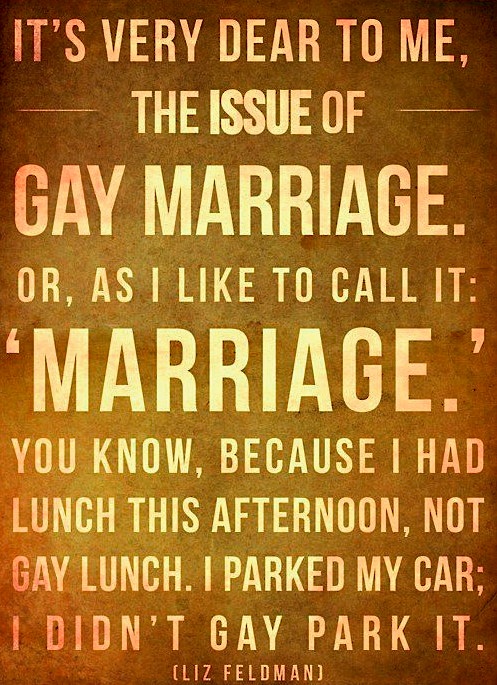
Feldman’s point, made with humor, is that she wants marriage between people of the same sex to be viewed as simply marriage, using the same term that we use for marriage between people of opposite sexes who happen to be, say, of different races or ethnicities or nationalities or of significantly different ages or of significantly different educational levels, or both over 60, or both under 20, or both of the same status (or different statuses) with respect to divorce or widowhood — all of these being socially significant properties of married couples, but for which we have no ordinary-language terms. That is, Feldman wants to normalize marriage between people of the same sex (as do I, under the heading of “marriage equality”).
But of course there are many people who vehemently resist the normalization of such marriages, and consequently reject unmodified marriage as a term embracing them. (In fact, they seem to massively prefer gay marriage as the relevant term, presumably because it injects sexuality — and by implication, sexual acts — into the vocabulary, while same-sex marriage is neutral in the matter.) So a dispute over the status of relationships in the law plays out in part as contention over vocabulary.