The decade of no skateboarding

March 18, 2024

An old One Big Happy strip that’s been hanging around on my desktop for a couple of years. When you go to explain why it’s so weirdly funny, it turns out to be a complex exercise in what’s known in the linguistics trade as quantity implicature: someone uses a quantity expression, like 6 people or 18 years old, and we understand the speaker’s intentions to be to suggest exactly that quantity, or at least that quantity, or no more than that quantity — in technicalese, we take the speaker’s words to implicate one of these things — depending on the context and our assessments of the speaker’s reasons for mentioning that quantity in the context.

The standard discussions of quantity implicature are about reports of states of affairs. If, for example, a well-intentioned speaker tells you that there were 6 people at their birthday party, you take them to be conveying that there were exactly 6 people. I mean, if there were 8 people at the party, it would be true that there were 6 people; but then it would be uncooperative to say that there were 6 people, because if you knew there were 8 you should and would have said so, therefore saying there were 6 implicates that there were exactly 6. (This would be a good time to take a deep breath and rest for a moment.)

Read the rest of this entry »

On being, turning, and wearing green

March 17, 2024

(Part of this posting will dive right into gay porn for the day, with street-talk musings on man-on-man sex that’s totally off-limits for kids and the sexually modest; I’ll hold this part off until the end, so if you need to you can bail out then)

☘️ ☘️ ☘️ It’s St. Patrick’s Day, and in my e-mail: two Bob Eckstein cartoons for the day (on turning and wearing green for the day); and a Falcon  Studios sale on gay porn, made holiday-appropriate by the mere addition of a shamrock, but which opens the topic of gay porn with actual St. Patrick’s day themes.

Read the rest of this entry »

The three Larrys

March 16, 2024

A complex tale that begins with a follow-up to my 3/1 posting “The grace of lovers”, about the sharing of enthusiasms with my first male lover, Larry (the pseudonymous Danny Sparrick in my writings about my sexual life). That’s Larry1. There are gripping stories about our time together and his life now, but the tale of the three Larrys is fabulously intricate as it is, so I’ll put off posting about these parts of Larry1’s life for another time. And focus on our exchange of enthusiasms, which will lead, circuitously, to Larry2 (in NYC, some years after Larry1). And then, a recent posting about a French conference on interjections, in which a 1982 dissertation on discourse particles I directed at Ohio State brings us Larry3, who wrote it.

There is still more, a epic of geographical (and social) wandering for both Larry1 and me; he grew up in Del Mar, a beach community in San Diego County, and ended up in provincial Japan; I grew up in little suburbs of Reading, in the Pennsylvania Dutch country, and ended up on the San Francisco peninsula; in between these terminal points, he and I more or less wandered the world (we both taught in China along the way, but not in the same place or at the same time; we both lived in England at one point and were able to get together in London then; and once we rendezvoused in Washington DC). Perhaps these odysseys will make another posting — but, again, too much for today.

Read the rest of this entry »

Grunt Oil

March 15, 2024

(Man-man sex discussed in street language, so not for kids or the sexually modest)

It’s 3/15, the day after Pi/Pie Day (in the US), and the Ides of March (everywhere), and also (in ZwickyWorld) Higashi Day — when, back in the last century, Jacques and I set off from Palo Alto CA (and Stanford) on our annual journey east (higashi) back to Columbus OH (and Ohio State); Nishi Day, for embarking on  the journey to the west, was on 12/15.

My Higashi Day was enlivened by a Fort Troff e-mail sale ad for their Grunt Oil silicone-based lube (named for the sound men make during anal intercourse). A tube of the actual product, with a plug for it that gives a relatively straightforward description of the stuff:


(#1) The packaging varies; there are less raunchy variants (missing the finger and the FUCK ME, COCK TOY! graffiti) and even raunchier ones, as we’ll see in a moment

Description: Hands-down, silicone is the gold standard for durability and slickness. Sure, water-based lubes are good when you need a quick clean up… but nothing beats the smooth, silky feel of pure high-grade silicone. Grunt Oil is super-concentrated for max longevity. It doesn’t break down in water, so you can use it in the shower. Clean up with soap and water.

Fort Troff caters to what I’ve called Ruff Dudes, hypersexual hypermacho anally hyperreceptive man-oriented men (with a fetish for sex machinery), existing in some paradoxical liminal world between actual leathermen and fantastical bdsm creatures. So #1 counts as vanilla in Fort Troff’s world.

But that’s not what assaulted my eye this morning. It turns out that the exciting feature of Grunt Oil is that it looks like cum. Creamy white jizz. This is supposed to be incredibly hot to Fort Troff’s clientele, and I’m really into cum, but an anal lube that looks like cum strikes me as a goofy idea. Even goofier than dildos scrupulously designed to replicate actual penises. (In both cases, the appeal is to the imagination, not to the senses.)

Read the rest of this entry »

The history-rebooted Easter egg

March 14, 2024

In the Economist‘s 2/10/24 issue, early in the piece “Chronicling the past: The present as prologue” (a review of 2020 by Eric Klinenberg, a book treating the Covid pandemic, still unfolding, as a historical event), this passage:

It has been an alarming few years. History — widely assumed to have stopped somewhere around the fall of the Berlin Wall and the Spice Girls’ first record — has got going again, with gusto.

The implicit claim is that any history worth recording came to an end with the fall of the Berlin Wall, in 1989 (the end of an old political order), and the Spice Girls’ first record, in 1996 (the end of an old pop-cultural order), but sprung back to life with the onset of the pandemic; things are happening again.

Readers with a keen ear, especially if they are British (the Economist is a British publication), might have detected something vaguely familiar in the way that claim has been worded; it’s a distant, glancing allusion to the first verse of a famous (in some circles) poem by British poet Philip Larkin — easy to miss, especially since it contributes nothing of substance to a review of Klinenberg’s book, but is just a little gift to readers who recognize the allusion to a culturally significant text: it’s what I’ve called an Easter egg quotation.

Read the rest of this entry »

Indirect speech acts on the phone

March 13, 2024

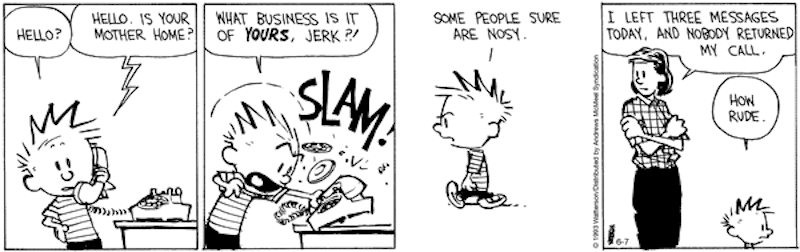
To cope with a day when I’m overwhelmed with e-mail to answer, an old Calvin and Hobbes strip salted away for just such days:


They exchange greeting hellos, and then the caller, detecting that the phone has been answered by a child, shifts to an indirect speech act designed to have the child get an adult — the caller specifically asks about their mother — to come to the phone: instead of (directly) asking Calvin to call his mother to the phone, they ask (politely) if his mother is home, assuming that Calvin will understand that they’re asking this because they assume she’s home and they want to talk to her, so they want him to turn the call over to her

The overall story here doesn’t depend on the phone being answered by a kid. It’s enough that the caller recognizes that the person answering the phone is not the one they want to talk to. In which case they could ask for them indirectly: Is Marcia home / in? (this being one big step of indirection beyond the conventionally indirect question May / Can I talk to Marcia?).

The crucial step in dealing with the yes-no question Is X home? is recognizing that because a literal understanding of it would be bizarre — why would some random caller need to know if X is home? — the caller must have some other motive in asking it. And on from there. But that’s where Calvin runs aground.

Well, that’s a lot for a little kid to work out in less than a second on the phone (and Calvin is not a patient or especially cooperative child). I actually remember being taught, explicitly, that if a phone caller, or someone at the door, asked if my mother was at home, that meant they wanted to talk to her, so I should get her. I imagine I could have worked this out eventually, but it might have taken some misfires for me to get the point.


Powdery residue falls on Canadian plains

March 12, 2024

It’s held on the tips of three fingers, it’s orange, it’s fully erect, and it leaves a messy powder. But is it art? Is it edible? Is it, omigod, about to shoot? A swirl of questions envelope the phallic cheese puff resting in the Cheetle Hand of Cheadle, Alberta, shown here accompanied by a bag of the cheese snack Cheetos, for scale:

Read the rest of this entry »

Manual monuments

March 12, 2024

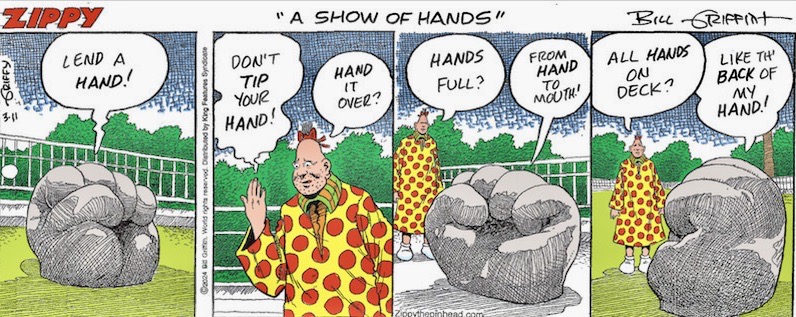
Today’s Zippy strip offers us a talkative piece of public sculpture in the shape of a hand — actually, a closed fist, upraised — that riffs together with Zippy on the manual, hand-based, lexicon of English:


The hand exclaims, Zippy questions, but their exchanges are absurd

The big topic here is the manual lexicon: lexical items that involve the noun or verb hand. The manual lexicon is enormous. embracing some fixed expressions referring to the bodypart, but mostly composed of figurative expressions etymologically traceable to the bodypart but now semantically distant from it.

The other topic is also sizable, but it’s artistic rather than linguistic: statues of hands, especially fists, especially in works of public art. I’ll start with that.

Read the rest of this entry »

Howdy Out

March 11, 2024

The second installment of my adventures with Howdy Boy, aka Troy Anderson (Stanford ’89/’90). In the first installment (my 3/8 posting “Howdy”), with the folksy-friendly salutation “Howdy”, he introduced himself as a student in my gigantic 1989 syntax course — and thanked me for not flunking him. Now, I have a passionate interest (both personal and scholarly) in people’s lives — their daily lives and their life histories — so when I learned that Troy was not only a Stanford football player (a huge guy who looks like the offensive tackle he was at Stanford) but also a high-ranking Go player, now a business executive, who got a BA in anthropology, and as a member of the Coquille tribe in Oregon compiled a dictionary of its lost language, Miluk, for his MA thesis in linguistics, well, I was totally intrigued. We embarked on learning about each other.

Meanwhile, there was the almost flunking out. I wrote him:

It [has] occurred to me that if there was any chance of your flunking out, it would have been because you were juggling too many balls at once, always a danger for very smart manic multi-taskers, as you obviously were at the time (and probably still are).

(I’ll return to the barely not flunking out below). And I added:

I haven’t been able to piece together your history in recent years, so if you could fill me in some, I’d like to hear about it. I might try to talk you into letting me write about you on my blog. (You can sample my blog at www.arnoldzwicky.org.)

Troy turned out to be extraordinarily open in his response — giving me an inventory of major life events, some quite personal in nature, offering to supply further details, and inviting me to post whatever I wanted. An attitude that resonates with the way he presents himself; as I wrote to him a little while later:

you’re a sunny person; your most natural facial expression is a smile of pleasure... I take that disposition to be a sign of a way of being, a moral quality — of openness, of empathy, of enthusiastic commitment. In any case, whether you know it or not, you project a kind of niceness (despite your imposing body) that has surely served you well in life

Clearly, I appreciated his brand of charm, despite his being so startlingly unlike me (except for sharing linguistics, that sunny presentation of self, and serious moral commitments).

But then, more or less in the middle of the inventory, came a swerve and a surprise.

Read the rest of this entry »

E-mail queries

March 11, 2024

I’m inundated by queries about my (many) published articles and (gigantically many) postings, queries that are variously self-serving, malicious, and, yes, seeking understanding. But I can’t possibly reply to everyone who has questions about things I’ve written; I pretty much confine myself to short responses to people I know well and replies to people writing theses (undergraduate honors theses, MA theses, and PhD theses), and even these must be brief, given the demands of my life.

And so a story, in which I explain some things that might be useful or illuminating to other readers. It begins with e-mail I got some time back from a purported graduate student — call them GS — in a European university — call it EU — who said they were writing a thesis on English syntax in which the notion of head within NPs and VPs plays a significant role. Our exchange as it unfolded …

Read the rest of this entry »