Today’s NYT has a nice op-ed piece (“The Wise Words of Maya Angelou. Or Someone, Anyway.”) by lexicographer Erin McKean about quotes and their attributions, on the occasion of the new US stamp honoring Maya Angelou:
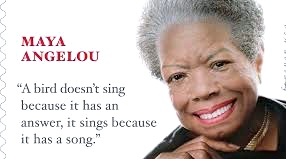
Today’s NYT has a nice op-ed piece (“The Wise Words of Maya Angelou. Or Someone, Anyway.”) by lexicographer Erin McKean about quotes and their attributions, on the occasion of the new US stamp honoring Maya Angelou:
Today’s POP (phrasal overlap portmanteau) — student loan shark (student loan + loan shark) — from the April 13th New Yorker:

Today’s Zits:

Pierce seems to believe that using the same label for things means that there’s a deep connection between them. In this case, why bears and worms but not other things? (In the real world, there are all sorts of gummi candies.)
Today’s One Big Happy:

Remember that he can’t read, so all he has to go on is what Ruthie says. And that he’s a little kid, who’s likely to have d for edh, pronouncing they like day.
Today’s Dilbert:

Alice’s swearing seems to have fried the boss’s brain: the power of words.
Ellen Seebacher writes to note this piece of extremely ostentatious taboo avoidance in the NYT Style section on the 2nd, in Guy Trebay’s piece “Dear Winter Coat: Goodbye and Good Riddance”:
At issue … is the question of when that hopeful day [the first day of spring weather] will arrive. It snowed on the first day of spring on the East Coast and remained so cold for the week thereafter that Olive & Bette’s boutique on Madison Avenue posted a placard outside with a popular and unprintable three-letter Internet acronym. “After Tuesday even the calendar goes,” what the heck, or initials to that effect.
Ellen was astonished that the paper treats WTF as an unprintable obscenity: the initialism inherits the taboo status of the word the F stands for. It turns out the Language Log has been down this road.
From Elizabeth Daingerfield Zwicky, a link to a Malaphors site, featuring
Unintentional blended idioms and phrases – It’s the cream of the cake!
The site (managed by someone who identifies himself only as Davemalaphor) keeps a running inventory of “malaphors” — the term came to the site’s compiler from Douglas Hofstadter (1989), who got it from a 1976 newspaper article; Hofstadter also cites Gerald Cohen’s work on “syntactic blends” (generally, not specifically those involving idioms).
[Recent items on the Malaphor site: He’s a black horse in all of this (dark horse + black sheep); The client is one of those hard-moving targets (hard to hit + moving target); I’m going to give him a taste of my mind! (a piece of my mind + a taste of his own medicine).]
In a separate development, inspired by postings on “idiom blends” in Language Log starting in 2004, I’ve been keeping an inventory of my own. Again there’s an earlier history, going back to a 1997 Memory and Cognition article on “syntactic and semantic components of experimentally elicited idiom blends”, whose ultimate antecedent is a 1961 Language article by Dwight Bolinger on “syntactic blends” (which, however, doesn’t take up the special case of idiom blends).
Today’s Bizarro, on corporate personhood:
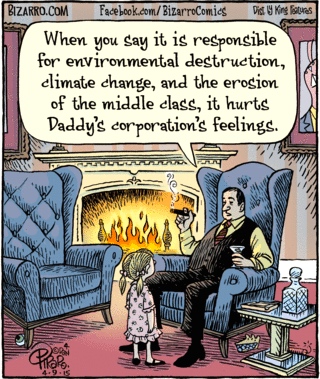
“Corporations are people”, Mitt Romney famously asserted in 2011, and this broad understanding of corporate personhood has led people to mock the doctrine by attributing all sorts of characteristics of natural persons to fictive ones, as above.
(Mostly about movies and tv, rather than language.)
In the Spring 2015 issue of The American Scholar, the piece “Looking for Mister Gustave: Who is the inspiration for the Grand Budapest’s concierge?” by Elena S. Danielson:
The central figure in Wes Anderson’s The Grand Budapest Hotel, winner of this year’s Golden Globe Award for Best Motion Picture, Musical or Comedy and the recipient of nine Academy Award nominations, is the hotel’s concierge, Monsieur Gustave H. Played with great aplomb by Ralph Fiennes, Gustave is a genuinely appealing, the epitome of Middle European charm and style. He recites syrupy Rilke-esque poetry while seeing to the needs of the hotel’s well-heeled guests — the men as well as the aging women who seek him out for certain discreet and salacious entertainments — who, in return, bestow extravagant gifts upon him.
But then one of these women, Madame Céline Villeneuve Desgoff und Taxis [wonderful name!] — the aristocratic Madame D — is found dead under suspicious circumstances. At the reading of her will, Gustave is awarded possession of a rare and valuable painting
The question is then whether Gustave is a con man, a swindler.
Danielson seeks a hotel con man in the writings of Stefan Zweig (whose work was an inspiration for Anderson’s film), but she “did not find any conniving concierges in Zweig’s mesmerizing short stories and novellas”. Then she looks at two more promising candidates, in Vicki Baum’s Grand Hotel and Thomas Mann’s Confessions of Felix Krull, Confidence Man.
