Name play in the comics

July 30, 2015

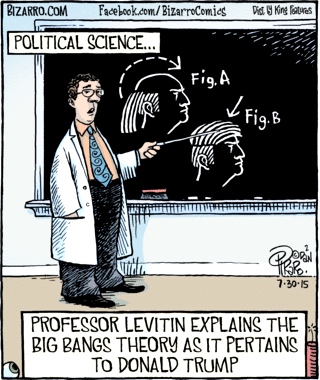
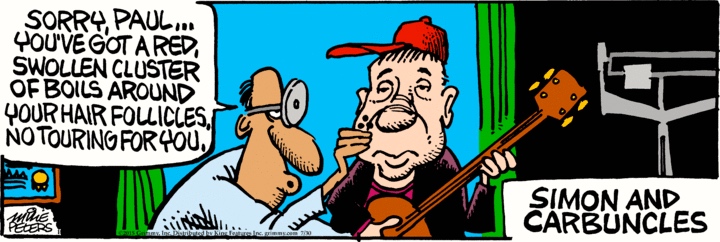
Two cartoons this morning with plays on proper names: a Mother Goose and Grimm playing on Simon & Garfunkel, a Bizarro playing on the Big Bang theory and possibly also The Big Bang Theory:

(#1)

(#2)

(If you’re puzzled by the odd symbols in #2 — Don Piraro says there are 2 of them — see this Page.)

Read the rest of this entry »

Raced and gendered (and classed)

July 30, 2015

On the 27th, in Charles M. Blow’s op-ed column in the NYT, “At Sandra Bland’s Funeral, Celebration and Defiance”:

Bland didn’t demur and knuckle under. Some have criticized her for her stance during the traffic stop, suggesting that if she had behaved differently, with more respect for the officer, she might have avoided arrest.

Maybe. But, it must always be remembered that the parameters of “respectable behavior” are both raced and gendered. The needle moves to differing positions for different people. That is, I believe, one of the reasons that this minor traffic stop so quickly escalated.

How dare a woman not present as a damsel? How dare a black person not bow in obsequiousness?

I was of course familiar with gendered, but the parallel raced was new to me, though it seems to have considerable currency among politically aware social critics. And, yes, there’s also the parallel classed.

Read the rest of this entry »
What’s wrong with this verb?

July 29, 2015

From July 18th, Jon Lighter in ADS-L:

[1] A television journalist with an English accent reports from Jordan that after the Tennessee gunman “came back [to the U.S.], he drunk drove.” This reveals the deadly seductiveness of the New Syntax: “drive drunk” takes no longer to say and is arguably more euphonious.

Lighter has a long history of scornfully criticizing innovative back-formed verbs like this one (to drunk drive / drunk-drive). His plaint is that in general there’s no justification for innovating new verbs when we already have a way to express the meaning, though the innovation might be defended if it provided a briefer alternative to the existing expression, which is not the case here; moreover, he assumes that the reason people innovate such verbs is merely to sound fashionable, a motive he deprecates.

There’s a lot to be said in response. I’ll start with some background about syntax and morphology and then move to the functions of innovative morphology and some sage observations by Larry Horn.

Read the rest of this entry »

Data postings

July 29, 2015

A new feature in the set of “Linguistics notes” Pages on this blog: data postings, two so far. Each of them has three parts: an inventory of postings on the topic (from Language Log and this blog); “raw data” (a collection of numbered notes on examples (jottings on examples, observed on the fly or taken from e-mail, mailing lists, or blog postings); and an index to the examples, keyed to the numbered notes. All three types of material will be regularly updated.

Read the rest of this entry »

Going on in Antwerp

July 28, 2015

This week in Antwerp, Belgium, the 14th International Pragmatics Conference. A giant conference, the 26th through 31st, with eight plenary speakers, a variety of panels, a great many lectures, and poster sessions.

I will have a small presence on the program, thanks to a paper my colleague Elizabeth Closs Traugott will be presenting:

Derailing Default Interpretations: Investigating the My Hobby webcomics by Randall Munroe (ECT in collaboration with AZ)

Click here to view the slides: IPrA handout

Primate testicle size

July 27, 2015

From the July 18th New Scientist, in the In Brief section, “Zoologger: The sex-addicted tiny lemur with giant testicles” (on-line; in print, “Tiny lemur is best endowed primate”):

“Oh my god! How do they manage to walk and climb without bumping these things on every branch?” asked Johanna Rode-Margono the first time she saw the testicles of a giant mouse lemur close up.

In turns out they don’t. They stumble and bump their balls with almost every step they take, says Rode-Margono, who is at Oxford Brookes University, UK. At a mere 300 grams, the lemur is roughly squirrel-sized. But for its size, it has the largest testicles in the primate world (American Journal of Physical Anthropology, doi.org/54q).

If we had the same testes size, relative to weight, the average man would have balls as big as grapefruits, says Rode-Margono.

The lemurs mate all year round but constant copulation has not saved them from deforestation – fewer than 17,000 giant mouse lemurs are left, she says.

Read the rest of this entry »

Misleadingly named animals

July 27, 2015

Via Kim Darnell on Facebook (a very long time ago), this poster:

Eight composite names — some N + N, some Adj + N. The question here is the semantic contribution of each of the parts. The poster deliberately disregards the fact that these are common names, not technical labels from biology; and it insists on treating these names as definitions, which is something no mere label can do. And it throws in some tongue-in-cheek remarks.

Read the rest of this entry »

Bacteriological picture books

July 27, 2015

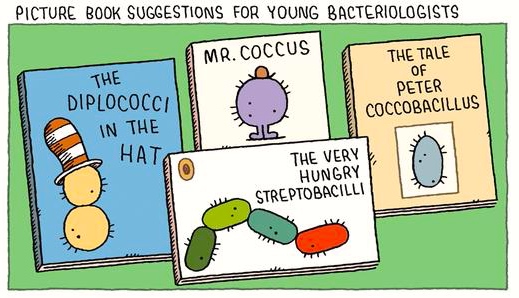
A Tom Gauld cartoon in the latest (July 18th) New Scientist:

(#1)

Bacteria crossed with children’s picture books.

Read the rest of this entry »

Land of 1,000 Dances

July 26, 2015

Following up on my “Name Rhymes” posting (with examples from Cab Calloway and Paul Simon), Mike Pope wrote to remind me about Wilson Pickett’s “Land of 1,000 Dances”, with a rather different rhyme scheme involving names. From one version of this song (there are many):

Got to know how to pony
Like Bony Maronie
..
Do the Watusi
Like my little Lucy
..
Out in the alley
With Long Tall Sally
Twistin’ with Lucy
Doin’ the Watusi

In my earlier posting, the rhyming words are adjacent in a line. Here we have rhyming couplets, but still involving names.

Read the rest of this entry »

Kongtoon

July 26, 2015

Today’s Bizarro, with yet another King Kong cartoon (it’s a cartoon meme):

The movie King Kong has a firm place in American popular culture: the giant gorilla has appeared as a character in a long series of movies and tv shows after the 1933 original film.

(If you’re puzzled by the odd symbols in the cartoon — Don Piraro says there are 6 in this strip — see this Page.)

xx