homophobia

February 5, 2016

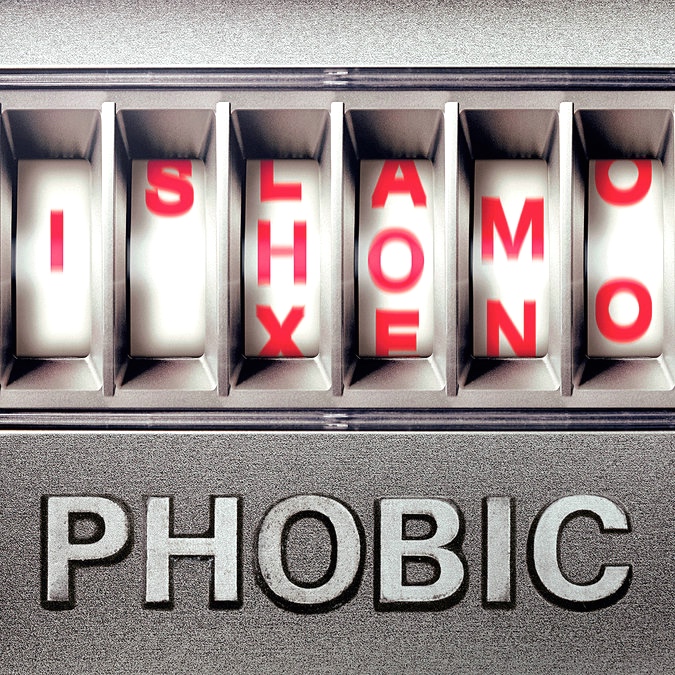
From the NYT Magazine on Sunday January 31st, “How ‘-Phobic’ Became a Weapon in the Identity Wars” by Amanda Hess, with this photo “Slot Machine” by Javier Jaén:

  (#1)

It started, innocently enough, at Hooters. A waitress who goes by Zola got to talking with a diner named Jessica. The two bonded over a shared romantic philosophy (each had a ‘‘sugar daddy’’ at home) and career focus (each moonlighted as an exotic dancer), and when Jessica invited Zola on a road trip to Florida to strip at some local clubs, Zola strapped in. Little did Zola know, she was hurtling toward the center of a backwater psychodrama in which she would face off against a series of pimps, johns, kidnappers, one very weepy white boy and Jessica herself, who had pulled her new friend into this nonconsensual weekend tour of the underground sex trade.

At least that’s how Zola told it in a tweet-storm last fall (though aspects of the account have since been disputed). When her story went viral, big media outlets picked it up, and the retellings brought a significantly more banal showdown — this one between journalists, sex-worker advocates and Twitter commentators. By posting Zola’s tweets — alongside photos of Jessica, clues leading to her personal Instagram profile and a throwaway joke about ‘‘hoes’’ — the women’s website Jezebel seemed to ‘‘mock someone for being a sex worker and further compromise their safety,’’ the writer and activist Lux Alptraum argued in a tweet. The treatment struck Alptraum as ‘‘whorephobic.’’ And that word struck Erin Gloria Ryan, then a Jezebel editor, as over the top: ‘‘lol ‘whorephobic,’ ’’ she replied. ‘‘Nobody’s afraid of anyone here, Lux.’’

Read the rest of this entry »

Valete Bob and Ray

February 5, 2016

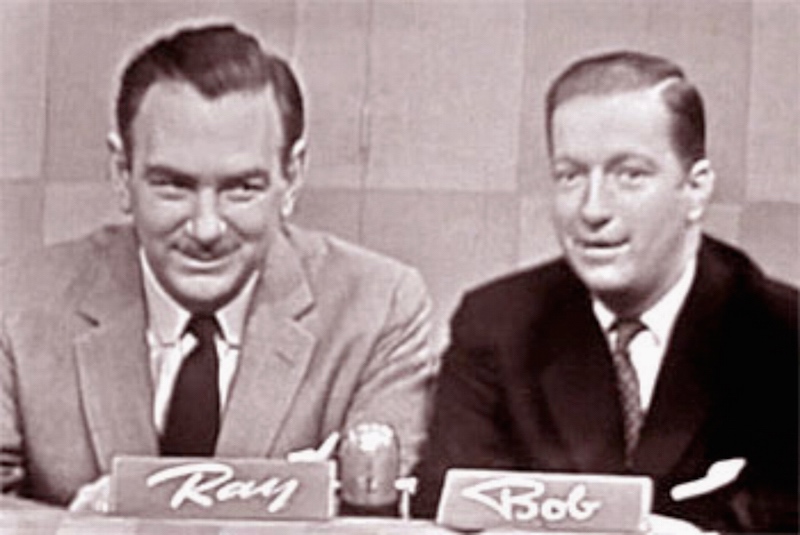
In the NYT yesterday, “Bob Elliott, Half of the Deadpan Bob and Ray Comedy Team, Dies at 92” by Peter Keepnews & Richard Severo (with a companion piece, “Recalling Bob and Ray, Who Paved the Way for Today’s Deadpan Humor” by Jason Zinoman):

Bob Elliott, who as half of the comedy team Bob and Ray purveyed a distinctively low-key brand of humor on radio and television for more than 40 years, died on Tuesday at his home in Cundy’s Harbor, Me. He was 92.

His death was confirmed by his son Chris Elliott, the actor and comedian, who said his father had had throat cancer.

Mr. Elliott and his partner, Ray Goulding — Bob was the more soft-spoken one, Ray the deep-voiced and more often blustery one — were unusual among two-person comedy teams. Rather than one of them always playing it straight and the other handling the jokes, they took turns being the straight man.

The pair early in their career:

Read the rest of this entry »

Word exchange/reversal or what?

February 5, 2016

Back on December 27th, Doug Harris sent me this example (crucial bit boldfaced), from that day’s Daily Beast, in the article “U.S. Health Care Is Failing My Patients: From chronic conditions to mental health, our system is failing patients and doctors alike” by Farah Khan:

(1) Substance abuse, easily one of the most widespread mental health problems in this country, has yet to be adequately addressed by the current health care system. Rehab services are far and few between for patients who are addicted to drugs and alcohol.

Formally, this looks like what’s known in the speech errors business as a word reversal (Vicky Fromkin’s  preferred term), word exchange  (my preferred term), word metathesis, or (more colorfully) word-level spoonerism: the conventional form of the boldfaced expression is few and far between. There’s no question that such reversals or exchanges do occur as inadvertent speech errors, but there are reasons for thinking that (1) is not in fact an inadvertent error, but is more like a classical malapropism, in which the speaker or hearer produces exactly what they intended, but their production doesn’t accord with the practices of the larger community. And there’s a third possibility: that the practices of the larger community have changed to such an extent that it can no longer be claimed that (1) is clearly not in accord with them.

Read the rest of this entry »

A late Christmas gift

February 4, 2016

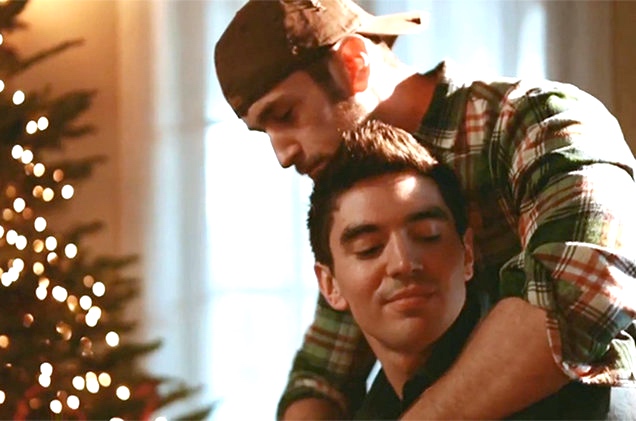
I haven’t been attending to things properly, so I missed a gay Christmas gift from singer-songwriter and underwear model Steve Grand (discussed on this blog back on 7/11/13). a sweet and sexy cover of Mariah Carey’s “All I Want for Christmas is You” (lots of kissing, snuggling in bed). A still from the video, which you can watch here:

Read the rest of this entry »

Some news not for penises

February 4, 2016

Despite my well-known interest in penises — in the actual body-parts, in phallic symbols, and  in terms for the penis (starting from the basic slang vocabulary cock and dick and going on from there) — I occasionally feel obliged to point out that sometimes a cigar is just a cigar and quite often an expression with /kak/ in it has nothing to do with penises. That last observation is my topic for this posting.

Read the rest of this entry »

downe

February 4, 2016

Another item from 2006, this time  a posting by Jerry Zee to the OUTiL (OUT in Linguistics) mailing list on 5/2/06 (lightly edited):

I’m an undergrad at Stanford [in Cultural and Social Anthropology and in Linguistics, graduated in 2007], involved in the queer Asian American community here, and was wondering if anyone had noticed the word “downe” – I believe it comes from Filipino American communities and is expanding, I think – for now I think it’s either a Bay Area, Hawaii, or California thing –- I wrote a silly little paper on the site for an anthropology class last year.

My perceptions of the term are that it’s a departure from ‘gay’, which in a lot of ways gets defined in terms of white mainstream gay culture, and it’s also a lot more expansive than gay – it’s like ‘queer’ in that sense, minus the political overtones that ‘queer’ carries. Also, used kind of like a password when the speakers are trying to be discreet in more open environments – “Are you downe?” comes across as pretty innocuous to someone who’s not in the know. And for now, it feels like a very Asian and a very NorCal thing to identify as.

Here’s what urbandictionary has to say:

1. Downe *91* up, *4* down
A person who identifies as homosexual, gay, bisexual, or queer. Frequently used within Filipino American and Asian American GLBT communities. (Origns: California? or Hawaii?)
“Are you downe?”
by alwayzfione Feb 3, 2004

2. Downe *7* thumbs up
Derived from the definition of “downlow” which was taken from the African-American Community. Brought in by the Filipino/Asian-American Male & Female LGBT community. Reinvented into the word “DownE” with a capital “E” expressed during the hype of the raving/exstacy scene which began to popularize in the early 90’s. Giving those who are on the “downlow” a more open environment (i.e. E-parties.) Those using the term “DownE” also used it to seperate themselves from society’s stereotype of a Gay Asian Male, as well as Gay Asian Female. As a means of communication. The internet played a major role in the growth in popularity for the word “Downe.” With websites such as Downelink.com, the definition of “downe” is constantly changing. A good thing or a bad thing, take it as you will. From my opinion, the definition can’t be found on any dictionary. Define it for yourself. Whether it be just another term for being Gay, Lesbian, Etc. or make it mean more to you than just a label.
Do you remember the downe scene back in 96? Now thats taking it way back to it’s roots.
by Downe O.G. Cali Nov 3, 2005

3. Downe *3* thumbs up
origin: california; definition: identifying oneself as being gay, bi, confused, questioning, experimenting, ambiguous, or simply wanting to get laid one way or the other.
“are you downe?”, “you downe to screw?”
by jaypee so cali Nov 20, 2005

[AZ note: nothing more of significance on UD since then, as far as I can see]

My response to OUTiL 5/2/06:

On May 2, 2006, at 4:31 PM, Jerry Zee wrote: “…also, used kind of like a password when the speakers are trying to be discreet in more open environments – “are you downe?” comes across as pretty innocuous to someone who’s not in the know…”

So it’s pronounced like “down”, not “downy”.

Earlier slang “down to V / for N” ‘be available/enthusiastic to V / for N’ seems to have influenced some of the reported usages.

The connection to “downlow” is plausible, but it would be nice to have some documentation of early uses, or at least memories for them. (I know, somebody’s going to say that all that E wiped out those memories.)

On the downelink.com site:

Flirt. Chat. Meet. ♥︎
The next generation of downelink is launching here soon!

downelink is the hottest destination for LGBTQ social networking. Connect with likeminded individuals, and be free to be who you are.

If you would like to join us for the relaunch of this tried and true brand, please join the mailing list.

And then on the site Are You Downe? Exploring a Social Movement among Gay Asian Youth, the most recent posting is from 4/28/09. The postings there give a picture of the downe community in the Bay Area and L.A. (for men, at least) as a place for young Asian men interested in other young Asian men (with various self-identifications as to sexuality) to party together, hook up, and find a boyfriend (one popular guy found dozens within a few years). The community (which was, of course, pretty small) seems to have largely dissolved. (Postings on the site also include some wrenching stories about coming out to an Asian American family.)

Meanwhile, Jerry has studied in China and at UC Berkeley and is now a
postdoctoral fellow in Science and Technology Studies at UC Davis, where he lists his areas of study as: environment, anthropology, meteorology, atmosphere, governing, China, East Asia. Also — joyous news — he now has a husband.
be gay/queer for

February 4, 2016

(I’ve been working on clearing out unblogged material on homosexuality, as part of a project to improve my “Homosexuality postings” Page. Here’s one on semantic bleaching, from ADS-L exchanges in 2006.)

Ben Zimmer to ADS-L 7/29/06:

Not sure if this has been noted here before, but one recent semantic development on the “gay” front is the construction “be gay for” = ‘have an unseemly or exuberant affection for (someone or something)’. For instance, the music magazine Blender has a regular feature, “The CD We’re Totally Gay For”. (Blender is part of the Maxim family, so the context is laddishly heteronormative.) Similarly:

Mediocre Bands You’re Totally Gay For (link)

And because “In My Arms” is one of those songs I’m completely gay for… (link)

I am gay for this BUCK-TICK song. (link)

Award Categories… I’m Totally Gay for this Blog or Best Overall Blog. (link)

We just started playing this again seriously and confirmed that we’re still totally gay for Tetsuya Mizuguchi!!! (link)

We’re totally gay for William McDonough, eco-architect and world-transformation guru. Same goes for Cameron Diaz, whose work for green causes is only made more charming by her valley-girl ditzitude. But McDonough and Diaz together in one lecture hall? Swoon, we tell you. Swoon. (link)

You could safely say I’m completely gay for Transformers and still not quite encompass my feelings for it. (link)

I love Verron Haynes, but I love Duce Staley more. I’m gay for the Steelers. (link)

Less common is “be queer for”, with the same implication of fannish exuberance or excitement:

And yes, I am, as my buddy Jay has noted, “totally queer for” the Decemberists. Yep. Fah-laming. (link)

Rusty is my former landlord and is completely queer for cycling. (link)

Examples with non-human objects seem to be akin to the playground sentiment, “If you love X so much, why don’t you marry it?”

My response:

An interesting sense development: the component of attraction remains, while the sexual component vanishes.

From Matthew Gordon 7/31/06:

I just noticed this one in an episode of the Simpsons. Lisa says to Bart, “You’re gay for Mole Man,” and Bart replies, “No, YOU’RE gay for Mole Man.” Then the camera pans to Mole Man who mopes,”Nobody’s gay for Mole Man,” or something like that. At first I was a little shocked by the potentially homophobic tone of Lisa’s line – it was meant as an insult – but Bart’s reply suggests the phrase has indeed been bleached of the sexual orientational content.

From Wilson Gray 7/31/06, reporting the older sexual use:

When I was in basic training [AZ note: that would be over 50 years ago], “be queer for” was used as an insult directed at anyone who slipped up and locked eyes with a member of the cadre: “What’re you looking at me for, soldier? You queer for me?” This was a question with no correct answer. Obviously, yes would be the wrong answer, but if you said no, it was an insult to the cadre-member, implying that you found him physically beneath your standard of masculine beauty. Your only recourse was to say nothing and drop down and give him twenty push-ups without waiting to be told.

You were supposed to use the thousand-yard stare and look *through* the members of the training cadre, not *at* them, whenever their gaze happened to fall upon you.


The prissy voice

February 3, 2016

A little while ago, Terry Tenette asked me about the character The Great Gazoo (voiced by the comic actor Harvey Korman) in the animated tv series The Flintstones — because the character’s voice suggested gay to him. I’d stopped watching the tv series by the time this character appeared (in 1965), but I then watched a clip with Terry and heard what he was picking up on, which was not the famous gay voice, but something I’ll call the prissy voice. We were then both struck by the similarity of the Great Gazoo’s voice to that of the character Dr. Zachary Smith (played by Jonathan Harris) in the tv series Lost in Space (which, probably not coincidentally, premiered in 1965). And I was reminded of the famous film sissies (film sissies — the name conveying effeminacy, weakness, or cowardice — has become a widely used term in film history and criticism) and their deployment of the prissy voice.

Read the rest of this entry »

Notes on male ballet dancers

February 2, 2016

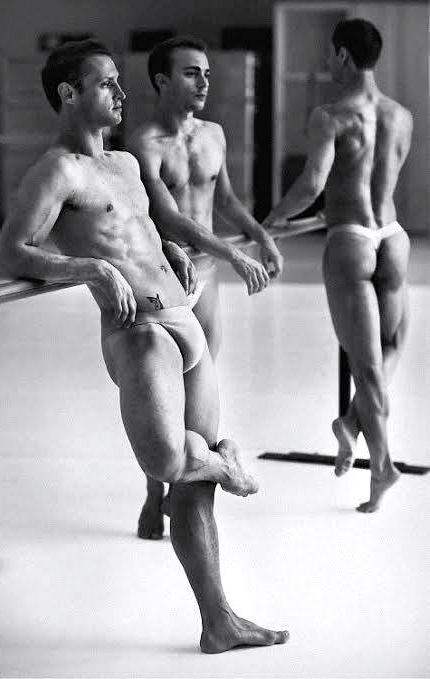
Two recent items passed on to me by Mike McKinley: one a photograph of young male dancers at the barre, the other a video compilation of dancer Joseph Gatti in an assortment of his roles. The photograph, found on a Facebook page (where it wasn’t identified in any way: where? when? who are they? who was the photographer?):

(#1)

The Gatti compilation can be viewed here; it has some remarkable stuff.

Read the rest of this entry »

A visit with Colby Keller

February 2, 2016

(Though there’s a substantial amount in this posting on art, books, and fashion, there’s also quite a lot about men’s bodies and man-man sex, in very plain language, so it’s not for kids or the sexually modest.)

Posted on AZBlogX on the 31st, “X-rated Colby Keller”, with five shots of artist and gay pornstar Colby Keller (who appeared on this blog in a 5/7/13 posting “The protean Colby Keller”, about “mail art”, gay porn, and playfulness): three from Mike McKinley, which can be arranged in a sequence, though they were taken at different times: CK unzipping in preparation for sex, CK exhibiting his body, and especially his substantial hard cock; and CK with gay pornstar Duncan Black, immediately post-fuck. Then two from Chris Ambidge: one showing CK doing a stool-lift, exhibiting his very considerable strength and balance; and one with CK displaying a favorite art book (more on the book soon), which had to go on AZBlogX because that substantial hard cock of his is standing up right in front of the book.

Before I get into the art and the steamy sex, here’s a pleasant, somewhat eccentric shot of CK amidst a field of flowers in Maine in 2014:

(#1)

Read the rest of this entry »