Today’s Rhymes With Orange, a fresh take on the Psychiatrist cartoon meme:
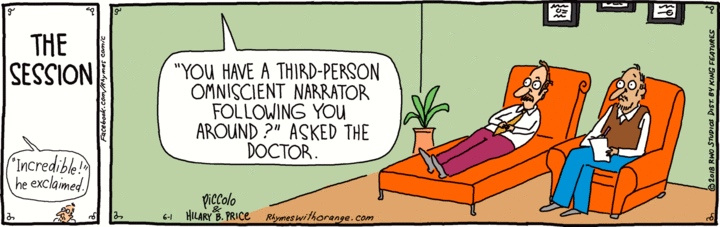
You don’t get a lot of narrative theory in cartoons, but here’s some basic stuff from Wikipedia:
Today’s Rhymes With Orange, a fresh take on the Psychiatrist cartoon meme:
You don’t get a lot of narrative theory in cartoons, but here’s some basic stuff from Wikipedia:
The Zippy from the 30th, with the Dingburg School of beatnik typewriter poets:
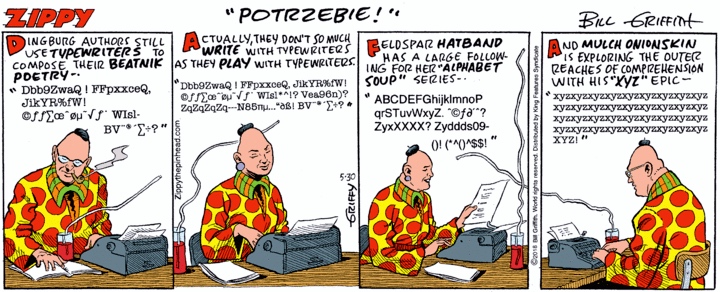
They compose on their typewriters, creating poetic texts that are (to the untrained eye) just strings of characters. Their names are absurd combinations of words Bill Griffith finds attractive or risible: Feldspar Hatband, Mulch Onionskin. (I am especially fond of feldspar myself, have been for years.)
It’s been a while since I posted chiastic (transpositional, Spooneristic) wordplay, so here’s a Bizarro from 12/16/08:
 (#1)
(#1)
The title To Kill a Mockingbird –> To Mock a Killingbird by transposition (exchange, reversal), of kill and mock (the sort of exchange seen in Spoonerisms as inadvertent errors). Formally of interest because the process “goes into” a compound word, to affect one of its parts (mocking), and also into an affixed word, to affect its base (mock). On the conceptual side, this particular kind of wordplay is shallow, thin, since only one of the two paired situations is represented in the cartoon: having served its purpose as base for transposition, the book To Kill a Mockingbird plays no further role in the proceedings.
A Leigh Rubin cartoon from the 22nd, illustrating an exit and a dramatic exit:
 (#1)
(#1)
First, this is a play on the ambiguity of exit, as a N referring to a concrete object (a door, used for exiting) or an act (of exiting). Then there’s another ambiguity, in the sense of dramatic in the nominal dramatic exit: it could be taken literally, as ‘pertaining to a play’, but here it’s used with a figurative sense ‘melodramatic, stagey, flamboyant’ (note the man’s gesture). In its second use, dramatic incorporates a figurative sense of the N drama seen also in the (originally US gay) slang compound drama queen.
A delicious Jew that would improve your dog’s joint health through glucosamine. Well, that’s what I heard, and it certainly made me sit up and take notice. So much so that I didn’t catch the name of the product being advertised on tv. There are a lot of possibilities; it might have been this one:
Ann Burlingham asked on Facebook for an identification of a plant in her Pittsburgh garden, which turned out to be Houttuynia cordata, chameleon plant:
 (#1)
(#1)
A stunningly invasive plant, which spreads by what I’ve called dragon-toothing: any tiny bit of the plant will root and turn into a new plant. In Columbus OH, I engaged in what I thought of as “gardening with invasive plants”, but there were a few plants that were too invasive even for me, and this was one.
Or: new adventures in sexuality slurs. Brought to my attention by “Is Punk the New F Word?: The word has been used to bully gay black boys for decades” by Charles Stephens in The Advocate issue for June/July 2018:
… Of all the homophobic slurs thrown around, being called a punk is the one I recall the most vividly. It cut the deepest. I don’t remember the first time I was called a punk, but I do remember the faces of those who hurled the curse my way. I can still see how their mouths contorted as they pronounced the slur and the contagion that followed — poisonous words polluting the air, followed by the deafening silence of teachers and other adults watching passively. I learned two things from this: (1) adults don’t want to be punks either, and (2) you can fight back or run away, but no one will protect you.

(#1) Bikini boys: punks defiantly giving off “In yo’ face, bitch!”
Alchemilla mollis. A satisfying plant we grew in Columbus OH. Handsome ground cover. Photographer’s joy. Etymologist’s delight.

(Flânerie, strolling from one thing to another in Victor Frankenstein’s neighborhood — and, as it turns out, in mine too.)
At the Cantor Arts Center at Stanford, the exhibition “Betray the Secret: Humanity in the Age of “Frankenstein””, 4/4/18 – 8/5/18, which I viewed yesterday, as a Memorial Day treat. The image for the show:

(#1) Beth Van Hoesen, Stanford (Arnautoff Class), 1945 (graphite and ink on paper)
Just one part of a larger Frankenstein celebration at Stanford. A mid-sized show, easily graspable within an hour or so — the Cantor is very good at this — and, thanks to its dependence on existing collections at Stanford, offering many works and artists you wouldn’t have predicted and might never have heard of (I’ll write about one of these artists below). In any case, thought-provoking, in line with the Cantor’s mission as a “teaching museum”.
The One Big Happy from the 2nd, with Ruthie dealing, once again, with a word she’s at best vaguely acquainted with:

The word Ruthie and Joe’s father is aiming at — readers of the strip know this, because the word is spelled for us in his speech balloon, but Ruthie and Joe don’t — is the Adj mere, a relatively infrequent item, certainly much less frequent in the kids’ experience than the N mirror. Then we stumble into a gigantic rat’s nest of massive variation on a large assortment of phonetic details.