Ripped from the headlines

April 3, 2021

Well, actually, the headline — from CNN Politics, “Gaetz showed nude photos of women he said he’d slept with to lawmakers, sources tell CNN” by Jeremy Herb, Lauren Fox and Ryan Nobles yesterday — isn’t problematic, but very early in the body of the story, we get this:


(hat tips to Mike Pope and Michael Covarrubias on Facebook)

Which is.

I was (actually) shocked at the idea that congressman Matt Gaetz (R of FL) — admittedly, an extraordinarily arrogant bully with the contempt for ordinary people and customary social conventions so often displayed by children of privilege — would have sex with women on the floor of the US House of Representatives. Then I saw the ambiguity in modifier attachment and realized that what was alleged was merely deeply boorish behavior: passing around, wink wink nod nod, naked photos and videos of his sexual conquests to other legislators and their staffs.

Now, about that modifier attachment…

Read the rest of this entry »

TV Day

April 2, 2021

Today’s my TV — Totally Vaccinated — Day, two weeks after I got my second Pfizer COVID-19 shot, the point when, authorities think, the vaccine is fully effective.

So this morning I ventured out in the neighborhood alone, for the first time in 13 months. With a (penguin) face mask, and using a walker (I’m still working on learning to walk again on my own), and only for a block (I still have the dyspnea problem from well before pandemic time — I had to stop two times along the way to catch my breath — and I’m going through a bad osteoarthritis patch, so most of my joints screamed) — but the hell with all that, it felt wonderful, like a fresh start.

I was wearing my GAY AS F🧁CK t-shirt, but it was cool, so the tee was under a flannel shirt. And on that flannel shirt I had proudly pinned my badge:

(#1)

Read the rest of this entry »

dildo, the insult

April 1, 2021

A Twitter comment on yesterday’s posting on dildos, the sex toys — entitled “Mitch is always DTF”  (Mitch is a dildo) — reminded me that the word dildo has developed a use as a slur or term of abuse, and that — despite this blog’s long-standing attentions to dildos as sex toys, to slurs in general, and to the development of vocabulary in the sexual domain into terms of abuse — I hadn’t previously recorded this development here. So here comes a gang of fuckin’ stupid dildos.

From GDoS:

1 a general term of abuse: a fool, an incompetent [clear examples are 20th century; in American slang dictionaries in the 1960s, e.g. College Undergraduate Slang Study 1967-8 Dildo A person who always does the wrong thing; 1998 what a pair of fuckin dildos] …

Read the rest of this entry »

Mitch is always DTF

March 31, 2021

(A lot about dildos and their uses, so probably not for kids or the sexually modest.)

The mail header on today’s Daily Jocks ad. DTF was new to me, but then I’m far from plugged into things — WTF I know, but DTF not, though I guessed the F is for fuck — so I had to look it up. From NOAD:

abbreviation DTF: vulgar slang down to fuck (used, typically on dating websites or apps, to indicate that a person is willing or eager to engage in sexual activity).

(Side query: how to tell when a use of fuck is narrow — a penis is inserted in a sexcavity — and when it is pragmatically broad, conveying (in the context of the moment) merely ‘engage in sexual activity’ — for which a frequent euphemism is ‘play’, which is easily understood too broadly, as covering things short of counting as sexual activity? It’s all a delicate verbal balancing act.)

Then there’s the fact that Mitch is a dildo, so it’s a bit of a stretch to talk about Mitch as always being enthusiastically ready to fuck.

Read the rest of this entry »

Tramp stamps

March 30, 2021

and odalisques (with their erotic lumbar regions, aka lower backs) and rhyming disparagements (like tramp stamp and slag tag). It starts with the Zits comic strip of 3/26:


(#1) The rhyming (and disparaging) idiom tramp stamp had passed by in the fringes of my consciousness, but this strip foregrounds it

Read the rest of this entry »

pruners

March 29, 2021

Another chapter in the design of everyday objects — objects crafted to perform their functions well, and to provide pleasure to the user or the viewer. The occasion is the early summer sprucing up of my front patio, just outside the big windows by the table where I work, providing me, during my long months in pandemic isolation, with the visual satisfactions of a substantial container garden and temptations for birds and squirrels (and, alas, a small but tenacious colony of roof rats).

Now it is finally both warm and usually dry, and I’m mostly recovered from my reactions to the Pfizer vaccine: notably, an unfortunate interaction — twice — between the vaccine and my osteoarthritis that caused many of the finger joints on my right hand to swell painfully, making that hand virtually unusable.

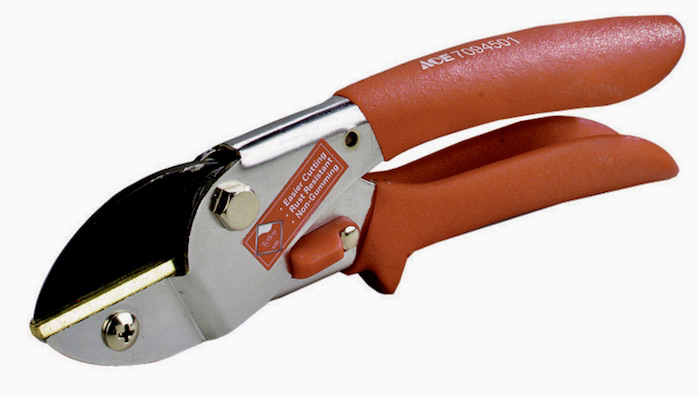
But now I can begin coping with the mess that the patio has become, including trimming and pruning the plants, cutting out the old wood, and chopping up the plants that have died. So I discover that my secateurs, or pruning shears, had gotten exposed to our rainy season and needed replacing. With an object much like this excellent tool from the local Ace Hardware:


(#1) Ace anvil pruners

On anvil vs. bypass pruners, see below. But first, on the terms secateurs, pruning shears, and pruners.

Read the rest of this entry »

All about -ette

March 28, 2021

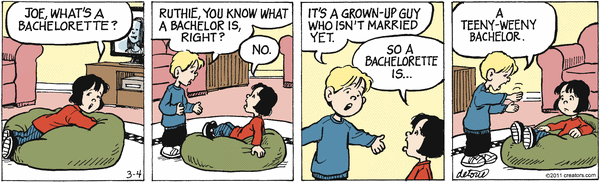
Diminutive, feminine (in some sense), both. In the One Big Happy strip of 3/4, in my comics feed on 3/36:

(#1)

In modern English — that’s important — the suffix -ette has two relatively productive — that’s also important — functions: as a literal diminutive, referring to a small version of the referent of the base to which –ette is attached (“diminutive” suffixes can have a variety of other functions, notably as expressing affection towards this referent); and as a literal feminine, referring to a female version of the referent of the base to which –ette is attached (“feminine” suffixes can have a variety of other functions, notably as markers of grammatical gender (ggender), as opposed to natural, or sex, gender (ngender); English doesn’t have ggender).

The big generalization about modern English is that –ette attached to bases with inanimate reference (like disk) tends to have the literally diminutive function (diskette), while attached to bases with human (or, more generally, higher-animate) reference (like usher), –ette tends to have the literally feminine function (usherette). Novel formations follow the generalization: a spoonette would be a small spoon, not a spoon in female shape, or a spoon intended for use by girls and women; while a guardette would be a female guard (perhaps viewed dismissively or derogatorily), not a miniature guard.

Ruthie’s brother Joe apparently fails to appreciate the big –ette generalization, and takes a bachelorette to be a miniature bachelor, rather than the female counterpart of a bachelor (in Joe’s terms, a grown-up girl — a woman — who isn’t married yet).

Read the rest of this entry »

Zippo, the comic strip

March 25, 2021

The 3/14 Zippy strip shows Claude and Griffy (and eventually Zippy too) caught up in what seems to be affixoid attraction (similar to word attraction), an irrational appreciation of or enthusiasm for a particular word-part — in this case, the word-final element –o (whatever its source might be):


(#1) All of the panels except the fourth are framed as two-person exchanges, in which the second is a response to the first: offering a competing alternative (panel 1), trading insults (panels 2 and 3), or expressing appreciation (panel 5)

Read the rest of this entry »

Tom Stoppard speaks to the meat

March 24, 2021

In the New Yorker, “Tom Stoppard’s Charmed and Haunted Life: A new biography enables us to see beneath the intellectual dazzle of the playwright’s work” by Anthony Lane, in the print edition of 3/1/21:

In 2007, the playwright Tom Stoppard went to Moscow. He was there to watch over a production of his trilogy — “Voyage,” “Shipwreck,” and “Salvage,” collectively known as “The Coast of Utopia.” The trilogy had opened in London in 2002, and transferred to Lincoln Center in 2006. Now, in a sense, it was coming home. The majority of the characters, though exiled, are from Russia (the most notable exception being a German guy named Karl Marx), and, for the first time, they would be talking in Russian, in a translation of Stoppard’s text. Ever courteous, he wanted to be present, during rehearsals, to offer notes of encouragement and advice. These were delivered through an interpreter, since Stoppard speaks no Russian. One day, at lunch, slices of an anonymous meat were produced, and Stoppard asked what it was. “That is,” somebody said, seeking the correct English word, “language.”

Since this is a blog mostly about language, you have no doubt seen where that answer came from.

Read the rest of this entry »

The fear begins to lift

March 23, 2021

The fear of death, now that I’ve had both shots of the Pfizer vaccine for the COVID-19 virus. And the vaccine will have taken full effect by April 2nd (Good Friday, though either Easter or Passover would have been a better omen), at which time I can feel reasonably comfortable venturing (masked and suitably distanced from others) out into the world, after nearly 13 months in isolation.

The end game involved some waiting in line that was unusually light and easy, as explained in a NYT Magazine Tip “How to Wait in Line”, by Maria Wollan (on-line on 3/16; in print on 3/21).


(NYT illustration by Radio)

Wollan’s subhead:

Distract yourself to pass the time. If you can, embrace the camaraderie of wanting something en masse.

Read the rest of this entry »