Analogies I: Zippy and Lewis Carroll

May 9, 2010

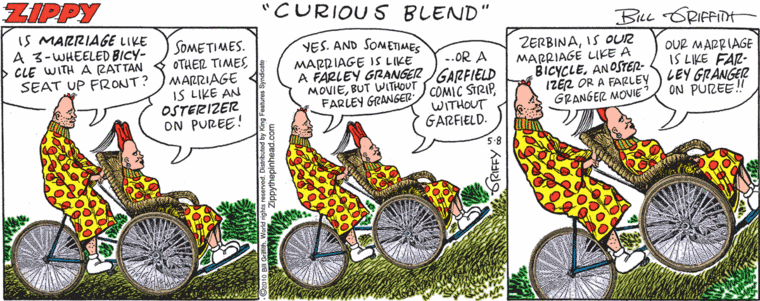
It’s the weekend: cartoon time! Yesterday brought us Zippy and Zerbina, on a bicycle, on their marriage:

Six simple analogies, “X is like Y”, in a row, none of them making much sense in this context — or in any context you can easily imagine.

The prototype of the inscrutable analogy is the Mad Hatter’s celebrated riddle “Why is a raven like a writing desk?” in Alice in Wonderland. This is one step beyond simple analogies, in that it asks for an explanation, a reason (preferably, a clever one) for the analogy; it expects an answer of the form “X is like Y because R”.

Read the rest of this entry »

69

May 8, 2010

Monty Python’s Contractual Obligation Album came by me as a random selection on iTunes Friday morning. It immediately launches into things with the perky little song “Sit On My Face”, which clearly describes a sexual act (reciprocal oral sex), throws in a couple double entendres on blow (in be blown away), and once uses sixty nine itself (in a verbed version: “Life can be fine if we both sixty nine”).

The U.S. Federal Communications Commission found the song “actionably indecent”, and in 1992 took legal action against KGB-FM in San Diego for playing it and eventually fined the station $9,200. Somewhere along the line it became an incredibly popular — often-requested but for legal reasons never played on the open air — song on the Dr. Demento radio show of novelty songs, comedy, and other oddities.

I’ll take a look at the notion of indecency at issue here (it seems not to be primarily about the use of specific words) and muse some about the status of the expression sixty-nine.

Read the rest of this entry »

Short shots #45: maple-apple scrapple

May 8, 2010

Yesterday Ned Deily reported on his Facebook page on a visit to the Farmer’s Market in Bethlehem, Pennsylvania, where he found

maple-apple scrapple

for sale. A wonderful rhyming and /p/-ful compound, suitable for chanting or cheering.

For those of you not in the Pennsylvania Dutch area or close by, scrapple is, according to NOAD2:

scraps of pork or other meat stewed with cornmeal and shaped into loaves for slicing and frying, esp. characteristic of eastern Pennsylvania

The Wikipedia entry goes into a lot more detail (specifying “hog offal, such as the head, heart, liver, and other scraps” and fleshing out, as it were, the cooking procedure), which might well put you off the dish (as many people are put off by the somewhat similar  Scottish dish haggis, also inspired by the thrifty instinct to use whatever you can of the edible materials available to you).

Fried scrapple, part of a complete breakfast in the part of the world I grew up in, though scarcely part of a heart-healthy diet.

Color coding

May 6, 2010

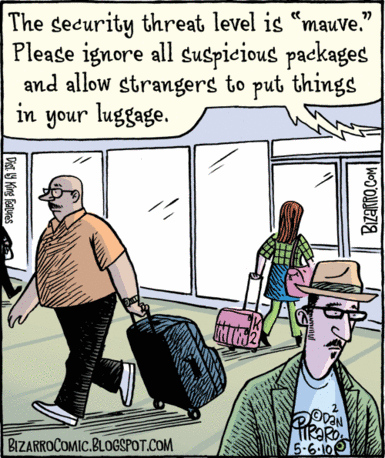
From Bizarro, a new color-coded threat level for U.S. Homeland Security:

The lavender-lilac, or pinky-purple, color mauve (named for the flowers of the mallows, of the genus Malva) — Whistler, contemptuously, “Mauve is just pink trying to be purple” — became culturally, socially, and economically significant following on William Henry Perkin’s 1856 discovery of the synthetic dye mauveine (the first of the many aniline dyes). (See Simon Garfield’s Mauve: How One Man Invented a Color That Changed the World.) It eventually became associated with femininity (due to its use in women’s clothing, most notably by Queen Victoria and Empress Eugénie), homosexuality (one gay man to another, contemplating a sunset, in Angels in America: “Purple? What kind of homosexual are you, anyway? That’s not purple, Mary, that color out there is mauve.”), and decadence (as in Thomas Beer’s book about the 1890s The Mauve Decade: American Life at the End of the Nineteenth Century — compare Oscar Wilde, Aubrey Beardsley, and all that).

The feminine/gay associations continue to be strong, as in the stereotype that (only) women and gay men know and use color terms like mauve and taupe; see Mark Liberman’s discussion, here, of xkcd’s recent explorations into color vocabulary as used by women and men.

Short shots #44: Money talks

May 5, 2010

Two things from Patricia Marx’s “Shouts & Murmurs” column “The Money Whisperer” in the May 3 New Yorker, p. 33.

First, an idiom understood literally, followed by a slinging of phonetic terminology:

I’d heard rumors. They said that he could move decimal points telekinetically, that he owned the global rights to the number three quintillion seventeen, that he could make a penny feel like a million bucks. Everyone knows that money talks, but only he, it was said, knew how to talk back. It had to do with fricatives and glottal stops.

Then later, an ambiguity in how a sentence is used in context: request or offer?:

At my wit’s end, I suggested that we see a financial counsellor, but my money curtly told me that if I came near it Mrs. Sherbet would move it into escrow. I took to roaming the streets. “Spare change?” a man on the corner said. I was about to accept the offer when I spotted my money and Mrs. Sherbet, clinking champagne glasses at an outdoor hummus café.

-pocalypse

May 4, 2010

Reported yesterday on ADS-L by Steve Kleinedler (of the American Heritage Dictionary), the portmanteau aquapocalypse, referring to the disastrous water main break in the Boston area (just repaired) that had millions of people boiling their drinking water. Steve remarks that it’s lots of fun to say.

Echoes of snowpocalypse (among the portmansnow words I reported on here and here; discussion by Jan Freeman here; and by many others).

I asked Steve if he had other -pocalypse words, but he had only these two in his files so far, though he suggested that Grant Barrett might have more. And indeed, Grant has so far picked up two for his Double-Tongued Dictionary site: carpocalypse (based on car, not carp), here; and shopocalypse, here.

And he notes that a Google search with word-initial wildcarding — here — pulls up a whole lot more playful -pocalypse words, among them: E-Pocalypse (EP by Welsh pop punk band Kids in Glass Houses), text-pocalypse (that awful txtng), yo-pocalypse (frozen yoghurt), Taco-pocalypse (from Taco Bell), O-pocalypse (reaction brought on by Obama’s policies), pork-pocalypse (swine flu), eco-pocalypse, e-pocalypse (environment). Some of these maintain some reference to, or at least connotation of, actual or predicted distaster, but in others, what’s conveyed by -pocalypse is some kind of extravangance.

These coinings are beginning to straddle the line between portmanteaus (playful, to be sure, but portmanteaus nevertheless) involving the second part of apocalypse and words with a suffix-like element (a libfix) –pocalypse, like the -gate of coinings for the names of scandals, which is no longer (necessarily) connected to the original Watergate.
ambulanza

May 4, 2010

As I said in this posting, on the headline “Mau Mauing the Flesh Eaters”, cultural references are the very devil. Even more so when the reference comes from some time ago.

So here’s Robert Hass, interviewed by Terry Gross on the NPR program Fresh Air, about the language of Walt Whitman’s Song of Myself — on the occasion of the publication of

Song of Myself: And Other Poems by Walt Whitman. Selected and introduced by Robert Hass. With a lexicon of the poem by Robert Hass and Paul Ebencamp. Counterpoint, 2010.

From a transcript of the program (available here, with audio linked from this address):

Gross: … afflatus [or] flatus actually means the miraculous communication of super natural knowledge, which kind of changes the whole feel of what he’s saying …

Hass: Yeah, it’s a word from 19th century theology. It was fun to look and say, blab of the pave. Does anybody else use the word pave as a noun? No, is the answer. We looked in every possible source. Another place he says, the kelson of creation is love. I looked up kelson. Whitman grew up on Long Island and then in Brooklyn, where there’s a shipyard, so he loved watching guys build boats. And the kelson is the piece of wood that connects the rudder to the frame of the boat.

So it was enormous fun doing the lexicon because it got us a chance to look at exactly the way he used these words. And over and over again, they turned out to be terrifically precise. When the young Henry James reviewed the first – an early version of Song of Myself, Whitman would throw in foreign words and James, with a little bit of fastidious snobbery said, one must regret Mr. Whitman too extensive acquaintance with the foreign languages.

Hass: … [Whitman] talks about the rushing by in the street the flaps of the ambulanza. But when we looked it up it turned out that the first army to develop a service to get wounded soldiers very quickly from the battle to hospital tents was the Italian army or the Piedmontese Army during the Crimean War. And the term for these very fast moving wagons taking people to the hospital was ambulanza and it was the newest, most cool word.

It’s time has, however, passed.

I was hoping that Hass would report on a clipped version lanza (as in Mario Lanza), but he and Ebencamp seem not to have found that one.

What, me worry?

May 4, 2010

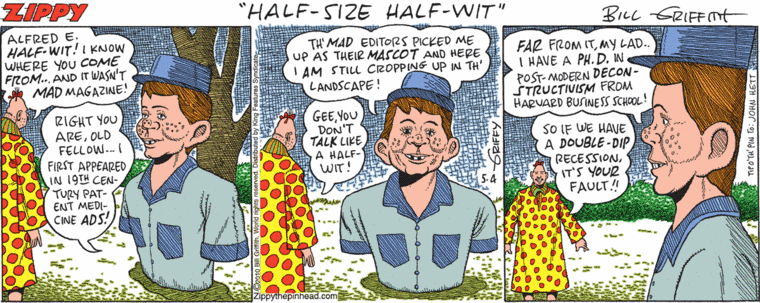
Today Zippy, the well-known pop culturist, interviews pop icon Alfred E. Neuman:

Neuman’s Wikipedia page leaves his origins murky:

Alfred E. Neuman is the fictional mascot and iconic cover boy of Mad magazine. The face had drifted through American pictography for decades before being claimed and named by Mad editor Harvey Kurtzman.

… Kurtzman first spotted the image on a postcard pinned to the office bulletin board of Ballantine Books editor Bernard Shir-Cliff. “It was a face that didn’t have a care in the world, except mischief,” recalled Kurtzman.

Griffy and Zippy are both Mad enthusiasts. I posted a few years ago on Griffy’s love for expressions from the comics (Griffwords), including, from Mad, the word potrzebie:

Potrzebie is a Polish word popularized by its non sequitur use as a running gag in the early issues of Mad not long after the comic book began in 1952. The word is pronounced “pot-SCHEB-yeh” in Polish and is a declined form of the noun “potrzeba” (which means “need”), but in “English” it was purportedly pronounced “PAH-tur-zee-bee” or “POT-ra-zee-bee.” Its Eastern European feel was a perfect fit for the New York Jewish style of the magazine.

Mad editor Harvey Kurtzman spotted the word printed in the Polish language section of a multi-languaged “Instructions for Use” sheet accompanying a bottle of aspirin, and Kurtzman, who was fascinated with unusual words and Yiddishisms, decided it would make an appropriate but meaningless background gag. After cutting the word out of the instruction sheet, he made copies and used rubber cement to paste “Potrzebie” randomly into the middle of Mad satires.

I continued:

Not yet in the OED.

Mad was also responsible for axolotl (the name of a salamander-like reptile) as a nonsense reference and ferschlugginer (adapted from Yiddish) as a sort of all-purpose modifier of negative affect.  Ferschlugginer hasn’t made it into the OED yet; axolotl, of course, is there, but without a reference to Mad.

Savoring words

May 3, 2010

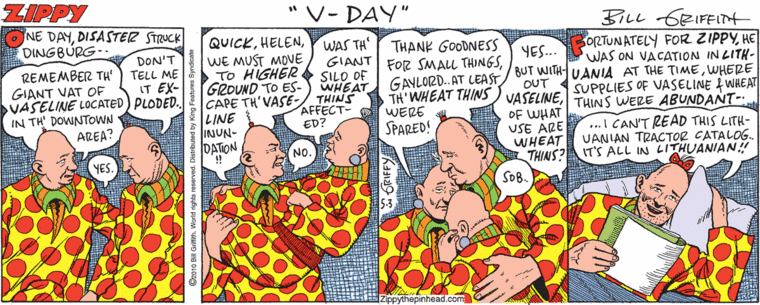
It’s not just Zippy; Dingburgers in general savor words. They like to use their favorite words and will dwell on them:

Vaseline and Lithuanian have caught their attention here.

Commercial products also figure prominently in Zippyworld. Here it’s Vaseline and Wheat Thins.

Does this contain any X?

May 3, 2010

Pete Wells writes in the May 2 NYT Magazine (“Cooking with Dexter: The nut case”) about eating out with his 5-year-old son Dexter, who’s seriously allergic to tree nuts, peanuts, and sesame seeds. Wells tells the story of a trip to Houston, where the family had some excellent Mexican food. At one point, they were having some campechana de mariscos (description, picture, and recipe in the story), which Dexter found a bit spicy for his taste, so his father offered him a hush puppy instead. Dexter ate it happily, but then asked, ominously, “Is there anything in this food that we weren’t expecting?”; his throat was itching, the first sign of an allergic reaction, which then developed into something much worse, requiring a shot from an epinephrine pen and a visit to an emergency room.

Despite being very cautious about what Dexter ate, his parents had “offered him a cornmeal fritter full of chopped pecans”.

More recently, they

asked a waitress whether the muffins that landed on our table with the menus contained any nuts or seeds.

“No,” she said, emphatically, “No nuts. Only peanut flour.”

They passed on the muffins.

Read the rest of this entry »