At the last minute, a weekend cartoon. From Scenes from a Multiverse:
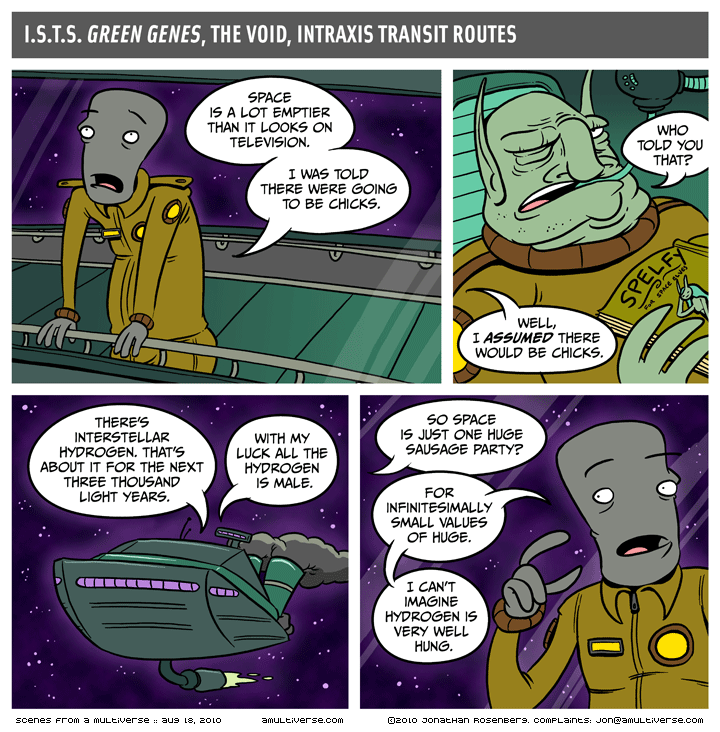
Two points. First, “for infinitesimally small values of huge”. (Later, “sausage party”.)
At the last minute, a weekend cartoon. From Scenes from a Multiverse:
Two points. First, “for infinitesimally small values of huge”. (Later, “sausage party”.)
More educational jargon, from Michael Quinion’s World Wide Words #689, 5/8/10:
LEARNING TERMS An unfamiliar word, GRADUATISED (GRADUATIZED if you’re American or very formal) appeared in an British article. It refers to a profession or occupation, the entry to which has been restricted to university graduates. The article addressed the problems of school leavers, who are increasingly finding it hard to get jobs for this reason. Educationalists have used GRADUATISED, its verb GRADUATISE, and its linked noun GRADUATISATION, at least since the early 1970s, though it’s still a term of art in the profession and is rarely found outside specialist or scholarly publications. A rare sighting of the noun was a comment by the (then) British PM Gordon Brown in the Evening Standard of London on 30 April 2008: “This is one of the wider problems with today, the graduatisation of the political and media worlds. So many people are now excluded because they left school at 16 or 18.”
Educational jargon tends to get very bad press (though both educational rubric and graduatize can be defended on the grounds that they are not only compact but also useful in their context), and innovations in -ize (verbings by derivational suffix) have been reviled for a long time, so graduatize gets a double dose of scorn. And, in fact, if you’re not familiar with it (as I was not, until Michael put this entry in WWW), its meaning can be very hard to guess even in context. But you can see its utility.
From the April 10 issue of The Teaching Professor:
Two Reasons Why I Still Use Rubrics
By Kevin Brown, Lee University, TNI began using grading rubrics for essays several years ago, and I was initially rather unhappy with how they worked. I found I was giving grades that I wouldn’t have given when I graded without the rubric. Often the grades were higher, but not always. I gave enough lower grades to cause me to notice those as well. (link)
The piece goes on to use just plain rubric — the short version of grading rubric — throughout (without explanation or examples; the readers are supposed to know the word already). I could work out roughly what rubric meant in this context, given OED2’s chain of senses for the word:the color red; a heading printed in red, or a passage so marked; a heading in general [note to etymological purists: no printing headings in black, or any color other than red!]; an injunction; a general rule. So a rubric in the teaching context is presumably some sort of rule for assigning grades. But it sounds like something more specific is intended. And so it is.
The word is teacher jargon (using jargon neutrally, for expressions used by a particular profession or group and not easily understood by others, usually serving to provide short reference to some concept important to the group). A rubric — the Teacher Planet site here has dozens of them, for history, math, social studies, and so on, even for the design of scavenger hunts! — provides a set of factors (each factor representing an expectation for specific knowledge, ability, or performance) and for each factor, descriptions for assigning a student to one of a certain number of levels. For the Scavenger Hunt Rubric:
Factors: Contribution to Group, Sites, Questions, Cooperation, Final Hunt Results
Grading for Sites: 5 Sites found are all relevant to project and good source for questions. 4 Sites found are mostly relevant to project and good source for questions. 3 A few of the sites found are relevant and provide a fair source for questions. 2 Few sites are relevant. Sites are not a good source for questions. 1 No relevant sites are included. Sites are not good sources for questions.
The descriptions require some judgment on the part of the teacher, of course.
So rubrics break down expressing expectations, setting goals, and assessing performance into a number of explicit factors for the purposes of grading. It would be interesting to see something about the history of the technique and its possible relationship to similar assessment tools in industrial, business, etc. settings.
Overheard at a local restaurant, young man to young woman:
If you do that, then you’ve deprecated yourself from being a consultant; you’re just an order-taker.
Unfortunately, I missed the preceding context, so I don’t know what “do that” referred to, but deprecate oneself from struck me as odd (I entertained the possibility that deprecated was an error for demoted). I can, however, interpret the expression if the action in question involved self-deprecation, so that the expression conveyed something like ‘ceased to be a consultant as a result of self-deprecation’.
Back on August 7, E. Ward Gilman (of MWDEU fame) e-mailed me about Burchfield’s Fowler (billed as the third edition, 1998, of Fowler’s Dictionary of Modern English Usage, 1926):
Quite a few years ago, when I was hoping to be able to write a review of Burchfield’s Fowler, I ran across another curiosity. It was the pronominal use of “various”, as in “I spoke with various of them”. This use was condemned in the original Fowler, with citations, and in Gower’s edition, with additional citations, but is omitted entirely from Burchfield. I don’t know whether it was omitted inadvertently or whether Burchfield left it out on purpose.
I replied that it was hard to tell: maybe Burchfield just decided the usage was now acceptable; unfortunately, we can’t ask him (he died in 2004).
Now some further discussion, reproducing some material posted to the American Dialect Society Mailing List back in August.
Both NOAD2 and AHD4 list pronoun uses of various, but with a usage note in each case. NOAD2 calls the pronoun use “colloquial American”, noting that “some traditionalists” insist that various is only an adjective. I see this opinion as denying the possibility of language change, in particular a change in which various developing an pronominal use parallel to several.
(In some postings i’ve called the operative assumption here Originalism — the very silly idea that the original use of a word is its only acceptable use now.)
[Digression 1 about part-of-speech classifications: these sources seem to use pronoun as the part-of-speech classification for quantifier words used as determiners with of. I’ll play along with that here, with a proviso to come shortly.]
[Digression 2 on this topic: OED2 does not in fact label such uses of several — in several of — as pronominal. Instead, these uses are treated as elliptical uses of the adjective several. OED2 does something similar for few in few of. But the June 2009 draft revision for many classifies it as a pronoun in many of. I assume that when revisions get to several and few, they will be similarly reclassified.]
[Digression 3 on this topic: on ADS-L, Randy Alexander noted the treatment of these items in CGEL as “fused head” structures: fused
determinative-head (in few, many, several), and fused modifier-head (in various). I am in fact a proponent of this analysis, but chose to formulate my discussion in more traditional terms so as to connect with the dictionary treatments.]
Back to usage advice. AHD4 reports very substantial hostility to pronominal various on its usage panel, with somewhat less hostility towards it with inanimate NPs. The usage note concludes:
It is not clear why this usage should be regarded as an error, since it is analogous to the use of quantifiers such as few, many, and several.
Well, it is indeed analogous, but few, many, and several developed pronominal uses well before various did. The offense of various is that it came late to the party; the doors were closed, and no new items are to be allowed in. Then commenters like Fowler fixed on it as an innovation, and others piled on, as often happens; it became part of the peevelore, to the extent that you felt
that MWDEU had to warn readers that some people view the usage as a
straightforward error, so that you might want to be cautious about using it. (Crazies win, as I said in a Language Log posting a while back.
The case is interesting, because it’s not clear what the fix is supposed to be. The usefulness of pronominal various is that various of can combine with definite NPs, as in various of them and various of these commenters. So if you proscribe pronominal various, then some other partitive construction must be used (several of, a number of), or an indefinite construction must be used (various people, various commenters), or a noun or pronoun head must be supplied for the adjective various (various ones of them, various commenters of these). Each of these work-arounds has its defects, but the first is probably the best; its defect is that the association with variety is absent in the alternative partitives.
From a (non-linguist) correspondent, Chris Ambidge:
This [usage] dates to my hometown, Northampton [in the East Midlands of the UK], in the mid 1930’s. There was a group (probably people who patronised a local pub) outing to some distant attractions, & a coach [that is, a bus] had been chartered, leaving at some early hour. A sign was posted @ the pub (& possibly on the door): “The coach for (destination) on (date) will leave at 7:30 am SHARP. If you come late, you will be had it.” That original construction … tickled my dad considerably, and entered the family argot used for emphasis: “If you do/fail to do such-and-such, you will be had it.” It then expanded to also mean (“those flowers really will be had it”) that some item or other was past its best & due for a discard. Which really has nothing to do with tardiness &/or missing the coach. I heard myself saying that about last week’s purple gladioli, & that inspired me to send the locution to a linguist.
Nice example of semantic extension.
I’m posting this in case anyone has experience with the coach-announcement usage of the expression (the family’s extension of it is unlikely to have been duplicated elsewhere; it’s probably one of those family things. — but see below) Please don’t write just to say that you’ve never heard it before and that it sounds strange to you; I assume that’s true of almost everyone.
My current hypothesis is that will be had it is a combination of two things. The first is the colloquial idiom to have had it, glossed by OED2 as follows:
to have no chance whatever of having or doing something; to have had one’s (adverse) fate finally decided, to be defeated; to be dead, to have been killed; to be ruined, broken down, useless; to have had enough
Note the ‘broken down, useless’ sense, and recall the family’s ‘past its due’ use of will be had it. Note also that this idiom is in the perfect, marked by the auxiliary have plus a past participle (had).
That’s thing one. Thing two is a piece of well-known variation in English, the use of auxiliary be rather than have in the perfect. The usage is mostly archaic and dialectal. Here’s OED2 on the subject:
in intr. vbs., forming perfect tenses, in which use it is now largely displaced by have after the pattern of transitive verbs: be being retained only with come, go, rise, set, fall, arrive, depart, grow, and the like, when we express the condition or state now attained, rather than the action of reaching it, as ‘the sun is set,’ ‘our guests are gone,’ ‘Babylon is fallen,’ ‘the children are all grown up.’
My suggestion is that the be had it of will be had it marks the perfect, so that will be had it can be glossed ‘will have had it’ (with the ‘have no chance whatever’ sense of to have had it above). Yes, the had of to have had it is transitive, but I believe there are some dialectal occurrences of be-perfects with transitives (as well as intransitives), though I’m away from the relevant sources at the moment.
I’ll pass this posting on to colleagues who are likely to know more about the matter.
Introducing a new feature on this blog: Short Shots, brief items with little comment. This inaugural posting has five items in it.
The text for today, from the excerpts (in the NYT yesterday) from Sarah Palin’s statement resigning as governor of Alaska:
I’ve never believed that I, nor anyone else, needs a title to do this — to make a difference, to help people.
My comment here is on the nor of nor anyone else. I would probably have used or myself, but Palin’s usage isn’t non-standard. But some commenters have had qualms about nor in cases like this.
There’s a lot of hostility out there towards certain words, especially when the complainer sees them as recent innovations, and especially when the words fit certain patterns. For instance, Mark Liberman reported (in “Centuries of disgust and horror”, here) on hostility towards some uses of the suffix –ize, as in incentivize. And direct, or zero, conversion of words to verbs or nouns (which I’ll call verbing and nouning for short) gets a lot of bad press: verbing weirds language (and so does nouning).
The usual objection to zero conversions is that they’re unnecessary: the language already has phrasal equivalents to the innovations, or has existing single-word equivalents. And the usual response to such objections is that the innovations are often shorter than the alternatives (brevity is good) and they almost always express subtleties not conveyed by the alternatives.
But sometimes people object to zero conversions simply on the grounds that they change categories.
Case in point: the nouning of the verb fail.