From Facebook friends, this distressing recent Saturday Morning Breakfast Cereal, featuring a malevolently uberpeeving personification of the English language:
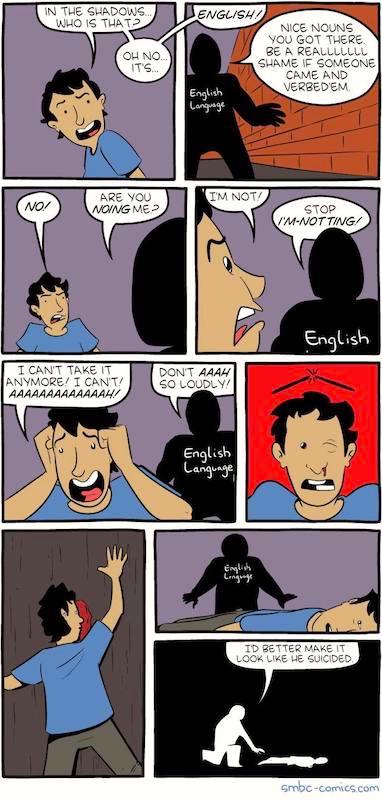
From Facebook friends, this distressing recent Saturday Morning Breakfast Cereal, featuring a malevolently uberpeeving personification of the English language:
A PartiallyClips from 2014, which somehow slipped my notice:

The officer in the cartoon — I’ll call him Andy, after E.B. White — objects to (1) broke as the PSP of break and to (2) What did you do that for? as (incorrectly) ending a sentence with a preposition, and he’s about to object to the driver’s use of (3) hyperbolic or intensive literally. Meanwhile, Andy’s partner Bill Strunk (note: the Strunk of Strunk & White’s Elements of Style was called Will) is busy doing usage-retributive damage to the car. Not, I think, the world’s greatest usage assholes, but arguably in the asshole pantheon.
From the most recent NYT “Metropolitan Diary” (on-line on the 26th, in the national edition on the 28th), a contribution from Michael Joseloff that begins:
Two teenagers with clipboards were stopping passers-by on the Upper East Side. I was in a hurry to get to the bank, so I tried to maneuver past them and avoid their pitch. No luck.
“Me and my friend are trying to raise money to buy uniforms for our basketball team,” one of the boys began, before rattling on with the rest of his memorized speech. To paraphrase Renée Zellweger in “Jerry Maguire,” he had me at “me and my friend.” He seemed sincere. I decided to help.
I was desperately hoping that he was going to help the kid by making a contribution. But no: he proposed to help by correcting the kid’s grammar.
The Unshelved cartoon from the 12th, passed on by Betsy Herrington on Facebook:

The GN takes a truly extreme (One Right Way) position that like can be only a verb, a bizarre view that results in her seeing the library poster as being incorrectly punctuated. (Ok, when in doubt, blame it on the punctuation.) She doesn’t even recognize the preposition use (Which one of these things is not like the others?), not to mention the many uses of like that are set off intonationally in speech and consequently should be punctuated with a comma — no doubt she dismisses these as simply incorrect, “not English” — in particular, quotative like (I asked when she was going, and she was like, “In a minute”) and discourse particle, or discourse marker, like, as in the library’s poster.
From the 9/6 New Scientist, in a letter from Bruce Denness (p. 28):
The tank shallowed towards one corner so that deep-water waves … began to break as they approached the shallow corner.
That’s the inchoative verb to shallow ‘to become, get shallow(er)’ — a direct verbing (or zero conversion) of the adjective shallow. I’m not agin verbings (unlike a number of peevers, who are driven into rages by them), and this one serves a real purpose, but it was new to me. It’s also venerable, and has even made it into NOAD2.
This morning: a classic Doonesbury on foul language; a Rhymes With Orange citing the spurious “rule” that an English clause must not end in a preposition; and a Zippy looking back at an ad icon of the 1940s and 50s (“drink more flavored liqueurs”, says Judge Arrow).
Yesterday on ADS-L, Charlie Doyle passed on a piece from the Monday Huffington Post on, omigod, the hated word moist; the HuffPo writer professed to be nauseated by the word (title: “Hate Moist? You’re Not Alone”) and went on to consider alternative expressions that would avoid the offensive moist. The ADS-Lers went over this years ago, starting with reactions much like Jon Lighter’s yesterday:
Truly incredible. Rationally inexplicable.
It “nauseates” them, even when applied to cakes!
Makes me want to use it more. And eat more cake.
I got back on the bandwagon:
Yes, it makes me want to stand up in a crowded theater and shout, “MOIST MOIST MOIST”.
And then Amy West took things in a new direction:
Me three. If you guys are coming to Boston for LSA/ADS in Jan. we can do this. While holding cake.
Ah, a convention event! I could totally get into that.
It’s one of those topics in English usage that just will not die. It erupted on ADS-L yesterday, with this query from Dan Nussbaum:
In the sentence, “Hopefully, the sun will rise tomorrow” the word hopefully is being used incorrectly. What word should be used?
And then we were off on a familiar path. Larry Horn got in first, noting that there was nothing incorrect about the example; Lisa Galvin reported that she had a professor long ago who said that the proper usage should be I hope rather than hopefully, since as it stands the sentence says “that the sun itself is full of hope that it will rise tomorrow”; and Larry replied:
“Hopefully” is a sentence adverb in such contexts and has been used as such for decades — while also being a manner adverb in “The dog is sitting hopefully by her food dish”. (Not arguing with Lisa here, but with her long-ago professor and my fellow [AHD] Usage Panelists who vote with the majority to condemn this perfectly ordinary and proper usage.)
Pretty much everyone who writes about English usage has taken on hopefully, and the informed consensus is solidly with Larry, but a bizarre irrational prejudice continues against sentence adverbial hopefully.
