From John McIntyre on Facebook today:
— JM: Today’s Pleonasm Award goes to outlets that referred to Thomas Jacob Sanford, who attacked the Mormon church in Michigan, as an armed gunman.
From John McIntyre on Facebook today:
— JM: Today’s Pleonasm Award goes to outlets that referred to Thomas Jacob Sanford, who attacked the Mormon church in Michigan, as an armed gunman.
E-mail today from Luis Casillas to me and Luc Baronian (it’s a Stanford connection), with his header:
Apparently English “n’t” is trulyn’t an inflectional affix after all
(intending to convey ‘truly not an inflectional affix after all’) and then the comment:
Seen on Twitter:
(#1) deranged grammar advice on-line
From the Economist‘s 8/24/24 issue, under the characteristically jokey head Beneath the (ap)peal, the informative subhead
South Asia’s long love affair with mangoes
(yes, about the appeal of the fruits in South Asia, incorporating –peal as a pun on peel ‘outer covering of a fruit or vegetable’)
Which stopped me in my tracks, because I would have written mangos rather than mangoes. It turns out that there’s real variation on this point; both mangos and mangoes are well attested (and have occurred in postings on this blog, though all the instances of mangoes are in quoted material, not from my hand). And, entertainingly, published lyrics for the song titled “Mangos” (made famous by Rosemary Clooney) come in two different versions, from different sources: one with mangos, one with mangoes.
So begins Psalm 118:24, in the KJV; the verse in full:
24 This is the day which the Lord hath made; we will rejoice and be glad in it.
Two things: one, the way in which the restrictive relative clause (with non-human antecedent) is marked — here with the relativizer which rather than that, or, unmarked, with no relativizer (in a so-called zero relative); two, the framing of the new day, in which we are exhorted to rejoice, as a gift of God (versus viewing it simply as the welcome granting of another day of life).
I take this up because the late Ann Daingerfield Zwicky was accustomed to greeting the new day by reciting the whole verse, made personal by a shift from 1pl to 1sg, but also with the morphology and syntax altered to fit her own dialect and style — with has instead of the archaic form hath; and with the which relative replaced by the shorter zero relative:
(ADZ) This is the day the Lord has made; I will rejoice and be glad in it
but maintaining her Episcopalian / Anglican creedal commitments; from the Book of Common Prayer (1662):
I believe in God the Father Almighty, Maker of heaven and earth, and in Jesus Christ his only Son our Lord …
I admired her custom, followed her on the grammar and style, but altered the text to suit me as a non-believer:
(AMZ) This is the day I have been given; I will rejoice and be glad in it
… visiopun being my coinage referring to a punning word presented visually — not actually said or printed, but alluded to by some striking image, usually with some lead-on hinting at the pun. An extremely simple, utterly flat-footed example of my own devising:
What do you call a US infantryman from World War I?
(#1)
The image is of a small male figure made of dough, so the punning word is doughboy. (Yes, the Pillsbury Doughboy. I simplified things by using an existing image.)
Now to a complex visiopun passed on to me on Facebook today by Emily Menon Bender (the source is cited in the image):
(#2)
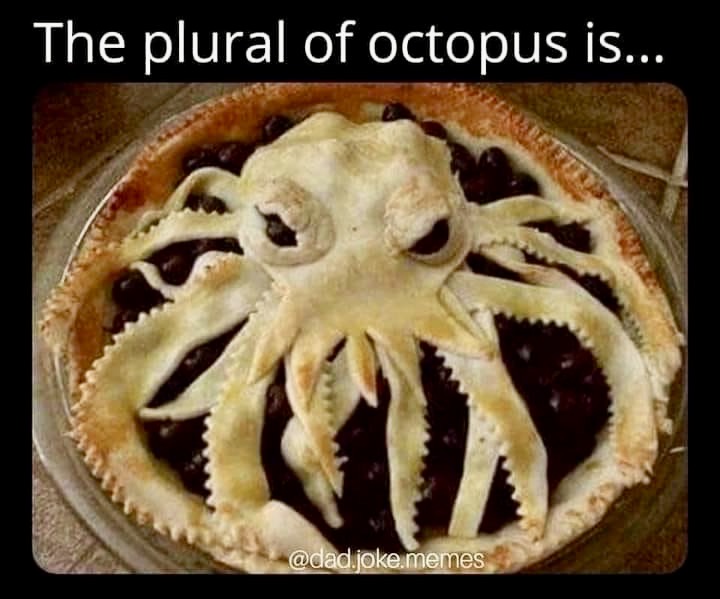
The image is of a pie in the shape of an octopus, so the punning word is octopie (/áktǝpàj/ in my AmE variety), a play on octopi, one of the plural forms of octopus. Cute.
My morning names a few days ago: surprising places the verb look has gone.
To come: the story of these items, from the OED. The related stories of some uses of say and like. All having moved from relatively concrete to much more abstract uses, serving discourse functions of various kinds.
(Hanging in my posting queue for some considerable time, but just as relevant now as then.
From John McIntyre on Facebook on 9/6/18:
Guardian writer refers to a “secret cabal” in the Trump administration. What other kind does he think there is?
The crucial point is the definition of cabal. From NOAD:
noun cabal: a secret political clique or faction: a cabal of dissidents.
That is, cabals are by definition secret, and secret cabal is pleonastic, so is to be avoided (in favor of plain cabal). The general principle is the Strunk / White Avoid Needless Words dictum. (Yes, we can dispute the applicability of the dictum in particular cases. More below.)
In my mental filing cabinet, the relevant drawer is labeled pilotless drone, after a specific example I discussed at some length back in 2007. Then, of course, the question will be whether my treatment of pilotless drones carries over to secret cabals
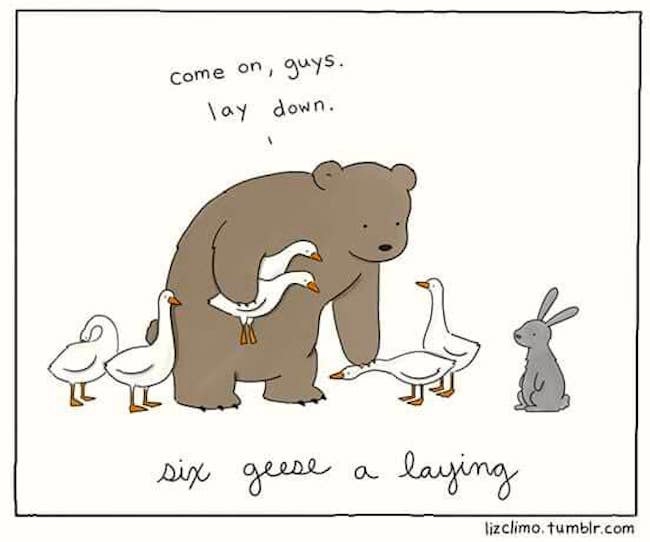
Liz Climo’s cartoon for today, 12/30, the 6th day of Christmas (“Six geese a-laying” — that is, laying eggs):
(#1)
Prescriptively incorrect, but extraordinarily widespread, lay down (in an imperative to the geese to lie down).
Yesterday on FB a query from my friend P (exchanges edited to remove personal chitchat):
A company is creating an outgoing voice message and they have come to blows over sentence structure. My suggestion to them is to fight bigger battles — but, alas, here we are.
They are going to the mat on “how can I” vs “how I can.”
Given your expertise, which is better?
“Thanks for calling COMPANY. Please tell me, in detail, how CAN I help you?
OR
“Thanks for calling COMPANY. Please tell me, in detail, how I CAN help you.”