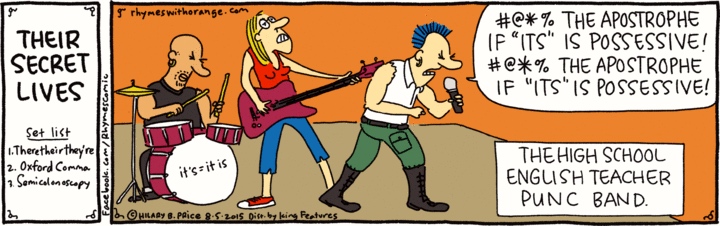
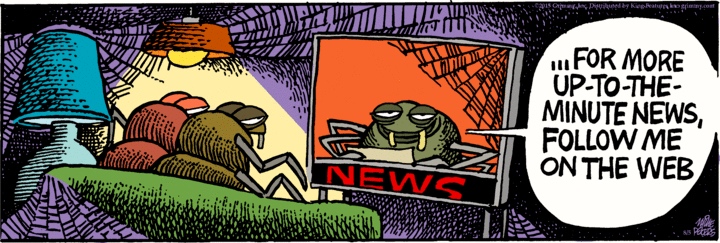
That would be today, with three language-related cartoons in my inbox: a Rhymes With Orange, a Mother Goose and Grimm, and a Bizarro:
 (#1)
(#1)
 (#2)
(#2)
 (#3)
(#3)
That would be today, with three language-related cartoons in my inbox: a Rhymes With Orange, a Mother Goose and Grimm, and a Bizarro:
(#1)
(#2)
(#3)
Following on my posting about the noun rajas, notably in rajas con crema ‘poblano (pepper) slices with cream’, there’s some unfinished business involving the word poblano.
One, recipes for this dish go back and forth between referring to the peppers as poblanos and poblano peppers. (Similarly in Mexican Spanish: poblanos vs. chiles poblanos). Some people judge the latter variants to be redundant, like Weimaraner dog instead of just Weimaraner.
Two, where does the word poblano come from?
Three, how does mole poblano, the sauce, fit into this picture.
And four, what does any of this have to do with Spanish pueblo ‘town, village’, and the Pueblo communities of Native Americans in the Southwestern U.S.?
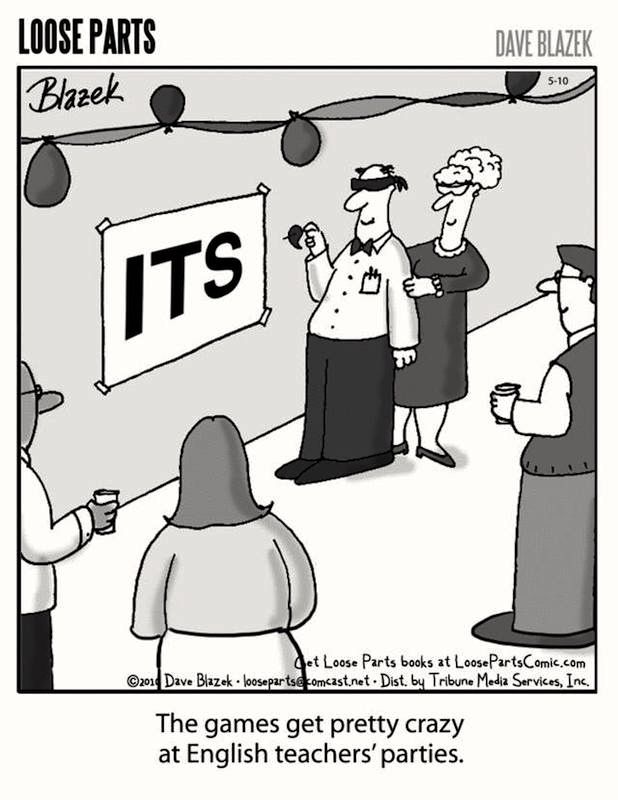
Another cartoonist new to this blog (like Ken Krimstein, recently posted on). The Loose Parts cartoon by Blazek below (from 2010) came to me from the Grammarly Facebook page via a friend:
 (#1)
(#1)
Pin the Apostrophe on the Word.
There’s a rich vein of cartoons mocking English teachers for their purported inclination to focus on minutiae.
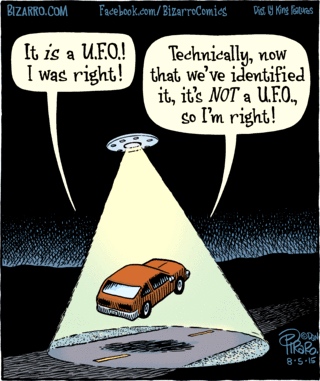
Today’s Bizarro:

Hun / hon.
The informal clipped form hon (for honey) as a term of address is stereotypically used, along with other pet names like the full honey, sweetie, dear(ie), and doll, by waitresses to their customers, in addition to the use of these as terms of endearment to genuine intimates. Many customers find the usage disrespectful and insulting, expressing intimacy in a situation where they see that deference to authority is called for.
(If you’re puzzled by the odd symbols in the cartoon — Don Piraro says there are 4 in this strip — see this Page.)
At first glance this looks like word salad, and things aren’t helped much if I tell you that it’s a VP, that it’s attested, and that it wasn’t an inadvertent error. Context, we need context.
It starts with a New Yorker Talk of the Town piece (July 6th & 13th), “The Horde” (by Claudia Roth Pierpont), about a Twyla Tharp performance. That led me to my files, where Tharp’s piece “Push Comes to Shove” came up because of the truncation in its title. And then to other Tharp dances in my experience. And to Tharp’s first name.
Tharp in a recent photo:

From the June 14th NYT Magazine, a “First Words” column by Amanda Hess, “When You ‘Literally Can’t Even’ Understand Your Teenager”:
A little paradox of Internet celebrity is that a YouTube personality can amass millions upon millions of young fans by making it seem as if he’s chatting with each of them one to one. Tyler Oakley, a 26-year-old man who identifies as a “professional fangirl,” is a master of the genre. He has nerd glasses, pinchable cheeks, a quiff he dyes in shades of blue and green and more YouTube subscribers than Shakira. Some of his teenage admirers have told him that he is the very first gay person that they have ever seen. He models slumber party outfits and gushes over boy bands, giving the kids who watch him from their bedrooms a peek into a wider world.
 (#1)
(#1)
In March 2012, Oakley faced the camera, balanced a laptop in his sightline and paged through a photo set of the curly-haired actor Darren Criss, whose turn as a hunky gay singer in “Glee” made him a fixture of teenage dreams. In these new pictures, which had just been leaked online, Criss was lounging on a beach wearing only a pair of low-rise jeans and a layer of perspiration. Oakley’s videotaped reaction was exultant. “I literally cannot even,” he informed his fans. “I can’t even. I am unable to even. I have lost my ability to even. I am so unable to even. Oh, my God. Oh, my God!”
Criss in high-hunky (almost shirtless) mode:
 (#2)
(#2)
Soon, Oakley’s groupies had immortalized his soliloquy in GIF form: “Can’t” upon “can’t,” looping forever. Now they could conjure the GIF whenever they felt so overcome by emotion that they couldn’t even complete a thought. Oakley was not the first to recast the sentence fragment “I can’t even” as a stand-alone expression. He just helped shepherd it out of the insular realm of Tumblr fandom and into the wide-open Internet.
From the 5/30 Economist, in “Republicans in name aussi” on Nicolas Sarkozy:
Even if the relaunch succeeds, however, Mr Sarkozy will have his work cut out.
Pretty clearly, the intention here is to convey ‘will have his work cut out for him’, that is ‘will have difficulty completing his work’, with the idiom have one’s work cut out for one, but here in a truncated variant. The shorter variant is simply not possible for me, though I can figure it out. It turns out that the shorter variant is specifically British. (Remember that the Economist is a British publication.)
Slogan on the side of a DHL truck in Palo Alto:
DHL — YOUR SPECIALISTS IN INTERNATIONAL SINCE 1969
The adjective international is serving as a noun here, conveying something like ‘international shipping’ or ‘international mail’ or ‘international delivery’. Informally, this is “nouning by truncation”, but the implicit noun head isn’t uniquely identifiable.
Two pieces of background here: on “nouning by truncation” and on the DHL company and its slogans.
Two recent examples of truncated expressions: from a Law and Order episode on tv, a character saying “I work the graveyard at” some place or another; and a reference in the Economist to David Cameron and Margaret Thatcher seeming to be barking.