Archive for the ‘Pronoun case’ Category

NomPrepObj

February 20, 2013

A fresh example of a nominative object of a preposition, noticed by Wilson Gray in the NYT opinion blogs (“The Two Julias” by Candice Shy Hooper on the 14th):

Jule must have wondered at a world in which any other slave in the South but she could find freedom in General Grant’s camp.

Wilson tried to attribute this error to a computer glitch, finding it hard to credit in otherwise literate prose. But of course it’s an error of nervous cluelessness (as Mark Liberman and Geoff Pullum have labeled it on Language Log), a type of hypercorrection that depends on a confusion between grammatical categories — in this case, preposition but (which takes an accusative object) and conjunction but (which combines with a clause, with nominative subject).
(more…)

Brief mention: equal time for NomConjObjs

October 13, 2012

Joe Biden on the campaign trail in Wisconsin yesterday:

It was made very clear that they [Romney and Ryan] do not believe a woman has a right to control her own body. That’s between she and her doctor. [elsewhere transcribed as: … own body – that’s between …]

A NomConjObj (nominative conjoined object), with a 3sg pronoun as the first conjunct. This is a Democratic match to Republican Mitt Romney’s

I like he and Callista. (about Newt Gingrich)

reported on here, along with an instance from Romney of the more frequent 1sg as second conjunct.

More perils of advice

September 7, 2012

From the Daily News (of the central San Francisco peninsula) yesterday, in “Man faces federal drug distribution charges: Perry Mosdromos, 46, allegedly sold medications to pay mother’s medical bills” by Jason Green:

Mosdromos, who remains in custody, hinted that the enterprise involves more than one person, according to the affidavit.

“Mosdromos stated the operation is much bigger than he,” [FBI Special Agent Matthew] Beaupain wrote, “however, Mosdromos did not disclose any co-conspirators or elaborate as to how the operation works.” (p. A4)

I’ve boldfaced the relevant clause, which has a nominative pronoun, he, in construction with than — in a context where the nominative strikes me as simply unacceptable; the operation is much bigger than him would have been the way to go.

(more…)

NomConjObj on the campaign trail

August 30, 2012

Ben Zimmer points me to this passage in Mitt Romney’s acceptance speech tonight:

Those weren’t the easiest of days – too many long hours and weekends working, five young sons who seemed to have this need to re-enact a different world war every night. But if you ask Ann and I what we’d give, to break up just one more fight between the boys, or wake up in the morning and discover a pile of kids asleep in our room. Well, every mom and dad knows the answer to that. (from the transcript)

In the bold-faced piece, a NomConjObj (nominative conjoined object), on which there is now a huge literature (brief account here). The structure is now widespread (especially in speech, but not only there), including among educated speakers: I have quotes from Barbara Boxer, Sonia Sotomayor, Prince Andrew of Great Britain etc., Ellen DeGeneres, Geoff Nuttall of the St. Lawrence String Quartet, and a huge number of linguists and other academics and professionals. In fact, some scholars of pronoun usage treat NomConjObjs as now the norm.

Still, many usageasters are appalled by them; see Bryan Garner‘s tweet about Romney’s usage above:

“if you asked Ann and I what we’d give….” this was a scripted speech!

Bad, bad, Mitt Romney! And this isn’t his first lapse; Mark Liberman reported here on Romney’s

I like he and Callista. (about Newt Gingrich)

I’d imagine that the structure is entirely natural for Romney (and for his speechwriters as well).


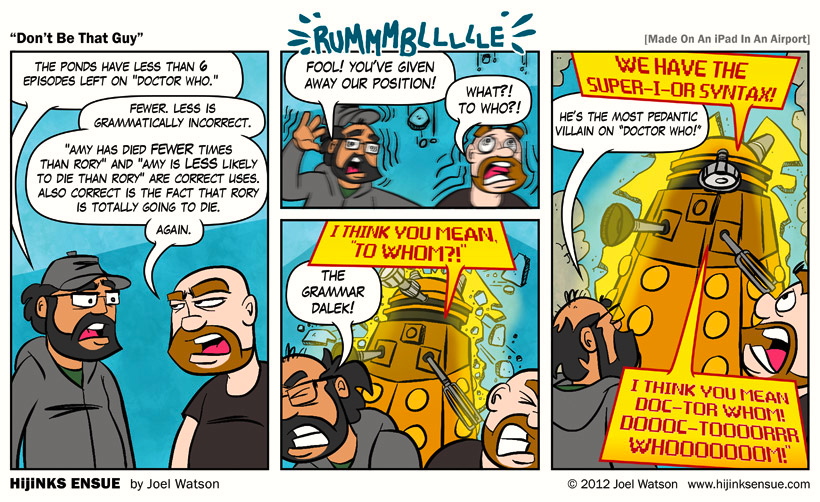
Grammar Dalek

August 11, 2012

From the webcomic HijiNKS Ensue by Joel Watson, an extraterrestrial opinion on who vs. whom:


(more…)

On the NomConjObj watch

July 27, 2012

From Thomas Grano, my sometime companion in the world of nominative conjoined objects (NomConjObjs), this catch:

At the end of three weeks, I finally called the chair of the search committee and invited he and his wife to go out to dinner with us. [in “They’re here!”, 7/24/12 Chronicle of Higher Education blog post by Lesboprof, available here]

That’s a 3sg pronoun in the first conjunct, in a direct object that’s the notional subject of an infinitive — the first example with this combination of factors that I’ve seen.

(more…)

The Pogo files

July 21, 2012

One cartoonist who reveled in language but has been largely neglected in my postings on linguistics in the comics is Walt Kelly, the creator of Pogo. The problem is that good examples of Pogo material are hard to find on the net. But here are a few high points: the quote “We have met the enemy and he is us”; notes on the Okefenokee swamp dialect in Pogo; and the inspired nonsense of Kelly’s song parodies.

(more…)

with whom

July 20, 2012

Yesterday’s Scenes From a Multiverse:

Jon Rosenberg’s comment, about the second panel:

I have no idea if Gil’s first line of dialogue is grammatically correct. I can tell you that I rewrote it about a dozen times and it is fully refined, correct or not. It is a grandiose turd with a diamond shine and I will not change it, ever.

Well, it’s still odd, thanks to the combination of with whom and hot lady … made the sexy.

(more…)

Unprovoked subject whomever

July 17, 2012

From Scott Horsley on NPR’s Weekend Edition Saturday last weekend (July 14th):

Republicans are fighting just as hard for Virginia, believing, as Mr. Obama does, that whomever wins the state will have a good chance of winning the White House.

A “free relative” clause whomever wins the state serving as the subject of a that-complement clause. Within the free relative, whomever is serving as the subject (despite its accusative case); standard English has

that whoever wins the state will have a good chance … [subject clause underlined]

“that whoever wins the state” outnumbers “that whomever wins the state” in ghits 10 to 1 — roughly 60 examples to 6, when irrelevancies and duplicates are omitted — but whomever occurs as a complement subject surprisingly often, and in the writing of experienced writers in serious contexts. These examples are the -ever parallel to the “unprovoked subject whom” cases I talked about in an earlier posting.

(more…)

look at who them was

June 15, 2012

Out of context, that sounds remarkably bad, but here it is in context (from Scott Kehoe, head of marketing at Audi, in an interview in a “Can Lincoln Be Cool Again?” segment on NPR’s Morning Edition this morning):

There was us and there was them, at that time, and if you look at who them was, there was Lexus, there was BMW, and Mercedes.

Now it’s better.

(more…)