Archive for the ‘Syntax’ Category

Dative delights

March 16, 2010

The world of English “datives” (using “dative” to refer to English NPs, especially personal pronouns, that are not direct objects but also are not marked with a preposition; English has no distinctive dative case, so “dative” here is a syntactic and not a morphological term) is rich and complex, taking in a number of phenomena beyond indirect objects with verbs of transfer, as in “Kim gave me a present”. (For some discussion, see Larry Horn’s 2008 paper ” ‘I love me some him’: The landscape of non-argument datives”, in Bonami & Hofherr (eds.), Empirical issues in syntax and semantics 7, here.  For an example that’s easier for most standard English speakers to parse, consider “I want to see me some polar bears”.)

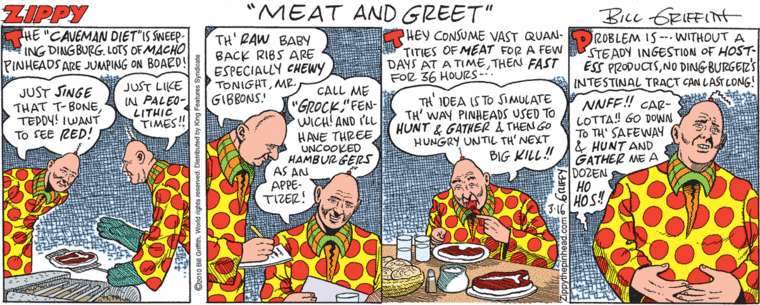
Now here’s today’s Zippy with a somewhat different sort of example:

In the last panel, we have “hunt and gather me a dozen Ho Hos”, with the accusative form me, where a reflexive myself is possible in standard English (though a bit awkward) with a benefactive ‘for myself’ interpretation, ‘hunt and gather a dozen Ho Hos for myself’.

[Added 3/26/10: This analysis is seriously messed up. See my comment.]

I beg (of) you

March 5, 2010

First came one character (a well-spoken FBI agent) on the television show Criminal Minds saying to another:

I’m begging of you. [to do something or other, which was supplied from the context]

Me, I would have used the transitive variant:

I’m begging you. [to do this]

(In the simple present and with an overt complement, the intransitive and transitive variants both suit me, though they strike me as subtly different semantically, and perhaps stylistically as well: “I beg (of) you to leave immediately.”)

OED2 has the intransitive pattern BEG OF SOMEONE TO DO SOMETHING from 1604 and the transitive pattern BEG SOMEONE TO DO SOMETHING from 1675 (plus BEG SOMETHING OF SOMEONE — “beg a favor / two favors / it of someone” — from 1711), and both continue in use today, with (apparently) some variability as to who uses which patterns and in what contexts.

That was this morning. Then this afternoon, I was reading Terry Castle’s The Professor: And Other Writings, and in the title chapter (pp. 213-4) there was a reference to Dolly Parton’s song “Jolene”. Castle quoted some of the lyrics, but didn’t quote the beginning:

Jolene, Jolene, Jolene, Jolene
I’m begging of you please don’t take my man

(which I came across in a Criminal Minds-inspired search on {“I’m begging of you”}.)

“Jolene” has been recorded many times by many different singers, and “I’m begging of you” occurs in various other songs as well — and in plenty of writing on the net. So though it’s not something I think I would say myself, it’s out there in significant numbers.

Ain’t variation grand?

NomConjObjs

February 25, 2010

A nominative conjoined object (NomConjObj for short) is, first of all, a NP which is coordinate in form (consisting of two or more conjoined NPs) and which serves as an object (a direct object or prepositional object). Then, at least one of the conjuncts is visibly nominative — that is, it is a 1st or 3rd person personal pronoun in its nominative form. (Other NPs show no visible evidence of their case.) Although many combinations are attested, only two seem to be really frequent:

NP and I [e.g., “to Kim and I”]
he/she and NP [e.g., “to he and Kim”]

(You will see that both serial position and person/number features are relevant.)

[Clearly, “nominative conjoined object” is an imperfect name, but it’s hard to imagine how to pack all the relevant information into a reasonably short name. And anyway, labels are not definitions.]

The full set of facts about pronoun case in English ranges over quite a bit of territory, including, most notably, AccConjSubjs, as in “Me and Kim went swimming”. The advice literature on the general topic is vast, and I won’t attempt to survey  it here, though I point out that MWDEU has an excellent entry (between you and I) on NomConjObjs.

On to some references on NomConjObjs.

(more…)

Double comparatives

February 4, 2010

Caught in a Lumber Liquidators ad in the New York Times Magazine on January 24, a testimonial from satisfied customer Aurelia C.:

We love our new floor, we couldn’t be any more happier …

A double comparative on the hoof.

MWDEU‘s article on double comparatives notes that

more and most came to be used in intensive function with adjectives already inflected for comparative and superlative” – “the most unkindest cut of all” (Julius Caesar) – from the 14th to the 17th century, after which criticisms by grammarians of the 18th century pretty much wiped it out from standard writing, and “the strictures on the double comparative and superlative became part of every schoolchild’s lessons—and they still are.”

(There’s another type of doubling in things like mostest, bestest, worser.)

Schoolteachers might still be striving to root out doublings, but the evidence from informal writing suggests that intensive more and most are flourishing. Googling on {“any more happier”} (as in the testimonial above), for instance, nets a huge number of examples, especially in negative and interrogative contexts, most of them exclamatory in tone. Apparently, a great many people feel that “I couldn’t be any happier” is insufficiently emphatic, so they need a more to get the full effect.

Short shot #35: paratactic conditionals

February 4, 2010

Conditionals can be expressed hypotactically, with the antecedent in a subordinate clause marked by if; or paratactically, with the antecedent and consequent simply juxtaposed:

[hypotaxis] If you break it, you bought it.

[parataxis] You break it, you bought it.

In paratactic examples the semantic relationship between the two clauses is not explicitly marked and has to be “worked out”.

Parataxis can be taken one step further, as in this example I overheard at a neighborhood restaurant last week, from a man interviewing a candidate for a job:

Any questions you have for me, just give me a call.

with the first part of the sentence conveying ‘if there are any questions you have for me; if you have any questions for me’.

I’m not sure what the range of such conditionals is. The any appears to be crucial, since some won’t do to convey ‘if there are some questions you have for me; if you have some questions for me’:

??Some questions you have for me, just give me a call.

But other any-words work:

Anything you want to know, just ask me.

Anyone you’d like to see, just tell me.

EDM/ODM and grade marking

January 28, 2010

I’ve been spending rather a lot of time preparing materials for my course this quarter, on this week’s topic, inflectional (infl) vs. periphrastic (periph) comparatives and superlatives (infl handsomer, handsomest; periph more handsome, most handsome). I’ve been writing on the topic for decades, and I posted to Language Log three times recently on the topic (here, here, and here), so I’ve collected an almost unmanageable amount of material. I started to assemble my responses to comments on these postings, intending to post that here. What I have so far is a kind of crude outline for my students’ use, though I’m still striving.

Here I’m pulling out a new bit, having to do with an interaction between infl/periph and another option in the structure of English, Exceptional Degree Marking (EDM) vs. Ordinary Degree Marking (ODM).

(more…)

Fronting

December 27, 2009

Louis W. Thompson had an op-ed piece in the NYT on Christmas Eve (“The Finest Gifts It Brings”) on “The Little Drummer Boy” (“Yes, torture can be set to music”, Thompson wrote). It’s a little masterpiece of annoying Christmas music.

There’s the relentless drumbeat of “rum pum pum pum”, 21 repetitions per play. There’s the overall tone — in Thompson’s words, “exalted …, pompous, candied, reverential.” And then there’s the syntax. Thompson quoted:

Come they told me, pa rum pum pum pum
A newborn king to see, pa rum pum pum pum
Our finest gifts we bring, pa rum pum pum pum

and added:

Backwards run sentences until reels the mind.

More on this sentence later. First, some comments on the syntax of the sentences from the song.

(more…)

Porn hypallage?

December 18, 2009

Noticed on a piece of porn spam just before I deleted it: a reference to amateur tits. You can find many hits for the expression, and also for amateur knockers and amateur boobs. There are a fair number for professional tits (but many fewer for professional knockers and professional boobs, because these expressions have other uses not referring to breasts — referring instead to people who habitually “knock” other people and their work and to people who habitually behave like idiots).

The first analytic question here is whether amateur and professional in these expressions are adjectives or nouns (or, possibly, adjectives in some uses and nouns in others). In either case, the expressions are composites of the form

modifier M + head noun N

and their semantic interpretation isn’t the default.

For composites in general, the default is (letting X‘ stand for the denotation of the expression X) for (M + N)’ to be a subset of N‘, that is, for the composite to be subsective, or hyponymic (a Christmas cookie is a cookie, a big cookie is a cookie). But non-subsective composites, of several types, abound. (For instance, I’ve posted on Language Log a couple of times about one type, resembloid composites, in which (M + N)’ merely resembles N‘ in some relevant way; see here and here.)

For Adj + N composites, the default relationship R between Adj and N is predication: a big dog is a dog that is big. Such cases involve predicating adjectives. But there are several types of non-predicating adjectives, some of which I’ve posted about — for instance, contiguous country, here, and regional country, here.

For N1 + N2 composites, there is also a question about the relationship R between N1‘ and N2‘. The default is for R to be one of a small set of relations (predication, possession, location, containment, material, etc.). But new composites can be created on the spot, in which R can be exquisitely specific or can have additional content beyond the default R. Language Log has had a series of postings on non-default Rs, starting with Geoff Pullum’s entertaining canoe wife posting.

Back to amateur tits and the like (from here on I’ll let this one example stand for the set). There is a noun amateur (as in “They are amateurs”) and an adjective amateur (as in “This is all so amateur”), so in the composite amateur tits it could go either way. However, both sorts of composites would be subsective: amateur tits, on either understanding, are tits.

So the complexity of amateur tits lies in the relationship R between M and N.

When M is N, R is default relationship of possession: ‘tits of, belonging to, an amateur’ (where the noun refers to ‘a person who engages in a pursuit … on an unpaid basis’ (NOAD2)),

When M is Adj, R is certainly non-default, non-predicating: amateur tits are not tits that are amateur (where the adjective refers to ‘engaging in or engaged in without payment; nonprofessional’ (NOAD2)). Instead, the amateur participant in the scene is not the tits, but the woman who bears them. That is, the property of amateurishness has been transferred, or displaced, from the woman to her breasts. This is an instance of the figure of speech known as hypallage, which I’ve posted on several times, in particular here (with, among other examples, free-range mayonnaise) and here (focusing on distracted driving).

My first instinct was to treat amateur tits as having the adjective tits in a hypallage. But the noun analysis (with amateur related to tits by the possession relationship) is also possible. In fact, it’s very hard to find evidence that clearly bears on the choice between these analyses, so for the moment I’m leaving the question open.
Singular, plural, collective

December 10, 2009

A follow-up to my posting on Ned Halley’s Dictionary of Modern English Grammar, about plurals and collectives.

The issue comes up in Halley’s entry on apostrophe (the mark of punctuation), where he writes (punctuation as in the original):

There remains the little problem of where the apostrophe goes according to single [I assume he’s (incorrectly) treating single and singular as interchangeable technical terms] and plural possessive use. But again, it’s simple. If the possessor is single, as in “the girl’s hat” the apostrophe is placed before the ‘s.’ If the possessor is plural, as in “the girls’ school” the apostrophe goes after the ‘s’ because it is, in effect, abbreviating what would otherwise be “the girls’s school.” Remember that collective words, such as children, crowd, and people, are singular, so in the possessive are written as “the children’s party”, “the crowd’s favourite”, “the people’s friend” and so on. [The emphasis is mine.]

This is seriously confused. I’m guessing that, as with single and singular, Halley is confusing characterizations of meaning (reference to an individual, as with single) and characterizations of grammatical properties (allowing an expression to take part in various syntactic constructions, for example subject-verb agreement, as with singular). There are excellent reasons why individuated reference and singular grammatical number should be distinguished — though they are obviously related — and I suppose it’s too much to expect that your typical person on the street would appreciate this point, but it’s utterly crucial for someone who hangs out a shingle saying they’re offering advice on grammar, syntax, and usage (as Halley does).

Here are the facts: the English nouns children and people are grammatically plural —

these/*this children/people [determiner agreement]

The children/people were/*was shouting. [subject-verb agreement]

(and refer to collectivities), but the noun crowd (which also refers to a collectivity) is grammatically singular, as can be seen from determiner agreement:

this/*these crowd of well-wishers

A complication: collective nouns like crowd sometimes show mixed behavior with respect to other sorts of agreement, allowing “notional” plural agreement in certain circumstances. But the facts about determiner agreement are clear, and indeed collective nouns are count nouns and have ordinary plural forms (crowds, for instance).

What sets children and people apart from most plural nouns is that they don’t have the -s suffix of regular plurals. Children is one of a number of irregular plurals, of several types (women, teeth, alumni, and more). People is one of a number of plural-only nouns with no suffix -s (cattle and police are two others). And there are zero-plural (or “base-plural”) nouns as well (like sheep), with the plural form identical to the singular. These are well-known phenomena, described (along with some other anomalies in the English system of number in nouns) in every reasonably extensive reference work on the structure of English. It’s inexcusable that Halley should not know about them.

Nominal ellipsis

December 8, 2009

In a recent posting I looked at some English constructions (Gapping, Verb Phrase Ellipsis) with verbal ellipsis in them, in light of the claim in some usage handbooks that ellipsis is subject to a formal identity condition, requiring that the understood verbal element be in the same form as the overt one. I find many examples that violate this condition to be entirely acceptable, but apparently some people are pickier than I am.

Then I thought to look at some cases of nominal ellipsis where the overt material and the understood material are in different forms. Things like

I accept the first argument, but reject the other two ___. [understood arguments]

I accept the first two arguments, but reject the third ___. [understood argument]

That was your dream. Kim’s ___ were all nightmares. [understood dreams]

Those were your dreams. Kim’s ___ was a nightmare. [understood dream]

For me, the first two are impeccable. The last two I judge to be acceptable but to require a bit of processing work. Others might have different judgments.

I haven’t come across treatments of nominal ellipsis in the advice literature, but then it’s hard to search for.