Archive for the ‘Syntax’ Category

ship my pants

April 14, 2013

Passed on by Karen Chung on Facebook, a HuffPo piece (with video) about a Kmart ad with ostentatious taboo avoidance:

‘Ship My Pants’ Kmart Ad: For The 12-Year-Old In All Of Us

Looks like Kmart has finally said, “F it, we’re not Target and we’re not Walmart… we’re @#$%*! Kmart.”

Touting the fact that if you can’t find what you’re looking for in store you can find it online and then have it sent to your home, Kmart has introduced its “Ship My Pants” ad… which you will make you laugh despite your higher aspirations.

Not since Benny Bell’s immortal “Shaving Cream”, has the word shit not been said [repeatedly] with such glee.

We shall endeavor to ship our pants very soon. Thanks, Kmart!
(more…)

A very old joke

April 9, 2013

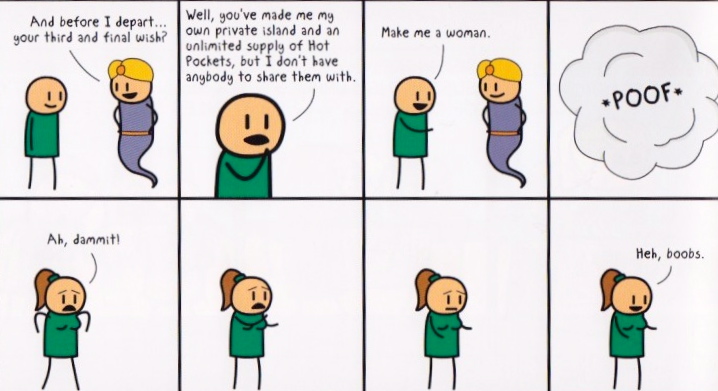
A Cyanide & Happiness cartoon collected in the 2010 book Ice Cream & Sadness:

An old joke, turning on an ambiguity in some double-object verbs: V NP1 NP2 interpretable either as benefactive (‘V NP2 for NP1’ — e.g. ‘make a woman for me’) or with some other argument structure (in this case, ‘make NP1 into NP2’, here ‘make me into a woman’). Another classic version: call me a taxi ‘call a taxi for me’ (benefactive) or ‘say that I’m a taxi’ (other: ‘say that NP1 is a NP2′)’.

[Added 4/10/13: There’s a gay version of the Cyanide joke, with the readings reversed. Someone tells a gay man that they can make him a man, meaning make him into a *real* (i.e. straight) man, but he takes them to be saying that they can make a man for him. There are several variants.]


eggs over easily

April 3, 2013

Today’s Bizarro:

The expression needs an adverb, right? Easy is an adjective, right? So eggs over easy is wrong-wrong-wrong; it has to be eggs over easily.

Well easy is indeed an adjective, a lot of the time; but it’s also an adverb. And in any case over easy (as a postmodifier of eggs) is an idiom, one of many involving easy used as an adverb; idioms are as they are, even if (like, say, by and large) they violate otherwise general principles of English syntax.

(more…)

Cyanide and Happiness roundup

March 24, 2013

Five strips from the webcomic Cyanide and Happiness, with various points of linguistic interest (some incidental to the humor of the strip).

(more…)

Fun with domain names

March 16, 2013

From Doug Harris in e-mail recently:

I had occasion, yesterday, to seek the owner of the internet’s top-level domain name .ck. When I googled it, I was pointed to, among other info sources, that of Wikipedia. We — you, I and a lot of others — never cease to be amazed how many people have way too much time on their hands, and find all sorts of silly ways to use it
It’s the domain name for the Cook Islands, and it’s lent itself to some playfulness.
(more…)

Another split antecedent dangler

March 13, 2013

Back in January I looked at a racy dangler in final position in its clause, where the referent for the missing subject was picked up from a combination of the subject of the clause and an oblique object in the clause; the antecedent was split between two different elements in the clause. Now this morning in a KQED Perspectives column by Steven Moss (“Transformation”), another split-antecedent dangler, less racy and now in clause-initial position.

(more…)

More sexual terminology

March 10, 2013

(Very high sexual content. You have been warned.)

In e-mail yesterday, an ad for the Cocky Boys gay porn video Creampie Surprise. Creampie is a compound noun in which the first element, cream, refers to semen (a fairly common metaphor). The whole thing is an allusion to the foodstuff known as a cream pie, but with a different, and decidedy sexual, meaning. (As far as I can tell, the food compound is always spelled separated, and the sexual compound always spelled solid, so that they’re distinguished visually, though they’re pronounced the same.)

(more…)

NomPrepObj

February 20, 2013

A fresh example of a nominative object of a preposition, noticed by Wilson Gray in the NYT opinion blogs (“The Two Julias” by Candice Shy Hooper on the 14th):

Jule must have wondered at a world in which any other slave in the South but she could find freedom in General Grant’s camp.

Wilson tried to attribute this error to a computer glitch, finding it hard to credit in otherwise literate prose. But of course it’s an error of nervous cluelessness (as Mark Liberman and Geoff Pullum have labeled it on Language Log), a type of hypercorrection that depends on a confusion between grammatical categories — in this case, preposition but (which takes an accusative object) and conjunction but (which combines with a clause, with nominative subject).

(more…)

In a syntactic quandary

February 9, 2013

An abstract I have submitted for the 2013 Stanford Semantics Fest (on March 18th). The abstract is quite compressed; it had to fit in a single page of text.

(more…)

laughing out loudly

February 4, 2013

The German correspondent of “Another invented rule” writes with another teacher-inspired query, going back to when he was a senior in high school. His story (lightly edited):

I had an English teacher back then, who abhorred (still abhors) AmE, and preferred BrE. He is neither American nor is he British. He’s German. According to him, Americans cannot speak English.

One day, we were asked to write a letter. We had to create a story of two people who are pen pals and who love sharing each other’s everyday stories.

I made up a story, wrote it down, and in one line I had written.. I was laughing out loud….

After a few days we got our homework back. What struck me the most was that he had marked laughing out loud as a mistake. Above, he he had written laughing out loudly.

Now that I’ve checked on the Corpus of Contemporary American English, there is no entry with an -ly ending. But when I type laugh out loud, I get many results.

My question for you is : Was my teacher correct? If not, why is it wrong to say “laughing out loudly”?

High marks to my correspondent for checking COCA, rather than relying on raw googling, since web searches will yield a respectable number of instances of laughing out loudly (and even a few of laughing aloudly), though these are wildly outnumbered by the standard English (Br or Am) laughing out loud.

(more…)