Archive for the ‘Syntax’ Category

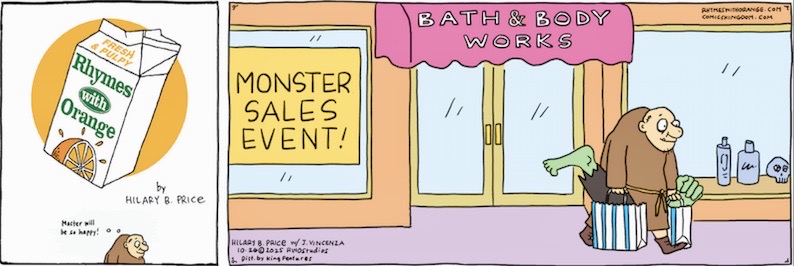
A monster sale at Bath and Body World

October 26, 2025

In today’s Rhymes With Orange strip, a sale at Bath and Body World:


A sale of body parts from and/or for monsters — not what comes to mind when you come across the N + N compound monster sale, which is a dauntingly large sale, one that’s (metaphorically) a monster

Now the details.

(more…)

An armed gunman

September 29, 2025

From John McIntyre on Facebook today:

— JM: Today’s Pleonasm Award goes to outlets that referred to Thomas Jacob Sanford, who attacked the Mormon church in Michigan, as an armed gunman.

(more…)

I also am of the ursine persuasion

September 18, 2025

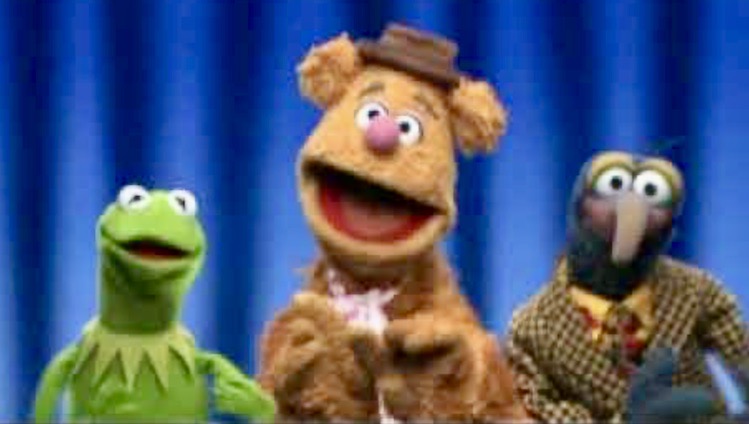
Encountered in going through stuff on Facebook: the episode “Fozzie encounters a bit of a language barrier” from “Rocky Mountain Holiday”, a 1983 Muppet special; in the episode, Fozzie Bear describes himself to Gonzo (a character of ambiguous species) following on reports of a bear in their vicinity:

Have you not noticed that I also am of the ursine persuasion … I’m a bear too and I speak fluent bearish

A huge ferocious bear appears, the main characters flee to Kermit the Frog, and Fozzie explains:

Gonzo! Gonzo! Just a slight dialect problem … she speaks Grizzly and I only speak Paddington

You can watch the episode on YouTube here.

(Nice ellipsis of the BEAR in grizzly bear (the name of a type of bear) and Paddington Bear (the proper name, on the pattern of FN + LN, roughly like Stanford Linguist) of a fictional bear, discovered in London’s Paddington Station), as if they were structurally parallel.

The principal characters:


Kermit, Fozzie, and Gonzo

(more…)

The craft of writing

August 29, 2025

The backdrop: yesterday’s posting “Days of grief and anger”. Lise Menn’s comment on it:

— LM: Wonderful writing; may the message reach some new ears.

And my response:

— AZ >LM: Thank you; I hope so. As for the writing, that took hours, of revisions ranging from the minute to the global, with a lot of weeping, but stoked by rage that had to be crafted to present itself as an passionate outpouring of spontaneous feeling, complete with an urgent comma splice. So it pleases me to have it my craft recognized and appreciated; I’ve been working on it for almost 75 years now, but here it’s crucial that I not come off like a splenetic geezer.

Yes, I was a kid 75 years ago, and I was already honing my craft as a professional writer and editor, going on to edit my high school newspaper (and write a humor column for it), finally getting paid for my writing at the age of 17, when I began four years of work at the Reading (PA) Eagle newspaper (one of the jobs that got me through Princeton). All those years later I’m writing, every day of the year, essays — academic entertainments, as I think of them — for this blog.

I am a facile writer — first drafts are a lot of fun — and I have plenty of material to work with, but most of the work of writing is revising, rewriting, reframing, polishing, and editing. It can take stunning amounts of time.

So now I bring you two writing stories, the first about Geoff Pullum and me, writing a one-page abstract on Auxiliary Reduction in English for a 1997 Linguistic Society of America conference paper, an abstract offered to the program committee at the time; the second about E. B. White, writing a single paragraph for William Shawn (the New Yorker editor from 1952 through 1987) on the 1969 moon landing. Pullum & Zwicky had 25 versions labeled as drafts, with of course an enormous amount of churn during each of those revisions (and still at least one typo survived in the published version); White’s piece had 6 versions labeled as drafts, with, again, lots of churn during each revision (but at least the magazine’s staff ensured that the published version was flawless).

(more…)

lx and g&s

August 6, 2025

(Not lox and Gilbert & Sullivan, though that’s a charming idea for a matinee; I’d prefer to think of lx (linguistics) and g&s (gender and sexuality studies) as two gay linguists, Lex and Gus, who go together like, oh, politics and poker (from Act I of the 1959 Broadway musical Fiorello!) — or, more relevantly, like mind and body)

A non-academic friend, new to my net presence, wondered what the things I said my blog is mostly about — lx and g&s — have to do with one another. My immediate, overly glib, reply:

Nothing intrinsic, but they happen to come together in me, along with gardening, Sacred Harp singing, an interest in food and cooking, Mozart and Haydn, and more. Various accidents of history and outgrowths of different parts of my make-up.

Strictly true, but in fact my postings about lx tend to have a lot of g&s content, and my postings about g&s very often end up illustrating points of lx. And sometimes they meld together — as in my recent (from 7/26/25) posting “F-lexicography”, on the semantics of the sexual verb fuck.

So now a quick visit to Lex and Gus’s world, just picking out things from here and there in work by me and my colleagues. Not a systematic survey, just the odd snapshots.

(more…)

Comma, comma, comma chameleon

August 3, 2025

Yesterday on Facebook, Michael Israel re-posted an item from The Oxford Comma site (showing the cover of an old issue of Tails pet magazine), with the (in this context) foolish advice “Use the Oxford comma, folks”:

(more…)

F-lexicography: the guest posting

August 2, 2025

What follows is a response to my 7/26 posting “F-lexicography, in which I wrote, combatively (and, as it turns out, not entirely accurately):

I argue that the OED treatment of the semantics of the sexual verb fuck is unsatisfactory, not compatible with the actual usage of English speakers for a long time now — apparently because earlier lexicographers, embracing normative views of sexual behavior, posited a single sense of sexual fuck, centrally denoting an agentive act of penis-in-vagina intercourse but with a large penumbra of vagueness, embracing many other sorts of sexual encounters. Then this inadequate treatment was adopted without comment or critique in Jesse Sheidlower’s The F Word. So that essentially all the authoritative literature on sexual fuck gets things wrong.

What follows is not the scorched-earth savagery that I would have expected from some of my colleagues, but a calm, thoughtful, and clarifying response from JS, which I reproduce here almost untouched, as a guest posting from him. I have some brief reflective words of my own afterwards.

(To properly appreciate much of what follows, you would really need to look at the (often technical) material reproduced in my 7/26 posting — admittedly, enlivened by a fair number of raunchy real-life citations, but still essays on technical syntax, semantics, and pragmatics. Not, I think, impenetrable, but also not especially reader-friendly.)

I had intended to go on to celebrate JS’s character — in particular, as shown in his response, but also more generally — and to situate him in a larger academic and personal context. But recent days have been medically perilous for me, so I’m settling for the bare bones right now, with a promissory note to get on with the rest of the picture later, painting in the humanity.

JS’s response, in between the lines:

(more…)
Visual negations

July 3, 2025

This morning on Facebook, Otto Santa Ana added a temporary profile picture:


The X NO KINGS signage, taking us into the territory of  “double negation”, since both the X and the NO of NO KINGS convey a variety of negation, namely prohibition

(more…)

The chronicler of lives

June 28, 2025

From  6/19 on Facebook, an exchange between Aaron Broadwell and me (somewhat expanded in this version):

— AB > AZ: Arnold, I wonder if you knew Miriam Petruck, who died about two months ago. [with the link below:]

Linguist List 36.1873, 6/17/25, “In Memoriam Miriam R.L. Petruck (1952-2025)”: by Hans C. Boas, dated 6/14/25

[beginning:] Dr. Petruck was born April 11, 1952. She received her B.A. in Linguistics from Stony Brook University in New York in 1972 and her M.A. in Linguistics from the University of California, Berkeley, in 1976. In 1986, she received her Ph.D. in Linguistics from the University of California, Berkeley, with Prof. Charles J. Fillmore as the head of her dissertation committee. Her dissertation on Hebrew body-part metaphors combined two of her lifelong interests, the scientific study of the Hebrew language and Cognitive Linguistics. Her dissertation was the first one to apply Frame Semantics to linguistic analysis. She became involved in the major research projects which Prof. Fillmore and his colleague Prof. Paul Kay undertook in the 1990s, developing the twin theories of Frame Semantics and Construction Grammar. She participated in the discussions leading to the creation of the FrameNet project (the practical implementation of Frame Semantics) in 1997, helping to define frames and to annotate some of the data in the FrameNet database.

For the rest of her life, she continued to publish and speak about both theories (particularly about Frame Semantics and its application to NLP), at conferences and seminars around the world.

— AZ > AB: I did indeed. Through my regular association with the Berkeley Linguistics Society in the old days. The death notice by Hans Boas on Linguist List focused on her position as a kind of international ambassador for FrameNet.

(more…)

Everyone’s a crinoid nowadays

June 9, 2025

We filter stuff flowing past us, consider this material, and evaluate its worth. As here:


(#1) Neocrinus, a stalked living crinoid species similar to those found in the Paleozoic (from Brian N. Tissot’s website, “Curious Creatures of the California Coast: Crinoids”, from 12/31/13); from Wikipedia:

Crinoids are marine invertebrates that make up the class Crinoidea. Crinoids that remain attached to the sea floor by a stalk in their adult form are commonly called sea lilies, while the unstalked forms, called feather stars or comatulids, are members of the largest crinoid order, Comatulida. Crinoids are echinoderms in the phylum Echinodermata, which also includes the starfish, brittle stars, sea urchins and sea cucumbers.

… Crinoids are passive suspension feeders, filtering plankton and small particles of detritus from the sea water flowing past them with their feather-like arms.

Oh, not crinoid, silly man; on Facebook, commenting on my posting from yesterday, “Today’s  bilingual jest”, Gadi Niram seemed to think it was clitic, but that was just a joke; really, the saying is that everyone’s a critic nowadays (or some similar piece of wisdom about the prevalence of unfavorable opinions coming from all quarters).

(more…)