Einstein was born in Germany and lived there as a child. By the time he died, he’d renounced his German citizenship and acquired two other citizenships, first Swiss and then American, which he kept throughout his life. So it’s not at all easy to describe his nationality. (I’m on this case because of the Swiss part of the story, of course.)
Archive for the ‘Switzerland and Swiss things’ Category
Nationality: the case of Albert Einstein
December 18, 2018The Swiss diaspora: Steinlen in Montmartre
December 18, 2018From Wikipedia:
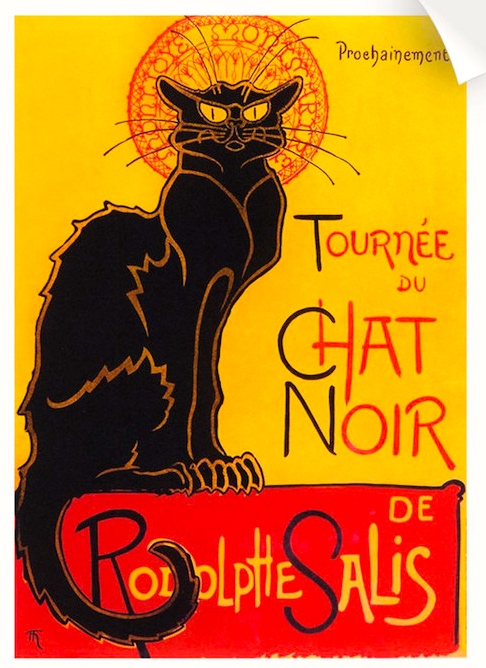
(#1) Steinlen poster of 1896 advertising the Montmartre cabaret Le Chat Noir
Théophile Alexandre Steinlen (November 10, 1859 – December 13, 1923), was a Swiss-born French Art Nouveau painter and printmaker. Born in Lausanne [in Canton Vaud in Francophone Switzerland], Steinlen studied at the University of Lausanne before taking a job as a designer trainee at a textile mill in Mulhouse in eastern France.
He then found his spot, the place that suited him in life: the Montmartre district of Paris.
And became Swiss French (in the narrow sense): a French person who emigrated from Switzerland. Narrowly Swiss French, in the way that distinguished 19th-century scientist Louis Agassiz was narrowly Swiss American: from my 2/7/13 posting “Swiss American”:
Agassiz was Swiss American in the narrow sense; he emigrated from Neuchâtel (in Francophone Switzerland) to Boston and took American citizenship.
Four Swiss rolls
December 17, 2018My pursuit of Swiss X, for various nouns X, continues with four Swiss roll chapters, starting with a cake roulade and going on to a rolled hair style; roll short for bread roll; and roll short for roll-up (referring to a bread roulade).
Bonus: the cake roulade is appropriate to the season, since a Yule log or bûche de Noël is one, just dressed up for Christmas.
Regionally ambivalent Switzerland
December 15, 2018Another chapter in the delineation of regions (areas, territories) — there’s a Region-talk Page on this blog listing my postings on the topic — prompted by my coming across various sites referring to Switzerland as a central European country. I was puzzled: Poland, the Czech Republic, Slovakia, Hungary, maybe Austria, ok, but Switzerland? If Switzerland is in central Europe, what’s in western Europe?
The answer is: not much. France, Belgium, the Netherlands, the UK, maybe Luxembourg. Having a coastline on the North Sea seems to be a necessary condition, but not a significant one: Denmark, Norway, and Sweden count as northern European (or Scandinavian), and Germany as central European. Whoa, Germany is in central Europe? What happened to the western European alliance, with the UK, France, and Germany as its major elements?
It’s a now-familiar story: different categories are delineated for different sociocultural — or other — purposes, with many transitional zones (lacking clear boundaries) and with political boundaries standing in, faute de mieux, for actual boundaries, though the categories cut across and subdivide political units.
News for bears: cities of bears
December 8, 2018On the 5th here, postings on the patron saint of bears and on Swiss saintly dogs (with a bow to the city of Bern(e)). Now: more on Bern; on the movie BearCity; and on two California cities of bears, Big Bear City in San Bernardino County and Los Osos in San Luis Obispo County.
News for (massive) dogs: St. Bernard of Menthon
December 5, 2018It’s about the lives of the saints (like some other recent postings); it’s about Switzerland (for some value of Switzerland); and it’s about dogs, really big dogs. St. Bernard of Montjoux, and the dog named after his 11th-century refuge for travelers in the Alps.
Nur in der Schweiz
December 2, 2018A report from Amanda Walker, one of our corresondents in Zürich, with news of a seasonal product promotion at McDonald’s. It’s gooey cheese time again!
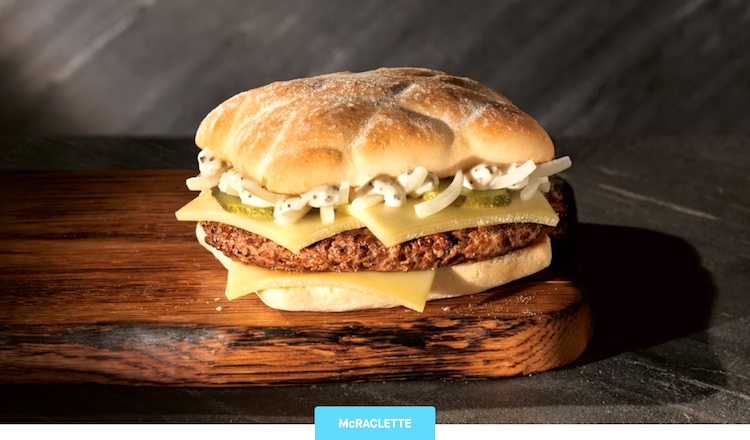
(#1) “Der McRaclette ist zurück … Das gibt’s auch nur in der Schweiz”
It’s back, and available only in Switzerland.
Swiss Tasmania
November 29, 2018The raw material: a poster on Pinterest, which led to photos of a quaint village:

(#1) Mt. Ida and Lake St. Clair, in the highlands of central Tasmania

(#2) The faux-Swiss village of Grindelwald, near Launceston, TAS
On the Swiss poster patrol
November 27, 2018… from a hundred years ago. Two items that popped up on Pinterest a while back after I posted about things Swiss:

(#1) Pilatus Railway poster (unknown artist for Burlingham Travel Pictures, 1918)

(#2) Swiss military “Flag Guard” poster from 1914, the year the Great War began
Wisc Swiss music
November 20, 2018From Joe Salmons on Facebook a few days ago, this arresting photo of celebratory alpenhorns indoors:
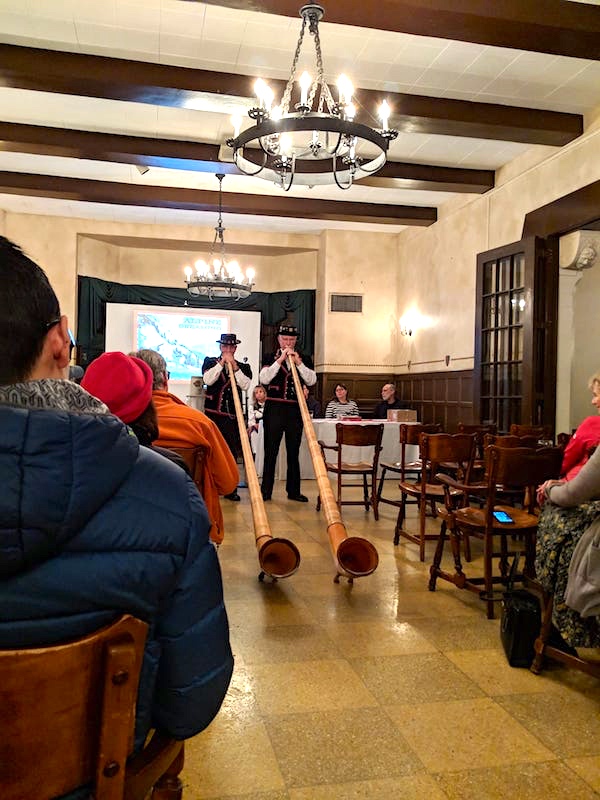 (#1)
(#1)
Two things: the occasion and the instruments.