Archive for the ‘Spelling’ Category

Child spelling

January 16, 2011

… and the mechanical conventions of writing.

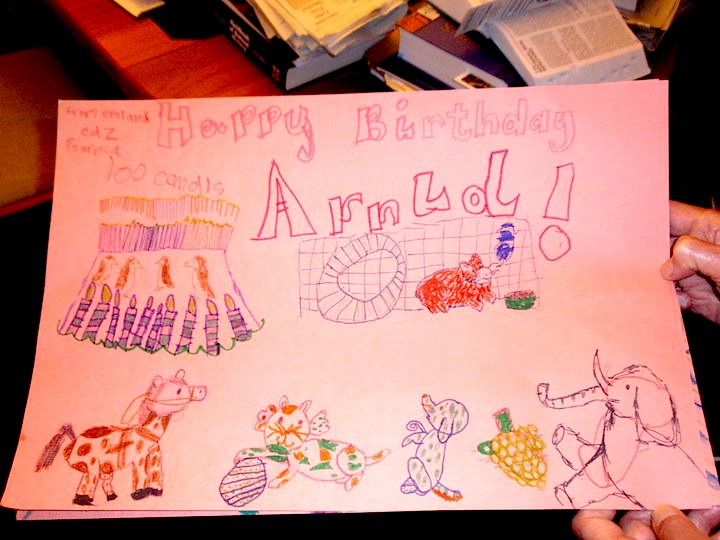
Exhibit A, a drawing that my grand-daughter Opal made for me on the occasion of my 70th birthday, back in September:

(Those are 100 candles, because Opal didn’t think 70 were enough.)

The point is the carefully outlined spelling of my name: ARNLD.

(more…)

Internet writing rant

January 3, 2011

A way-over-the-top rant on internet writing, here (hat tip to Bruce Webster):

Hey, Y R U Not Paying Attention?

Strong language warning, but it’s all in a good cause. Besides, you probably need this or know someone who does.

The long text begins:

Y, R & U
ARE FUCKING
LETTERS
NOT FUCKING WORDS

and goes on to bitch about texting abbreviations, apostrophe misuse, comma misuse, and common misspellings. I’m not able to post the thing here, because the resolution of the image is too poor, but you can enjoy the version on the American Digest site.

I write PRINCIPLE you write PRINCIPAL

December 25, 2010

From “E.P.A. Challenges Texas Over Rules on Emissions” (NYT December 23):

The regulations will in principal curb emissions by requiring plans to use the best available technology to control them.

Yes, yes, that should be PRINCIPLE, not PRINCIPAL (and it’s been corrected in the on-line version). One of the most common spelling errors in English, in both directions. (When I served on boards at granting agencies, we used to get huge numbers of grant proposals listing PRINCIPLE INVESTIGATOR(S), to the point where I had colleagues who half-seriously suggested that such proposals should be summarily rejected for spelling errors. Surely a disproportionate punishment.)

PRINCIPAL/PRINCIPLE is one of those irritating details of English orthography that in fact makes no effective difference in comprehensibility but is maintained through a fetish for correctness — there are a number of these — and elicits orthographic rage from some people, who feel that if we “give way” on these points then we’re on the slide to chaos and the death of the language: according to them, it’s our duty to chide and punish those who violate the orthographic canon (especially those who “ought to know better”, like writers and editors on the NYT).

As I’ve said many times, the deep sadness of these attitudes lies in their focus on things of absolutely no consequence at the cost of attention to genuinely consequential matters.

Yes, I noticed the spelling in the Times, but to tell the truth, I don’t fuckin’ care.

Data points: Faith vs. WF 12/1/10

December 1, 2010

Michael Pollan and Eric Schlosser, in an op-ed piece (“A Stale Food Fight”) in the November 29 NYT, about the FDA Food Safety Modernization Bill now under consideration in the U.S. Congress:

… the bill is under fierce attack from critics — egged on by Glenn Beck and various Tea Partyers, including some in the local food movement — who are playing fast and loose with the facts.

First point: Tea Partyers (with a Y) rather than Tea Partiers. Second point: the NYT‘s rendering of the bill’s name as “the F.D.A. Food Safety Modernization bill”, with periods in F.D.A. that are not in the bill’s name. Two different kinds of conflict between faithfulness (Faith) and well-formedness (WF) — see the inventory of postings here — resolved in two different ways: in favor of Faith in the first case, WF in the second.

(more…)

Alphabets

November 27, 2010

In the NYT today, a story (by Elisabeth Malkin) about the Spanish Academy’s forthcoming spelling reforms and the reactions worldwide to them, focusing especially on objections from Spanish-speaking nations in the Americas to what is seen a dictate coming from abroad (headline: Rebelling Against Spain, This Time With Words). And a certain amount of silliness over one much-discussed aspect of the reforms, the elimination of CH and LL as separate letters of the alphabet, with Hugo Chavez of Venezuela weighing in on the issue:

If the academy no longer considers “ch” a separate letter, Mr. Chávez chortled to his cabinet, then he would henceforth be known simply as “Ávez.” (In fact, his name will stay the same, though his place in the alphabetic order will change, because “ch” used to be the letter after “c.”)

The elimination of the digraphs CH and LL as letters of the alphabet won’t change the spelling of any word, just the order of words in alphabetic lists — though that will entail a massive re-working of dictionaries (for new editions) and armies of copyeditors to ensure consistency in them and in other alphabetical lists. (Other reforms will entail re-spellings.)

Here’s the current Spanish alphabet, with 29 letters:

The revision will reduce the number of letters to 27; palatal Ñ will remain a separate letter.

For contrast, look at the current Welsh alphabet, with 28 letters:

Here there are plenty of digraphs — CH DD FF NG LL PH RH and TH — most of them representing “mutated” forms of basic phonemes; CH, for instance, represents the fricative /x/, a mutation of /k/. (One exception is FF, which represents /f/; the letter F represents /v/.)

The letters K Q V X and Z from the Latin alphabet are not used, since there are other spellings for borrowed words that have these letters in their spellings in source languages; for instance, K and CK from other languages, where they are pronounced with a /k/, are spelled with C, which represents /k/ in Welsh orthography, and PH from other languages, where it’s pronounced with /f/, is spelled with FF, as in FFÔN ‘phone’.

For consonants, the only real complexity is that there are two spellings for /f/: FF for a basic /f/ and PH for /f/ as a mutated form of /p/. (Vowels are another story.)

Actually, a pretty straightforward system, though it looks odd to people used to other spelling systems based on the Latin alphabet.
imposter vs. impostor

November 25, 2010

Maureen Dowd’s op-ed column in the NYT yesterday was headed

The Great Game Imposter

and later references to the Afghan man who passed himself off as a top Taliban commander used the spelling IMPOSTER. The day before, the headline in the news section went

Taliban Leader in Secret Talks Was an Impostor

and this front-page story used the spelling IMPOSTOR throughout.

The -ER spelling has appeared on Language Log, most notably in the title (and body) of a posting by Mark Liberman on 7/18/08:

Ranking fields by the difficulty of imposter detection (link)

(with comments addressing the spelling).

The facts are these: the -OR spelling is older, but the -ER spelling has been gaining on it, to the point where most current dictionaries give the -ER spelling as an alternative; both spellings are found in great numbers; but some people still consider the -ER spelling to be a mistake.

It was a bit of surprise to find the New York Times, which generally tries hard to enforce One Right Way, especially in mechanical matters, willing to let Dowd (or her editor) have the -ER spelling, and even to carry it over to the head.


Spectacular spelling fail

September 4, 2009

A Wisconsin highway sign, noted on The Smallest Minority site on July 30:

(under the heading “Guvernment Skools” and filed under “Education”). The company that made the sign quickly fixed it (the instructions to the company had everything spelled correctly).

The spectacular spelling fail — all three words on the main sign are misspelled — is, you will see, attributed to the school system; it’s framed as yet another symptom of the appalling decline in the quality of schooling. (Some of the comments also snipe at Wisconsinites.)

For some people, everything bad in language is the fault of the schools, or of young people, or both, and these opinions seem to be immune to facts. In the case at hand, there’s an obvious alternative hypothesis.

All three errors are letter inversions: IS for SI, IE for EI, EI for IE. This is just too perfect (well, too perfectly wrong). It’s what you see in the spelling of many dyslexics (I’ve had dyslexic students who spelled like this — very bright students, I hasten to add). If that’s the root cause, then we might wonder how a dyslexic came to be making up highway signs.

(Hat tip to Victor Steinbok.)

BlackBerrys and BlackBerrying

June 23, 2009

In the 22 June NYT, the story “At Meetings, It’s Mind Your BlackBerry or Mind Your Manners” (by Alex Williams) looks at smartphone use in meetings in the corporate and political worlds. Two points of note: the plural of the noun BlackBerry and the verbing of the word — together in this passage:

“You’ll have half the participants BlackBerrying each other as a submeeting, with a running commentary on the primary meeting,” Mr. Reines [Hillary Clinton adviser Philippe Reines] said. “BlackBerrys have become like cartoon thought bubbles.”

The article has BlackBerrys as the plural throughout. This is the plural spelling that is “faithful” to the base, by preserving the spelling BlackBerry. The alternative is to subject the base to the “change Y to I and add ES” rule that’s usual for pluralizing nouns spelled with a final Y following a consonant letter; that’s the “well-formed” version.

I’ve posted to Language Log many times on conflicts between Faith and WF. In fact, variation in the spelling of the plural for nouns with final Y — (rubber) ducky, Germany, Zwicky — was a topic in one of the earliest of these postings.

And there is variation here. Though the Times seems to have gone for Faith, other writers opt for WF, as on this site:

Wirefly’s 48 hour sale includes most BlackBerries for FREE (link)

Now, the verbing of BlackBerry. There are several senses of the verb out there, but the most frequent use seems to be as a “dative verb”, with its object understood as denoting the recipient of a communication (as in the quote above). Many have noted that as nouns denoting instruments or means of communication come into the language (in the course of technological innovation), they become immediately available as dative verbs; the point is made very clearly in Beth Levin’s 1993 book English Verb Classes and Alternations.

So we now have verbs bluetooth, skype (sometimes spelled with initial caps, sometimes not), text, IMS, etc. — and BlackBerry.

The question is then how to spell the PST/PSP forms of this verb. Again, there’s a conflict between Faith and WF. Both resolutions are attested: WF (with Y changed to I) in things like:

Thinking of Ben, I decided that he was the man to ask. He always had an answer to this sort of thing, so I BlackBerried him. (link)

but Faith (preserving the Y) in, for example:

Her frenetic yet motionless characters reflect the irony of BlackBerryed life: It only looks as if you’re busy. (link)

It occurred to me that if I said something live in person, it would not be as interesting to him as if I’d BlackBerryed him. It occurred to me that if I wanted to talk to him I’d have to BlackBerry him and say, “Please talk to me.” (quote from Peggy Noonan, blogged on here)

Wheelbarrows

June 6, 2009

A few days ago a Facebook poll appeared on “wheelbarrow” vs. “wheel barrel” (well, it’s spelled “barrell” in the poll). As it happens, “wheel barrel” was one of the earliest entries in the Eggcorn Database. 

When my vote was posted on my Facebook wall, commenters suggested jocular alternatives to “wheel barrel” — all of which (and others besides) turned out to be attested.

(more…)

Toons and tunes

May 15, 2009

At breakfast yesterday, my granddaughter Opal (aged 5) used the word tune in conversation, and I noted with some surprise that she said [tjun]. Surprise because these days around here, I would have expected [tun]; “yod-dropping” after alveolar consonants (including t d n) when they are in the same syllable is widespread  in “General American” and has been increasing for many years (though the details are very complex), despite mockery of pronunciations like “Toozday” in the media. Opal no doubt picked the yod up from her parents (and her mother, Elizabeth, from her mother, Ann; my usage is variable).

We moved on to the Warner Brothers series of animated comic short features (Bugs Bunny, Porky Pig, the Roadrunner, and so on), the name of which Opal pronounced as [luni tjunz], and she was quite firm about the yod. My visual recollection was that the second word was spelled TOONS (as in cartoons), though Elizabeth was sure that it was TUNES (sometimes misspelled TOONS, so that I might well have seen that spelling) — and since Opal is fond of some of these cartoons, especially the Roadrunner, Elizabeth had seen the LOONEY TUNES logo many times. Of course she was right.

Then it turned out that Opal had [tjun] in cartoon (where [tun] is standard) as well, quite possibly as a carryover from the tunes of Looney Tunes. We didn’t press a correction on her; little kids are resistant to explicit correction in such things, and Opal is especially resistant (well, obstinant).

(more…)