Archive for the ‘Lexical semantics’ Category
December 16, 2024
An invitation on Facebook on 12/13 from linguist Jennifer Arnold, performing her musical role (crucial phrase underlined):
If you like to sing, come to the Chapel Hill Messiah open sing tomorrow evening! I’ll be in the viola section.
My response:
I had a confused moment when I thought you’d be singing the praises of the Messiah of Chapel Hill (whoever he is; I’m woefully out of touch with things, and thought I must have missed the rise of a Prince of Peace in the New South).
(more…)
Posted in Ambiguity, Compounds, Constituency, Lexical semantics, Metaphor, Music, Semantics of compounds | 4 Comments »
December 2, 2024
🎄 🎄 when I began this posting, it was penultimate November, and this year also Black Friday, when the anticipation of Christmas becomes a constant, unremitting dinging, accompanied by exhortations to SHOP NOW; I held to my long-standing practice of not leaving the house on Black Friday for any purpose other than retrieving my mail from the mailboxes in the condo parking lot
Meanwhile:
 (#1)
(#1)
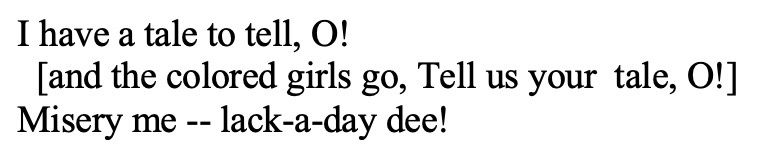
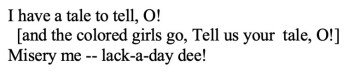
A tale of the jim-jams, the most acute form of the jams (joint and muscle afflictions), a story that began on Friday 11/22 with the jams, reached utter jim-jam misery on Monday 11/25, and then slowly moderated since then; but also a tale of plans gone utterly awry (lyrics above from “Walk on the wild guardsman side”)
(more…)
Posted in Holidays, Jokes, Language and food, Language and medicine, Lexical semantics, My life | 6 Comments »
November 28, 2024
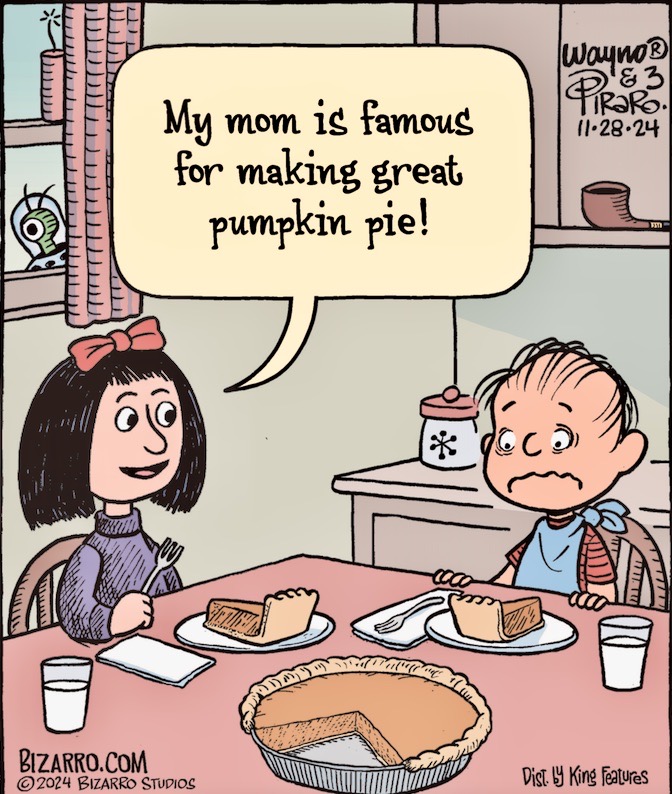
The Wayno Bizarro for today, 11/28, is an exercise in cartoon understanding:

(#1) Wayno’s title: “Horrifyingly Tasty”; I would have suggested the more bloodthirsty “Eat Your Gods” (if you’re puzzled by the odd symbols in the cartoon — Wayno says there are 3 in this strip — see this Page)
But it’s all totally baffling unless you recognize the references to Charles Schulz’s comic strip Peanuts; you really have to know about Linus and the Great Pumpkin. (Meanwhile, your appreciation of the strip will be enriched if you know that today is US Thanksgiving, a harvest festival for which the traditional foods include pumpkin pie for dessert.)
And while we’re talking festivals, the cartoon is a festival of ambiguities in English, structural and lexical.
(more…)
Posted in Ambiguity, Common & proper, Grammatical categories, Holidays, Language and food, Lexical semantics, Linguistics in the comics, Parsing, Understanding comics | 2 Comments »
November 27, 2024
(Men’s bodies and man-on-man sex, discussed bluntly, so not suitable for kids or the sexually modest)
On Pinterest this morning, this painting by Polish queer artist Wojciech Woś (now working in Berlin):
(more…)
Posted in Art, Color, Homosexuality, Language and the body, Language of sex, Language play, Lexical semantics, Male art, Phonetics, Polish, Spelling | Leave a Comment »
November 24, 2024
(There will be mentions — in vernacular but not actually vulgar terms — of male-male sexual practices that some will find icky, so this posting will not be to everyone’s taste; and it might stretch some kids’ horizons a bit, so a gentle warning)
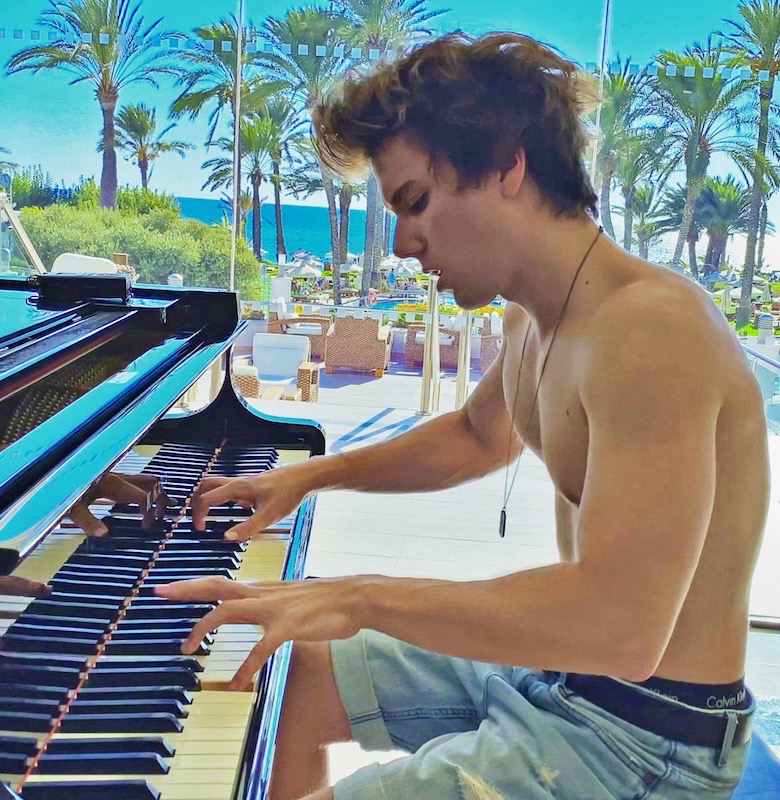
From back on 10/30, e-mail from Gadi Niram, with a video gift for me, saying: I found this video (and the young man in it) to be quite a pleasant diversion:

(#1) Screen shot from the video, which you can view here
A shirtless young man in ripped denim shorts playing the 3rd movement of Beethoven’s “Moonlight” Sonata (Piano Sonata No. 14 in C-sharp minor, Op. 27 No.2) on a fancy grand piano (with a mirrored fallboard, as in the finest piano lounges). alongside the pool at at what looks like a tropical oceanside resort. (For a bit of extra sexiness, those shorts are down far enough in the back to expose the waistband of his black Calvins; here the girls and the gay boys swoon.)
(more…)
Posted in Back formation, Compounds, Context, Conversion, Derivation, Language and the body, Language of medicine, Lexical semantics, Morphology, Music, Portmanteaus, Technical and ordinary language | 4 Comments »
November 22, 2024
(Well, consider the title if this posting, which tells you that it’s going to get into some vivid descriptions of sexual parts and sexual acts — plus a photo that’s just barely WordPressable — and you’ll see that it’s not suitable for kids or the sexually modest; and from here on, you’re going to get the C-word raw and unconcealed, but your enthusiasm for this dirty talk will probably be diminished when it turns out that this posting is mostly about lexical semantics)
(more…)
Posted in Address terms, Context, Dialects, Gay porn, Insults, Language and the body, Language change, Lexical semantics, Metaphor, Metonymy, Personification, Style and register, Taboo language and slurs, Variation | 6 Comments »
November 18, 2024
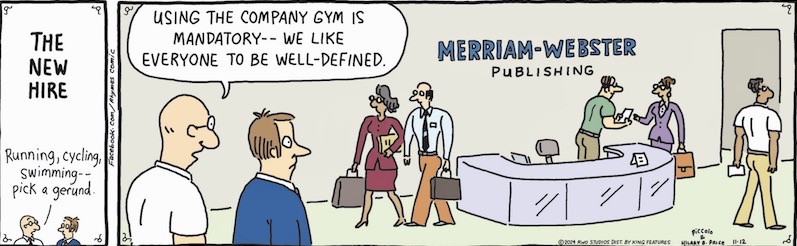
The 11/12 Piccolo / Price Rhymes With Orange strip takes us to the Merriam-Webster company gym, where the lexicographers get defined:
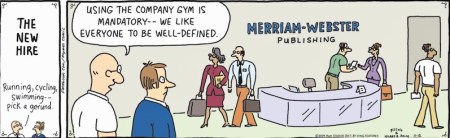
(#1) It’s pun day at the definition factory, with bodybuilders’ definition punning on lexicographers’ definition
Confronted with a pun strip, I’ll usually go on to cite definitions from NOAD (or similar sources) for the punning expression and its model, and I’ll do a version of that here, getting at the expression well-defined by starting from the verb define, going on to the adjective defined (modified by the degree adverbial well ‘thoroughly’ in well-defined), and then steaming on to the noun definition and the conceptually related verbs cut and shred.
But what I find on this little trip has nothing at all from the vocabulary of bodybuilding. Not in NOAD, where I start (because I can access this dictionary on my computer with a few keystrokes); not in the OED (no surprise; its on-line version for this vocabulary is still antique); not — oh wonderful irony — in the on-line Merriam-Webster; not in AHD5; and not (to my astonishment) in GDoS. So for the bodybuilding vocabulary, I’ve cobbled together definitions from various bodybuilding sources. But apparently bodybuilding is so esoteric a world that its vocabulary has not yet reached mainstream lexicography. (A surprise to me. I’m not part of the bodybuilding world, but I have, yes, bodybuilder friends, also friends who are into bodybuilding competitions, and friends who have a taste for bodybuilders; and meanwhile, the gay male world and the world of physique magazines have long been intertwined, so I’m familiar with the bodybuilding world.)
(more…)
Posted in Homosexuality, Language and the body, Lexical semantics, Linguistics in the comics, Linguists, Puns, Sociolinguistics | Leave a Comment »
October 31, 2024
🐅 🐅 🐅 three tigers for ultimate October, aka Halloween; by the pricking of my fingers, something wicked this way lingers
Specifically, my fingers pricked out the name Anold for Arnold a little while ago, as they do with regrettable regularity (Gorgo finger not work right), but this time it was in a link on Facebook to this blog, so not self-correcting. But George V. Reilly caught the error and pointed it out to me, so that I could fix it. And then today, I had an inspiration, which I posted as a response (somewhat revised here) to George:
— AMZ > GVR: It has occurred to me to take up Anold the anold as another identity. The anold is a brightly colored arboreal lizard — a type of anole — in its rare and precious Swiss variant. Characterized by its curiosity (in several senses — “Look, Bruce, what a curious lizard!”) and its remarkable, um, snout.
This is the anold’s organ sometimes known jocularly as a Swiss nose. All noses are phallic, but some are considerably more phallic than others. (A lexical note on the noun snout, from NOAD: ‘the projecting nose and mouth of an animal, especially a mammal’.)
Meanwhile, while noses and snouts are phallic symbols, lizards (and dinosaurs and dragons) as wholes are much more impressively so. From GDoS on the noun lizard:
7 (Aus./US) the penis [1st cite 1969], with phrases meaning ‘to urinate’: bleed / drain / flog / squeeze the lizard; and phrases meaning ‘to masturbate’: bleed / gallop / pet the lizard and choke / stroke / whip one’s lizard
So now we’re deep into phallicity. Well, it’s my blog. Phallicity happens.
(more…)
Posted in Holidays, Language and animals, Language and the law, Lexical semantics, Phallicity, Signs and symbols, Switzerland and Swiss things, Typos | 3 Comments »
October 30, 2024
(Publicity for a gay porn video, entertaining in its way but absolutely off-limits for kids and the sexually modest)
🎃 🎃 🎃 three jack-o’-lanterns for penultimate October, Halloween Eve (that is, the day before the day before the day of the dead) — in my house, the day when the pussyboys go out to seek their phallic prey
Into this scene comes this morning’s e-mail from the Falcon | NakedSword Store, offering:
Hot House movie download discounts — full movies $11.95 each
With, right at the top, the crudely pun-titled video Swim Meat and its cover illustration, offering four fine pieces of swim meat, one (Johnny V’s) just barely concealed by his swimwear; plus three proudly jutting tubesteaks that I’ve had to suppress for WordPress modesty (but here you can view the uncensored cover, along with the publicity text):
(more…)
Posted in Compounds, Discourse organization, Gay porn, Holidays, Hyperbole, Language and the body, Language of sex, Language play, Lexical semantics, Metaphor, Puns, Semantics of compounds, Style and register, Taboo language and slurs | 1 Comment »
October 21, 2024
A fallout from my 10/17 posting “An underwater Psychiatrist cartoon” (“all about the noun favorite: an implicit superlative, denoting a top-ranking element in some comparison set”), this e-mail from my old friend Benita Bendon Campbell this morning:
the word favoris in French, as you probably know, means ‘sideburns’ and I can’t imagine why
Bonnie, who’s had a long career as a teacher of French, tends to assume that my command of that language is vastly greater than it actually is — a kindly person would say that my knowledge of French is spotty — but in this case, yes, I had a dim recollection of this odd fact, mostly because favoris ‘sideburns’ got borrowed into (British) English, where it enjoyed a brief fashion in the 19th century. Summarized from OED (1972) under the noun favourite, with a colorful cite from Benjamin Disraeli (the British novelist and Prime Minister):
noun favori ‘sideburn’ (usually in plural); 3 19th-century British examples (Disraeli from 1831: His beard, his mustachios, his whiskers, his favoris.) Etymology: a borrowing from French.
So it’s into French that we must go.
(more…)
Posted in Art, French, Language and the body, Lexical semantics, Slang | 2 Comments »