Archive for the ‘Lexical semantics’ Category

Taking Goat to lunch

November 15, 2025

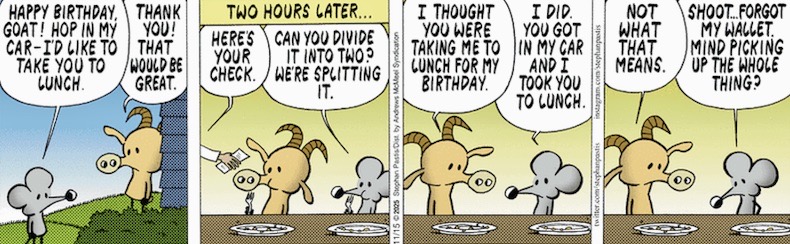
Today’s Pearls Before Swine, in which Rat lives up to his name:


The crucial point: take you to lunch in the context of birthday greetings to Goat — in this context, clearly an instance of the phrasal idiom I’ll label take someone to (‘host someone at (an event), treat someone to (an event)’), and so understood by Goat (and, I think, by all readers of this strip); but then, in a kind of lexicographic bait and switch, Rat maintains that he meant only the caused-motion verb take (‘convey something to (an event at) some place’) and takes no responsibility for paying for the occasion

Then, in an appendix to this main discussion, I expose my bafflement at the treatment of the phrasal idiom take someone to in dictionaries: I can’t find one that lists it (while treat someone to is well covered).

(more…)

Gods and tables

November 10, 2025

In e-mail from Tony Velasquez on 11/8:

your 11/7 blog post about category errors and the potential for making jokes with them … reminded me of something I’m reading, How God Becomes Real, by Tanya Luhrmann …, who argues that knowing  … that a god exists uses a different ontological attitude than knowing … that a table exists. She also points out that this attitude toward the spiritual has a lot of affinity with the sort of ontological attitude taken in play. It’s interesting to me to think that the attitude toward category errors you take that leads you to create jokes is opposed to a very different attitude to what could be called the category error, on Luhrmann’s thinking, that spiritual beings are real in the same sense that tables are real — an attitude that, instead of leading to play or jokes, often leads to violence and war.

(more…)

poetite

November 2, 2025

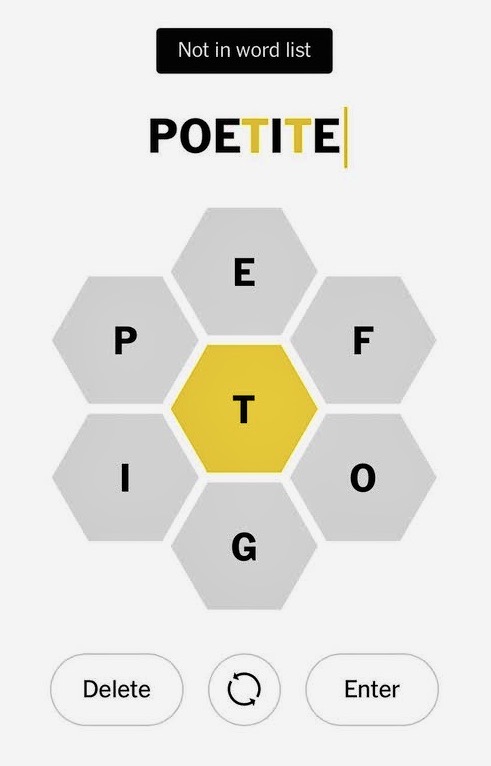
Faced with this judgment on Facebook today about the Spelling Bee puzzle from the New York Times,


(#1) POETITE: not a word (in the Spelling Bee dictionary)

Dennis Baron owlishly protested with word play incorporating a pun on concrete:

It’s the stuff concrete poems are made from.

Well played, Dennis!

(more…)

A monster sale at Bath and Body World

October 26, 2025

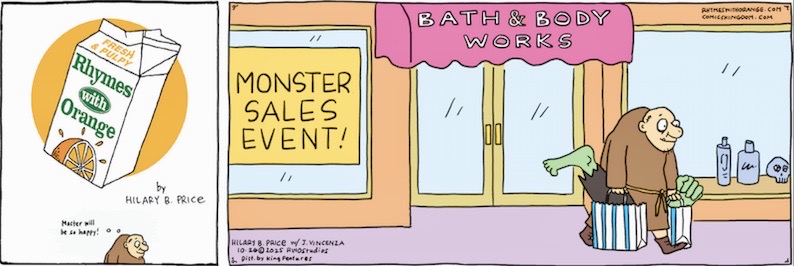
In today’s Rhymes With Orange strip, a sale at Bath and Body World:


A sale of body parts from and/or for monsters — not what comes to mind when you come across the N + N compound monster sale, which is a dauntingly large sale, one that’s (metaphorically) a monster

Now the details.

(more…)

Quiche, Henri, les flics!

October 21, 2025

Gretel Cunningham Young (of Columbus OH, where she grew up, with my daughter Elizabeth, many years ago) on Facebook yesterday:


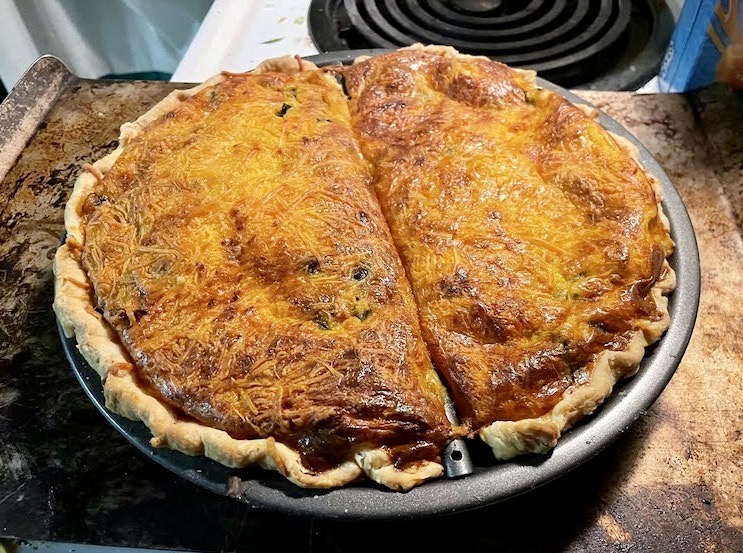
— GY: My goal was to make a half-vegetarian, half-carnivorous quiche, so I ordered this divided pan

Noting her reference to carnivorous quiche, plus an odd quirk in way English vegetarian is used, I reacted to her statement with some alarm (my response in an expanded and improved form here):

— AZ: But I don’t think I want to get near a carnivorous (‘meat-eating’) quiche, lest I be devoured by it. vegetarian quiche has the adjective vegetarian ‘(of food or diet), plant-based, excluding meat’, not the noun vegetarian ‘(of people) a vegevore, someone who eats only plant-based food; a non-carnivore, someone who does not eat meat’. A quiche that’s a vegetarian would not be a threat to me (as a being made of meat), but it would nevertheless be creepy, in a cannibalistic sort of way. The meaty correspondent to vegetarian quiche ‘quiche for vegetarians’ would be quiche for carnivores.

(more…)

The Pomeranian-nimbus

October 12, 2025

An Ellis Rosen cartoon that came by on Facebook recently:


(#1) The hybrid creature the pomeranian-nimbus, being taken for a walk, on a leash, by its owner — so being presented as an extraordinary dog, a cloud canine; note that the woman’s dog recognizes the p-n as a dog, and appears to want to play with it (see the wagging tail)

(The name of the dog breed is standardly capitalized, because it’s a proper name denoting a creature originating in the geographical region of Pomerania, and I’ll use Pomeranian from here on.)

The compound Pomeranian-nimbus is a copulative  N1 + N2 compound (like Swiss-American or hunter-gatherer), denoting a thing or things of both the N1 type and the N2 type.  But in fact the creature is not just a mix of Pomeranian dog and nimbus cloud, but is actually a nimbus Pomeranian ‘Pomeranian dog that is (also) a nimbus cloud’ (your standard N + N compound in English is semantically modifier + head) — rather than a Pomeranian nimbus ‘nimbus cloud that is also, or at least resembles, a Pomeranian dog’. A nimbus Pomeranian, or, more compactly, a nimbopomeranian, a nimpom for short.

(more…)

Graduated consonants

September 21, 2025

From Andrew Garrett on Facebook today:

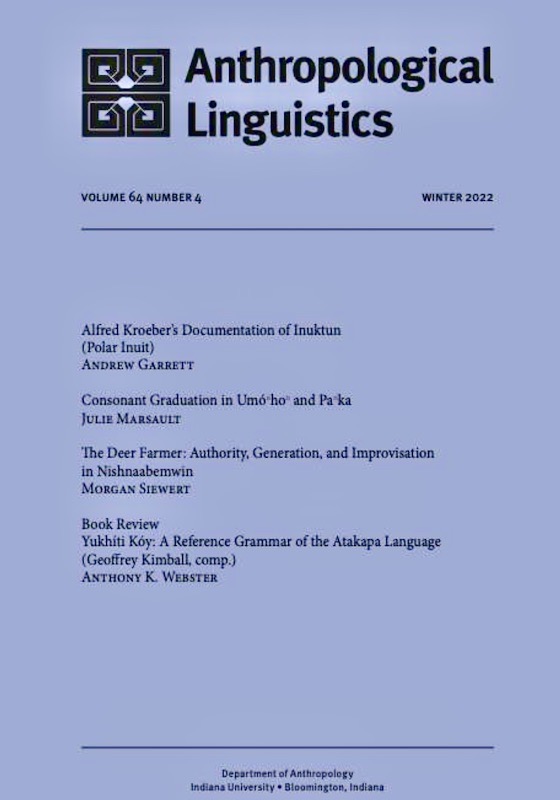
— AG: Glad to be in this (new, despite the ostensible date) issue of AL. The press perpetrated an amusing typo in Julie Marsault’s title:


(#1) Graduated consonants

I went right for the typo (quite likely to have been introduced by a spellchecker during the layout stage for the cover [but now see Michael Vnuk’s cogent critique of this idea, in his comment below]):

— AZ: Clearly, graduated consonants are like graduated pearls; they come in a series of sizes: bigger, louder, noisier. I can hear them now.

(more…)

The risks of pedantry

September 20, 2025

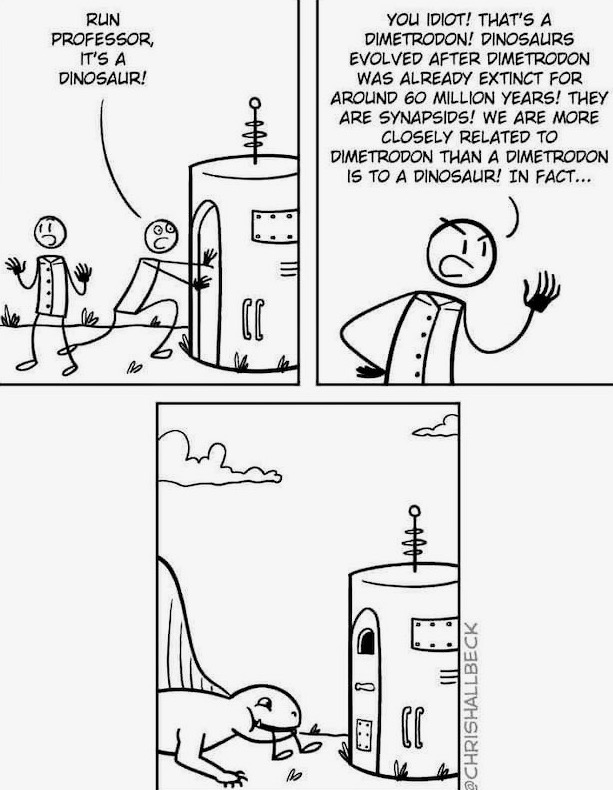
This Chris Hallbeck cartoon came by me on Facebook this morning — a strip packed with matters of science (paleontology, specifically), lexicography and usage (the senses of the noun dinosaur, and the contexts in which they’re used), and pragmatics (the way in which the noun is used in interactions, especially in language about language; in the enforcement of language norms; and, oh alas, in the relevance of things said to the interests of those participating in the speech context):


A Maximumble cartoon from 5/24/14, whose humor turns crucially on the pragmatic foolishness of the (now deceased) professor (in the face of a ravening monster, he stops to insist, irrelevantly in the context, that his companion must use the proper terminology, while the companion flees to safety); and which is based on the usage of the noun dinosaur — for a member of a clade of prehistoric reptiles bearing the zoological taxonomical label Dinosauria; versus, in non-technical American usage, for any dinosaurid creature, resembling the prototypical dinosaurs (many people have seen a family resemblance)

(more…)

I also am of the ursine persuasion

September 18, 2025

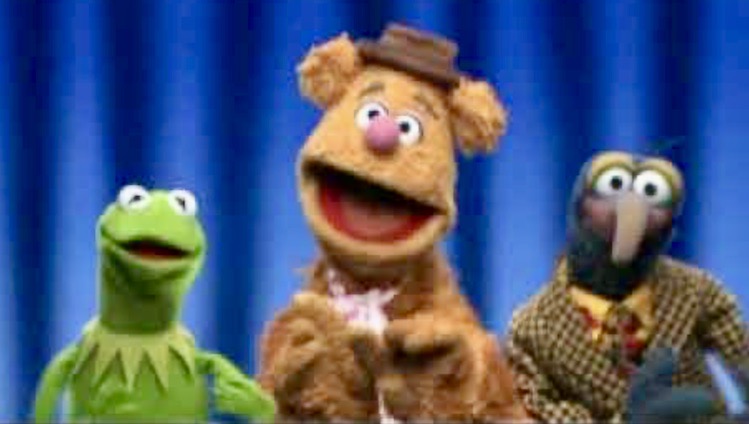
Encountered in going through stuff on Facebook: the episode “Fozzie encounters a bit of a language barrier” from “Rocky Mountain Holiday”, a 1983 Muppet special; in the episode, Fozzie Bear describes himself to Gonzo (a character of ambiguous species) following on reports of a bear in their vicinity:

Have you not noticed that I also am of the ursine persuasion … I’m a bear too and I speak fluent bearish

A huge ferocious bear appears, the main characters flee to Kermit the Frog, and Fozzie explains:

Gonzo! Gonzo! Just a slight dialect problem … she speaks Grizzly and I only speak Paddington

You can watch the episode on YouTube here.

(Nice ellipsis of the BEAR in grizzly bear (the name of a type of bear) and Paddington Bear (the proper name, on the pattern of FN + LN, roughly like Stanford Linguist) of a fictional bear, discovered in London’s Paddington Station), as if they were structurally parallel.

The principal characters:


Kermit, Fozzie, and Gonzo

(more…)

Putain ouais!

September 9, 2025

(Swearing in French, and English, so not to everyone’s taste)

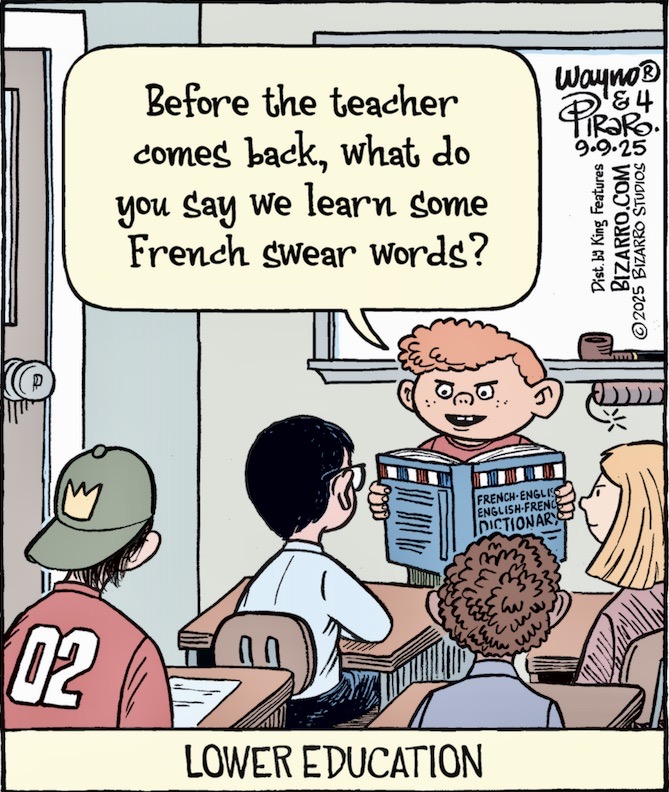
Today’s Bizarro strip, in which Wayno shows us what goes on in a lower education classroom:


MonkeyJack (as I’l call him) asks the question, expecting the answer, in chorus: Fuck, yeah! To which he will tell them all to shout it out the way he does, loud and clear: Putain ouais! (if you’re puzzled by the odd symbols in the cartoon — Wayno says there are 4 in this strip — see this Page)

But then there’s Wayno’s title, a play on higher education (sometimes known as tertiary or post-secondary ed): this semi-technical term has higher ‘closer to the high end, the top of something’ (of formal education here, so referring to university education); and it’s opposed to K-12 education, referring to school education, that is, primary and secondary ed. Though lower ‘closer to the low end, the bottom of something’ is the opposite of spatial higher, lower education seems rarely if ever used to refer to K-12 ed.

Then lower education becomes available for play, using one of the other senses of low. And if we’re going down there, might as well go raunchy, so we get low as a rough synonym of louche ‘disreputable, sordid’, the opposite of high ‘morally or culturally superior’ — and lower education, an education in the seamier side of things, in vulgarity, like swear words. And swear words in French, ’cause everyone knows everything’s dirtier in French.

And that’s today’s quick linguistic joke. Meanwhile, life has been amazing in some ways (people said the most wonderful things about me on my 85th birthday) but almost unmanageably difficult in most ways. I am hanging on.