Archive for the ‘Implicature’ Category
May 22, 2015
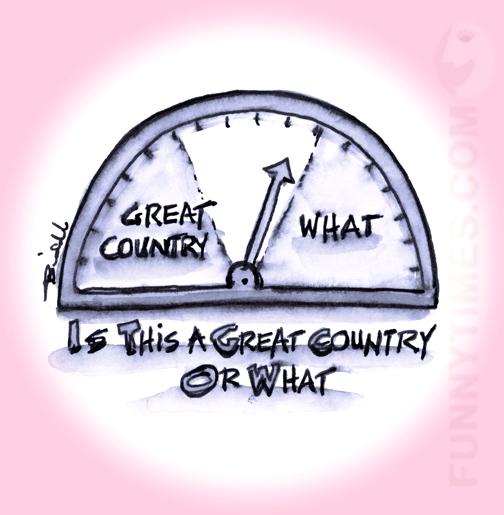
A Meg Biddle cartoon in the June 2015 Funny Times:
 (#1)
(#1)
Yes-no questions with the tag or what? are regularly used to emphatically assert the truth of the questioned proposition. So
Is this a great country, or what?
has the effect of proclaiming that this is indeed a great country. But the question has at least one other reading, merely asking for an alternative answer to Is this a great country?, and that’s the reading Biddle is playing with in the cartoon.
(more…)
Posted in Ambiguity, Idioms, Implicature, Linguistics in the comics, Pragmatics, Questions, Snowclones | Leave a Comment »
August 14, 2013
Back on July 11th, I posted this:
Unlike my other postings this morning, shirtless men will not come into it. That is, this posting is shirtlessnessless.
Yes, shirtlessnessless. The formal pattern here is indefinitely extendable, but rapidly yields words of vanishing utility in real life.
(more…)
Posted in Derivation, Implicature, Morphology, Pragmatics | 1 Comment »
July 10, 2013
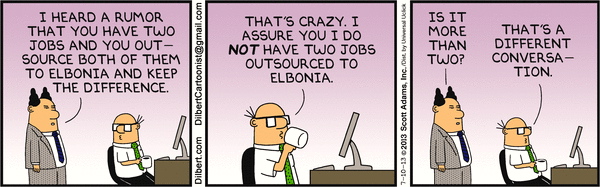
Today’s Dilbert has the devious Wally flouting Grice’s maxim of Quantity:

(On Grice’s maxims, see this posting.) Saying “not two” implicates — conversationally implicates — not two or more, but Wally disregards this in favor of treating not two as ‘not exactly two’. But the pointy-headed boss has enough experience with Wally to suspect his deviousness.
Posted in Implicature, Pragmatics, Semantics | Leave a Comment »
May 26, 2013
Today’s Pearls Before Swine, with a type of language play I have no ready name for:

(The human in the last panel is the cartoonist, Stephan Pastis. And Rat’s question is rhetorical, conveying ‘the word shame means nothing to you’.)
In this form, you pile up phonologically identical words or parts of words to make a gigantic expression that is almost impossible to parse (without the context that sets up the expression): pen the writing implement, the pen– of penultimate, Sean Penn the actor, and Penn the university; the ultimate ‘final’ of penultimate, ultimate ‘very best’, and the ultimate of Ultimate Frisbee. (On penultimate, ultimate, etc, see this posting.) The effect of the set-up is to license what sounds like a massive attack of stuttering.
Posted in Implicature, Language play, Linguistics in the comics, Pragmatics, Speech acts | 6 Comments »
September 21, 2012
In a David Brooks NYT op-ed column (“Après Rahm, Le Déluge”) of a week ago:
The Chicago school system is a classic case of a bloated, inefficient Economy II organization. The average Chicago teacher makes $76,000 a year in a city where the average worker makes $47,000 a year. Rising school costs have helped push the system deep into the red. Meanwhile, the outcomes are not good.
This passage begins by asserting that the Chicago system is bloated and inefficient. The next sentence asserts that the average Chicago teacher makes 1.6 times as much as the average Chicago worker, leaving us to calculate by Gricean relevance that the second sentence follows the first because teachers’ salaries are bloated, bloated implicating that these salaries should be much smaller (perhaps around the average worker’s salary, or even less). All of these are arguable propositions.
(more…)
Posted in Implicature, Pragmatics, Relevance, Semantics | 2 Comments »
July 22, 2012
In a comment on my recent Pogo posting, Bob Richmond gave a link to a posting of his (“Hum a few bars and I’ll fake it”) on the joke template that begins with the question “Do you know X?” and has some variant of the “Hum a few bars” reply as the punch line. (Several of these are from comic strips.) The joke turns on the ambiguity of the verb know, a use-mention ambiguity, and the speech-act ambiguity of Do you know? questions.
(more…)
Posted in Ambiguity, Implicature, Language play, Linguistics in the comics, Pragmatics, Speech acts, Use and mention | Leave a Comment »
May 28, 2011
In today’s Zits, Jeremy insists on understanding dishes as the plural of dish and nothing else (as a way of avoiding work), so as to put his mother into the position of having to inventory the contents of the dishwasher or refer to these contents with a phrase like everything in the dishwasher:

He’s messing with words here, deliberately disregarding dishes as a label for a higher-level category of artifacts, as in do/wash the dishes (and in fact in compounds like dishwasher and dishcloth, where the first element dish is understood as a reference to this higher-level category; a dishwasher washes dishes in the broad, not the narrow, sense). Dishes are the central members of this category, but it includes a lot more than dishes.
(more…)
Posted in Categorization and Labeling, Implicature, Linguistics in the comics | Leave a Comment »
 (#1)
(#1)