Archive for the ‘Anaphora’ Category

Data points: anaphora 4/25/11

April 25, 2011

An account to friends of my sighting a famous Palo Alto resident who happens to be (like me) a Princeton graduate.

Dinner at Mandarin Goumet, couple to my left, the man very familiar-looking, older, ramrod-straight, expensive but understated suit, imperious in tone. Then the guy to his right and my left mentioned Princeton, and he and I both swiveled to look at him for a moment.

The issue is the referent of the he and the referent of the him in the final clause. Two men have been mentioned, and in principle either pronoun could refer to either of them. But my little tale was about the first man mentioned, and he is clearly the referent of the he, so that the second man must be the referent of the him. I could have used the first man and the second man (or some other NPs), but 3sg personal pronouns do the trick just fine, despite the in-principle ambiguity of my version.

Resumptive pronoun, or something

February 1, 2011

From Bruce Webster in e-mail a few days ago, a pointer to an NFL.com story of January 27 about Jeff Fisher leaving as coach of the Tennessee Titans (“Split is best move for both Fisher and Titans” by Michael Lombardi). The final sentence in this passage is the one of interest; the problematic subordinate clause is bold-faced, but the larger context is important:

When defensive line coach Jim Washburn walked out the door and headed to Philadelphia, so did a piece of Fisher. Fisher believes the game is won up front — in both the offensive and defensive lines. He took great pride in being strong in both areas, with his players and coaches. Once he lost Washburn, whom Titans management allowed his contract to expire, Fisher lost any chance of having the kind of team he envisioned.

(more…)

Sloppy identity

January 30, 2011

From a comedy routine on this week’s Prairie Home Companion:

I hate myself. Pretty soon you will ___ too.

(Ellipsis marked by underlines, antecedent VP bold-faced.)

Two readings for the second sentence (with the filled-in ellipses in square brackets]:

(a) Pretty soon you will [hate me too]. (intended reading: pronoun filled in by carrying over the morphosyntactic person/number features of the antecedent in the previous sentence)

(b) Pretty soon you will [hate yourself too]. (pronoun filled in from the morphosyntactic person/number features of the antecedent in its own sentence)

The crucial point is that in neither reading is the object pronoun in the ellipsis filled in by substitution of an actually occurring NP (myself or you), which would give

*Pretty soon you will hate myself too.  OR

??Pretty soon you will hate you too. [requires some sort of conceptual split of the addressee into two persons]

Instead, the understood object pronoun (me or yourself) has the person/number features of the antecedent and the ±reflexive feature appropriate to its clause. (This is a species of what is sometimes called “sloppy identity”, since the pronoun is generously interpreted in context.)

… Just in case you were inclined to believe, in accord with a literally ancient, initially plausible, but nevertheless very silly, idea, that (certain types of) pronouns literally replace repeated NPs. Such pronouns pick out referents (in the discourse world), not linguistic expressions; the linguistic expressions (sometimes) supply the materials for referent-finding, but they’re the means, not the end.

(It might help to think of the way such reference works in signed languages, where the referents can be picked out by literally pointing to pre-established places in visual space, rather than by using conventional “pronominal” signs.)

VPE: antecedent-finding

January 25, 2011

The construction known as Verb Phrase Ellipsis (VPE) has an omitted complement (the ellipsis, usually a VP) that is interpreted by reference to an overt constituent (also usually a VP) serving as antecedent (details summarized here). Usually the antecedent is quite close to the ellipsis, but in some examples it’s more distant, and one or more potential antecedents intervene. These examples are grammatical, but not always easy to interpret; the interpretive task is quite similar to the task of finding antecedents for third-person definite pronouns.

(more…)

Referent finding: own

December 29, 2010

From the “Findings” column (by Rafil Kroll-Zaidi) in the January 2011 Harper’s Magazine, this note (no source provided; relevant expression boldfaced):

Discus fish rear their fry by allowing them to feed continually on their own skin mucus for the first few weeks of life, but whenever the fry have bitten one parent for about ten minutes they are sent off to bite the other.

The writer presumably thought that their by itself allowed for two choices of referent, one picked out by discus fish, the other by their fry and them, and that adding own would disambiguate things in favor of the first. But in fact it does no such thing, and to my mind actually tends to favor the second reading (though in either case the following clause clarifies whose skin mucus is being nibbled on).

Their parents’ instead of their (own) would be a considerable improvement, though it would still allow for the very unlikely reading that the fry are allowed to nibble on their grandparents’ skin mucus. With pronouns, there’s rarely a way to exclude unlikely readings.

Now, own can be a useful tool. In describing the sexual encounters in gay porn flicks, I’m often faced with complex choices of referential expressions. Here, for instance, is a portion of the summary of some action in the film Manifest (full posting here), involving the actors S and W. Warning: high explicit sexual content.

S lies down on his back and takes W up his hole.

S jacks himself off while W fucks him (W: “love that hole”). S comes on his own belly.

If you’re following the arrangement of bodies here, S could come on W’s belly or on his own; his own belly stipulates the latter, while W’s belly (with a referential full NP W’s) would stipulate the former.

Using referential full NPs (rather than pronouns) is sometimes the only way to keep the participants clear. Here’s another passage, describing a three-person encounter in Manifest (with D as well as S and W):

D lies down on his back, licks W’s hole while S blows D, then S jacks D off.

The two boldfaced occurrences of D are the crucial ones here. The pronoun him for either would be unclear as to whether D or W was getting blown / jacked off; the arrangement of bodies would allow for either.

Just a few simple examples illustrating the choices of referential expressions.


Data points: referent finding 8/20/10

August 20, 2010

From the NYT Science Times of August 17 (John Markoff, “Step 1: Post Elusive Proof. Step 2: Watch Fireworks.”):

“The difference between the alchemists and the chemists was that the printing press was used to coordinate peer review,” [NYU professor Clay Shirky] said. “The printing press didn’t cause the scientific revolution, but it wouldn’t have been possible without it.”

Among the reader’s tasks is to find the referents for the two it‘s in

(1) … it wouldn’t have been possible without it

There are two candidates in the text for each it: the printing press and the scientific revolution.

(more…)

A split antecedent, wrapped around its anaphor

May 11, 2010

From Linda Greenhouse’s op-ed piece in today’s NYT, “Just Answer the Question”, about U.S. Supreme Court nominee Elena Kagan:

I thought it was preposterous, and so did the court [SCOTUS, in 2009], to claim that the man who had successfully brought the case had lost his right to dispute. [as did the court would be a possible alternative to and so did the court]

The anaphor is the so did in the inverted VP so did the court ‘the court did too’. Its antecedent is the VP thought it was preposterous to claim that …, half of which (thought it was preposterous) precedes so did the court, half of which (to claim that …) follows it, making the anaphor sort-of (strictly) anaphoric and sort-of cataphoric. The unsplit version would be

I thought it was preposterous to claim that …, and so did the court.

though reordering the court’s opinion and Greenhouse’s opinion would also be possible:

The court thought it was preposterous to claim that …, and I did too / and I thought so too / and so did I / as did I.

These last versions are truth-functionally equivalent to the first two, but because of the ordering differences they aren’t discourse-functionally equivalent. I’m not sure why Greenhouse chose the version she did, from among the choices starting with her opinion and then alluding to the court’s opinion. Maybe she wanted to bring her reference to the court’s opinion up as close as possible to her expression of her opinion. (Or, of course, maybe an editor re-framed what she originally wrote.)

In any case, I have no examples of this sort of split antedent in my files, though I didn’t object to the version as printed.

Playing with anaphora

November 16, 2009

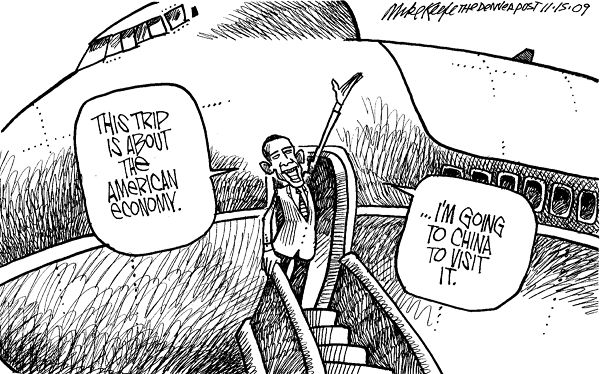
Mike Keefe’s Denver Post editorial cartoon of November 15:

Out of context, “I’m going to China to visit it” is puzzling, since the referent for the pronoun it would appear to be China, so that Obama would seem to be saying that he’s going to China to visit China, which is sensical but fatuous. But the preceding sentence supplies a better referent for the pronoun it, namely the American economy.

This little text still requires some interpretive work, since you have to extend the meaning of visit some to understand how someone could visit the American economy. That’s not very hard to do, and then you see that the text conveys that the American economy is in China. Clever.

Ellipsis on an island

October 16, 2009

Malcolm Gladwell, “Offensive Play”, New Yorker 10/19/09, p. 52, quoting a football player:

(1) “They cleared me for practice that Thursday. I probably shouldn’t have. I don’t know what damage I did from that, because my head was really hurting.”

“I probably shouldn’t have ___” contains an instance of Verb Phrase Ellipsis (VPE); the underlines mark the location of the elliptical material. VPE is a type of anaphora, zero anaphora in particular, so we need to find a referent for the missing VP.

The way VPE normally works is that the referent is supplied by an overt VP in the linguistic context that serves as an antecedent for the anaphor, as in this real-life example, where the antecedent is bold-faced.

I lost weight with Jenny Craig, and you can ___ too.

(that is, you can lose weight with Jenny Craig too.)

But sometimes the referent has to be dug out from non-VP material. Some people find such examples unacceptable — they are often at least hard to process — and there’s a considerable literature about some of them, under the heading “anaphoric islands”; see the Language Log discussion here.

(1) is such a case, where the elliptical material is something like “practiced” or “gone to practice” and the referent has to be dug out “from within” the noun practice, which is derived from the verb practice.

Some further examples (some of them intentionally jokey) from my collection:

(2) Many cases go unrecorded, and those that are ___ rarely make it to court. [referent from within the adjective unrecorded]

(3) Me: That’s a gift.
Wife: And he is ___. He’s very gifted. [referent from within the noun gift; note wife’s repair.]

(4) Constants aren’t ___ and variables don’t ___. [referents from within the nouns constants and variables]

(5) Friendly fire isn’t ___. [referent from within the NP friendly fire]

(6) one of those see-through blouses you don’t even want to ___! [referent from within the adjective see-through]

(7) A Writer Who Doesn’t ___ [referent from within the noun writer]

Just In: NYT Violates PAP!

October 11, 2009

I haven’t posted for some time on the Possessive Antecedent Proscription (PAP), a fictitious principle of English usage/grammar that bars possessive-marked nouns as antecedents for personal pronouns, as in this NYT front-page headline on October 9:

Astor’s Son Is Convicted of Stealing From Her

Astor’s (referring to Brooke Astor, “the legendary New York society matriarch”) is the possessive-marked noun, and it serves as antecedent for the personal pronoun her (functioning here as the object of the preposition from).

Most readers will fail to see any problem with the NYT headline, but a few will recoil from it. These will be people who have been explicitly taught the PAP, in school or in a usage handbook or style sheet. I have yet to come across anyone who tacitly induced the PAP from their linguistic experience. In fact, in my experience everyone who espouses the PAP violates it (with no apparent awareness of having mis-stepped) on occasion. (I used to track such violations down, but it was a time-consuming and unrewarding occupation, and I’ve given it up.)

[Before I go on, let me say that if you want to cleave to the PAP, that’s fine. If you do so, no one will criticize you for your bit of harmless nuttiness (sort of like not stepping on the cracks in sidewalks). Just don’t go around slapping people down for not sharing your avoidance of possessive antecedents.]

The PAP seems to be mostly a product of three bad ideas:

(1) the idea that pronouns are simply replacements for repeated nouns (“That’s why they’re called pronouns, dummy!”);

(2) the idea that possessive-marked nouns are adjectives (because they modify — in some sense of modify — nouns), so of course — see (1) — they can’t serve as antecedents for pronouns; and

(3) the idea that if a linguistic element can in some way contribute to difficulty in understanding, ambiguity, unclarity, or awkwardness, then it should always be barred.

Idea (3) is breath-takingly silly, though it’s trotted out again and again as ammunition against some usage or construction a writer doesn’t like; the writer cites some examples, involving the item in question, where one of these defects arises. Taken at face value, (3) would prohibit speech and writing completely.

The other two ideas spring from more technical misapprehensions, both with long histories in the Western intellectual tradition. But in both cases, they are just hypotheses, however venerable, and most modern linguists reject them, for good reason.

For a more extended discussion of the PAP, see the material here (please check this before you comment on this posting), and note these Language Log postings:

GP, 10/5/03: Menand’s acumen deserts him: (link)

AZ, 10/8/03: Louis Menand’s pronouns: (link)

AZ, 10/21/03: Grammaticality, anaphora, and all that: (link)

AZ, 10/23/03: In search of the fimpossant: (link)

AZ, 2/20/06: Collateral damage: (link)

AZ, 5/22/08: More theory trumping practice: (link)