Archive for the ‘Science’ Category
April 21, 2021
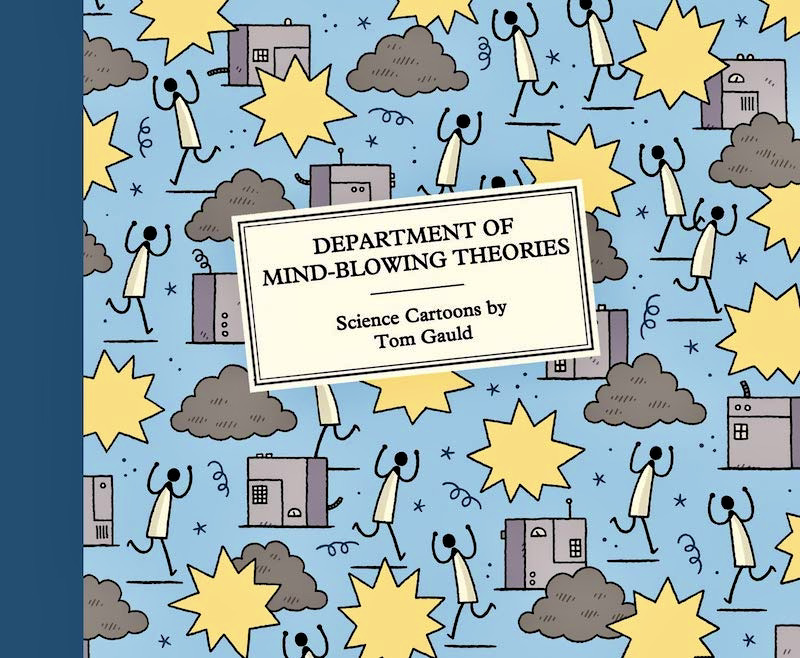
Tom Gauld cartoons from New Scientist magazine, in a 2020 collection:
(#1)
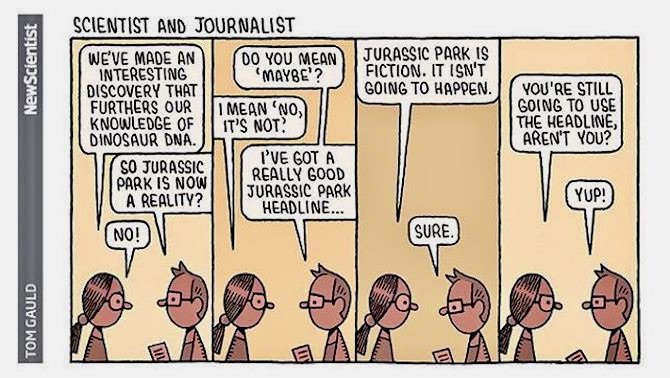
— with three cartoons that especially caught my interest. One on science vs. journalism over de-extinction (already posted on this blog); one on the agony of Science Hell, the scene of eternal scientific mansplaining; and one on the adverbial literally understood literally (which then provides the title for the 2020 book).
(more…)
Posted in Hyperbole, Idioms, Linguistics in the comics, Science, Usage attitudes | Leave a Comment »
April 19, 2021
Well, yes, it’s a big thing, or will be if it works, but the story here is about a proposal to revive — de-extinct seems to be the technical term — the woolly mammoth, à la Jurassic Park.
Dinosaurs, no; see the scientist in this wry cartoon by Tom Gauld (originally from New Scientist, then reprinted in You’re All Just Jealous of My Jetpack and in Department of Mind-Blowing Theories):
(#1)
But woolly mammoths, sort of and maybe. And on that there’s recent news from Harvard (where is Tom Lehrer when we need him?).
(more…)
Posted in Biology, Linguistics in the comics, Mammoths, Movies and tv | 2 Comments »
February 24, 2021
Morning names for yesterday (2/23). In both cases I found the names (one common, one proper) vaguely familiar but couldn’t recall actually having experienced the name in use (though obviously I must have, to have them pop up in my mind on awaking). I then made guesses about the referents of the names — and was well off the mark in both cases.
(more…)
Posted in Etymology, Gender and sexuality, Morning names, Movies and tv, Music, Physics, Science | 2 Comments »
January 13, 2021
A set of morning names from a long time back: consilience, Jay Gould, and Vespa. I will get to them, eventually, one by one. Today it’s consilience, with an entertaining etymology and an interesting two-part history.
From Wikipedia, the initial discussion:
In science and history, consilience (also convergence of evidence or concordance of evidence) is the principle that evidence from independent, unrelated sources can “converge” on strong conclusions. That is, when multiple sources of evidence are in agreement, the conclusion can be very strong even when none of the individual sources of evidence is significantly so on its own. Most established scientific knowledge is supported by a convergence of evidence: if not, the evidence is comparatively weak, and there will not likely be a strong scientific consensus.
The principle is based on the unity of knowledge; measuring the same result by several different methods should lead to the same answer. For example, it should not matter whether one measures the distance between the Giza pyramid complex by laser rangefinding, by satellite imaging, or with a meter stick – in all three cases, the answer should be approximately the same.
(more…)
Posted in Books, Etymology, Morning names, Science | 1 Comment »
August 29, 2019
As we slide into a US holiday weekend — leading to Labor Day, the first Monday in September, this year on the 2nd — my birthday (on the 6th) looms as well. Coming up is a prime-th birthday, the 79th, an auspicious number to my mind, just one short of the 80th, which many view (like the similarly vigesimal 20th, 40th, and 60th) as a landmark birthday, in this case the gateway into old age. But for the moment I’m prime, baby.
(more…)
Posted in Chemistry, Holidays, Language play, Mathematics, Music, My life, Palindromes, Puns | 3 Comments »
July 14, 2019
Selling avocados in Santo Domingo DR:
(#1)
H2O KT is a play on Sp. aguacate ‘avocado’, treating it as:
the chemical formula H2O for agua ‘water’ + ca, the letter K /ka/, + te, the letter T /te/
that is, as la formula química del aguacate ‘the chemical formula for the avocado’. The joke isn’t quite perfect: K is indeed a symbol for a chemical element, potassium, but there’s no element T (though there is Te, the metalloid tellurium). (There is a compound potassium telluride, K2Te, but I don’t know how it interacts with water.)
The joke will lead us to the demotivational industry (with a penguin interlude); to snark and Mad magazine; to color blindness; to egg and avocado dishes; and to a sexually suggestive cartoon and its gender ideology.
(more…)
Posted in Chemistry, Gender and sexuality, Humor, Language and food, Linguistics in the comics, Penguins, Science, Spanish | 2 Comments »
October 24, 2018
In this morning’s comics feed: a Zippy with the slogan “Kindness, Acceptance, Inclusion”; a Bizarro with a Discomfort Control mechanism; and a Rhymes With Orange about the facial recognition of a Mr. Banner. The first two can be understood at some level even if you don’t get the cultural references involved (though they’re much more entertaining if you do), but the third is probably just incomprehensible if you don’t recognize Mr. Banner.
(more…)
Posted in Acronyms, Holidays, Language and religion, Linguistics in the comics, Movies and tv, Science, Technology | 1 Comment »
August 31, 2018
Today’s morning name: Caran d’Ache. A Swiss art supplies company specializing in pencils. With a complex linguistic and social history behind its name. There will be cartoons as well. (No food, sex, music, or plants, but you can’t have everything. On the other hand, there will be clowns and some chemistry / materials science.)

(#1) The box for a 40-color selection of pencils, proudly flying the Swiss flag
(more…)
Posted in Art, Language and politics, Linguistics in the comics, Morning names, My life, Names, Russian, Science, Switzerland and Swiss things | 2 Comments »
May 19, 2018
A fabulous design from Elizabeth Daingerfield Zwicky yesterday:
(#1) “6-fold” (or: “The 6-fold Way”)
To come. On 6-fold symmetry: snowflakes (natural and in paper), many monocot flowers, Kekulé’s carbon ring for benzene, the major colors of the color wheel (reproduced in the rainbow flag for Gay Pride).
Then on number, color, and gender parallelisms, which will give us 6 as purple and queer. And how the opposition of the secondary hues green with purple in #1 parallels the opposition of the primary hues blue with red (and, in the background of #1, the opposition of the primary hues red with yellow).
And on the name 6-fold way, adapted from the Noble Eightfold Path of Buddhism and Murray Gell-Mann’s adaptation of the idea (under the name The Eightfold Way) to a theory organizing subatomic particles.
(more…)
Posted in Art, Color, Gender and sexuality, Language and plants, Language and religion, Numbers, Rainbow, Science, Signs and symbols | 1 Comment »