For the Washington/Lincoln holiday (February 22) in the U.S. (now expanded to take in all U.S. Presidents), Clyde Haberman devoted a “NYC” column in the NYT to the apostrophe, starting with the annual puzzle about whether it’s Presidents’ Day, President’s Day, or Presidents Day. Haberman noted the “floating apostrophe” in the name of the holiday and then moved on to the usual catalogue of apostrophe abuses: restaurant bathrooms marked Mens and Womens, welcome mats at the doorstep of The Anderson’s, its/it’s confusions, and more.
Archive for the ‘Punctuation’ Category
Apostrophe abuse
March 3, 2011A little more periodophilia
February 28, 2011Ok, I swore that I wasn’t going to post any more about periodophilia in the New York Times, in initialistic abbreviations, after writing on J.F.K. referring to JFK Airport, but then two came by me in rapid succession — both of them involving initialisms that are pretty much always periodless outside the pages of the NYT, so that they look distinctly odd in Times-style, where adherence to the style sheet trumps actual usage (WF, or well-formedness, in this case according to a style sheet, winning over Faith, or faithfulness, in this case to the sources).
Internet writing rant
January 3, 2011A way-over-the-top rant on internet writing, here (hat tip to Bruce Webster):
Hey, Y R U Not Paying Attention?
Strong language warning, but it’s all in a good cause. Besides, you probably need this or know someone who does.
The long text begins:
Y, R & U
ARE FUCKING
LETTERS
NOT FUCKING WORDS
and goes on to bitch about texting abbreviations, apostrophe misuse, comma misuse, and common misspellings. I’m not able to post the thing here, because the resolution of the image is too poor, but you can enjoy the version on the American Digest site.
Data points: Faith vs. WF 12/1/10
December 1, 2010Michael Pollan and Eric Schlosser, in an op-ed piece (“A Stale Food Fight”) in the November 29 NYT, about the FDA Food Safety Modernization Bill now under consideration in the U.S. Congress:
… the bill is under fierce attack from critics — egged on by Glenn Beck and various Tea Partyers, including some in the local food movement — who are playing fast and loose with the facts.
First point: Tea Partyers (with a Y) rather than Tea Partiers. Second point: the NYT‘s rendering of the bill’s name as “the F.D.A. Food Safety Modernization bill”, with periods in F.D.A. that are not in the bill’s name. Two different kinds of conflict between faithfulness (Faith) and well-formedness (WF) — see the inventory of postings here — resolved in two different ways: in favor of Faith in the first case, WF in the second.
A comma, doctor!
November 21, 2010Shaoni Bhattacharya, “Tracking the rhino killers”, New Scientist of November 20:
Typically gangs [of poachers] fly in on light aircraft, use veterinary darts to sedate animals and cut off their horns without alerting rangers, then leave the animals to bleed to death.
Unpleasant story. But the first time through, I read the sentence as having cut off their horns parallel to sedate animals — that is, as saying that the poachers use veterinary darts to sedate animals and (somehow) to cut off their horns — rather than to the “higher” VP use veterinary darts to sedate animals, which, on a moment’s reflection, is clearly the intended sense.
“Low” readings are often seductive, but in this case the incorrect low reading could easily have been excluded, by the use of a serial comma:
Typically gangs fly in on light aircraft, use veterinary darts to sedate animals, and cut off their horns without alerting rangers, then leave the animals to bleed to death.
But apparently the style sheet rules, no matter what.
Spoken emoticons
June 12, 2010More for Commencement Weekend: a Bizarro on spoken emoticons…
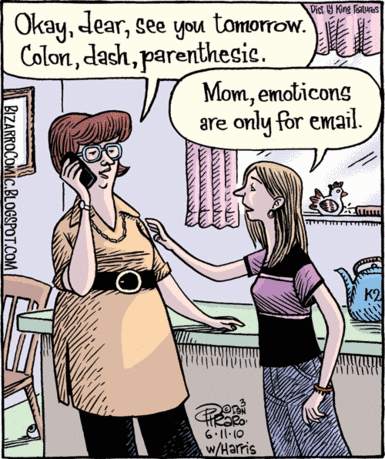
A borrowing-back from the written language to the spoken language, along the lines of the spoken obscenicons in this cartoon.
Some Language Log postings on emoticons:
ML, 1/31/06: All your emoticons are belong to Cingular? (link)
ML, 2/2/06: Invention of the supine round bracket (link)
ML, 9/29/06: Secrets of the BBC sexes (link); use of emoticons by women
BZ, 9/21/07: The prehistory of emoticons (link)
ML, 1/26/09: Emoticons as skin care (link)
BZ, 3/20/09: Oh no, it’s ngmoco:) (link)
CP, 1/16/10: Sarcasm punctuation mark sure to succeed:-! (link)
The Oxford comma in lyrics
January 1, 2010From a January 4 New Yorker piece (abstract here) by Lizzie Widdicombe about the New York band Vampire Weekend, which has a devoted following and also many detractors (“Their aggressive preppiness rubs people the wrong way”, one fan observed):
In the comments sections of music blogs, Vampire Weekend is often cast as a band of rich kids, avatars of bourgeois lameness. For instance: “This is what people who host home decorating shows listen to on the drive to work”; “It’s like the Whiffenpoofs started a ska band.”
The band members say they are surprised to be accused of being so calculating. [Rostam] Batmanglij, the band’s keyboardist and producer, justified their lyrics with the write-what-you-know defense. “I remember when Ezra [Koenig] first played me this song he’d written with the lyrics ‘Who gives a fuck about an Oxford comma?.’ ” he said. “He had just discovered this Facebook group called Society for the Preservation of the Oxford Comma.”
But,
October 6, 2009Last time it was sentence-initial yet followed by a comma, in a New York Times editorial. This time it’s but, in the editorial “Mr. Obama’s Promise of Transparency” (October 5):
As a senator, President Obama co-sponsored a robust proposal to protect journalists and their sources who rely on confidentiality to reveal abuses, scandals and other inner workings of government agencies. But, White House officials are now proposing deep revisions to a Senate Judiciary Committee bill that weaken protections against forcing reporters to reveal their sources.
In my earlier posting I quoted MWDEU on sentence-initial but:
The only generally expressed warning is not to follow the but with a comma…
The argument is that the force of the but is weakened by the unneeded comma. Such commas are rare in the materials in our files.
It seems to me that in cases like the NYT quote above, the effect of the comma is not to weaken the force of the but, but to indicate a short pause after it and so to throw some emphasis onto it. A colon would be even stronger, but a comma will do the job. The effect is one to be used sparingly, but I don’t see that the comma should be banned here.
Yet,
September 15, 2009From the NYT editorial “Reforming the Financial System” (September 14): a first paragraph ending:
He should take justifiable pride in some of the aggressive steps his administration has taken to rescue the financial system and the broader economy.
and a second paragraph beginning:
Yet, the important work of regulatory reform remains undone.
The point of interest is the comma after sentence-initial yet.