Archive for the ‘Perception’ Category

Resonant twanginess

May 13, 2025

… or, maybe, twangy resonance. In any case, the sound of a family of stringed musical instruments of varying appearance, but united by the quality of the sound they produce. Two of them historically situated in the old Austro-Hungarian Empire, one in the Appalachian region of the US.

Together they are the topic of the remaining section of my 5/11 posting “Zimbalist, accompanied by Satie”. That first part was about the occupation noun zimbalist ‘player of a cimbalom / cimbal‘ (an instrument especially associated with Hungary and its capital Budapest, and the most muscularly twangy of the three instruments). The second part, yesterday’s posting “Zimbalistics”, was about the artistic family the Zimbalists (none of whom actually played any of these instruments, despite their family name). Today, I’m onto that instrument (also known as the hammer(ed) dulcimer) and its relatives the seriously twangy zither (especially associated with Austria and its capital Vienna) and the mid-twangy Appalachian / mountain dulcimer (not now associated with central or eastern Europe, whatever its ultimate origins might have been).

These three instruments then tail off into the more sonorous or plinky fiddle (as a folk instrument), banjo, and guitar. As a linguist I’m inclined to think of the twangy instruments as analogous to affricates and the sonorous / plinky instruments as analogous to fricatives (sonorous ones voiced, plinky ones voiceless), though I realize that these comparisons — a kind of synesthesia — might just confound many of you. (Ok, for me, cimbalom music is deep purple, zither music is bright orange, and mountain dulcimer music is a dark yellow. Your colors might vary.)

In any case today you’ll get YouTube videos that show you the instruments and let you listen to their wonderful twangs. I have a sentimental attachment to cimbaloms and zithers, from pleasant times spent in Vienna in years long gone; I’ve had to restrain myself from bombarding you with endless cimbal and zither performances. In fact, today’s presentation will be (again) compressed, under pressure of time.
(more…)

What is figure, what is ground?

February 5, 2025

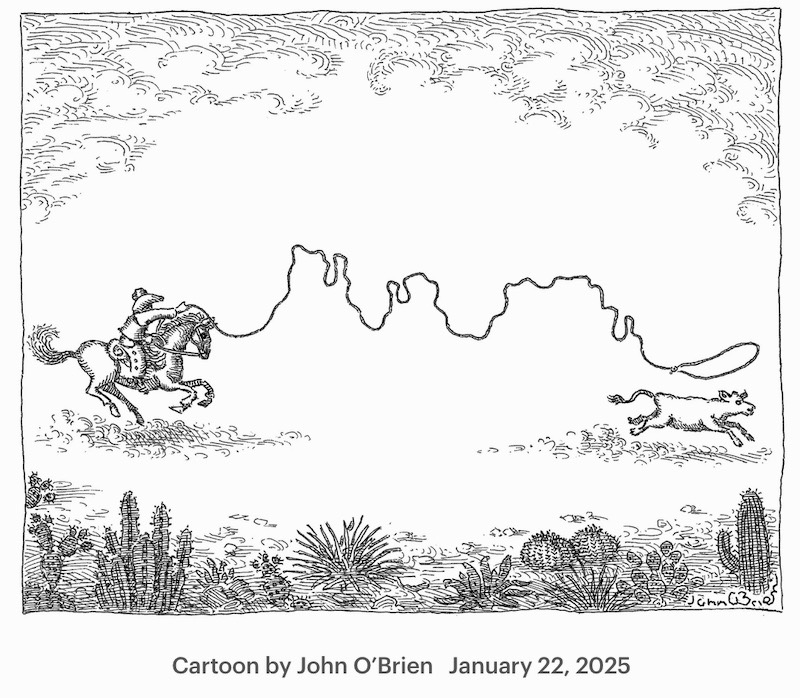
A remarkable John O’Brien cartoon in the 2/3/25 New Yorker, in which a cowboy whips his lariat in pursuit of a cow, with a stark desert landscape of mesas and buttes outlined behind them:


(#1) But wait! That line in the cartoon is both the lariat — the figure — and the outline of the landscape — the (back)ground — so that looking at the cartoon, you perceive the one, then the other, shifting from one to another: what is figure, what s ground?

It’s a percept-shifting visual illusion, exploiting an ambiguous image, in particular a figure-ground ambiguity. Here done as a joke in a cartoon, a visual parallel to what I’ve called sense-shifting pun jokes.

(more…)

Alaskan prime

January 1, 2025

🐇 🐇 🐇 three rabbits to inaugurate the month January and the year 2025

From Chris Waigl on Facebook yesterday. One fact that you need to know about CW is that she lives in Fairbanks AK (further facts, about CW and about Alaska, will become relevant as we go on):

Soft-spoken barista in a medium-loud café, as heard by me: … and would you like salmon on top of your cappuccino?

The barista said cinnamon, CW heard salmon. Phonologically similar, but from two different conceptual worlds. Why would CW even have entertained the possibility that the barista was offering salmon?

(more…)

Apostrophobia

November 16, 2024

Wayno’s Bizarro for 11/8 — yes, I am hopelessly overwhelmed with posting material, wondering whether I’ll ever catch up; on the other hand, my health has taken a turn back to normal awful, which I’m entirely able to cope with — is a Psychiatrist strip in which the patient is said to be suffering from (in fact, cowering behind the therapeutic couch in the grips of) the fear of contractions:


Of the types of traditionally-labeled “contractions” in English, the patient here — call him NoA — seems to exhibit sensitivity specifically to just one, now known in the linguistic literature as Auxiliary Reduction, AuxRed for short (in I am > I’mI had > I’d, and you are > you’re), though in fact Wayno sees NoA’s sensitivity as triggered by all occurrences of the punctuation mark the apostrophe, of which there are a great many types — hence Wayno’s title for this cartoon, “Punctuation Trepidation” (if you’re puzzled by the odd symbols in the cartoon — Wayno says there are 7 in this strip — see this Page)

Now if this is NoA’s affliction, he’s in for a world of trouble, because in modern English spelling the apostrophe is used as an abstract mark for possessive forms of nominals — singular in someone’s cat and the queen of England’s hat, plural in the boys’ bat — a visual mark accompanying the possessive S; but while the the letter S in such forms corresponds to phonological content, the apostrophe neither represents phonological content nor indicates a place where some phonological content is omitted. So, how does  NoA know that /sʌm.wǝnz.kæt/ in some sense has an apostrophe in it and he should cringe in fear at it?

(more…)

Annals of mishearing: effing gee, the carpet store

September 16, 2024

A frequently experienced tv commercial in recent days, encountered at first only through the audio, which I heard to be for a local carpet company called, apparently, effing gee or effing G, involving the verb F or eff /ɛf/, an initialistic euphemism for fuck. Given my nature and my professional interest in taboo vocabulary, it would be fair to think of my perception as Freudian mishearing, of who knows what original. But, surely, a carpet company wouldn’t choose a name with fucking encoded in it, maybe playfully conveying that it was fucking good (though that would be a bold commercial move).

The next time I heard the ad, I understood the company name to be effigy, which is at least an English word (and not a swear), but baffling as a company name. Significantly, having heard the name originally as beginning with /ɛf/, that perception persisted.

Next time around, I shifted my perception to something more likely, in which /ɛf/ is in fact a letter name: FnG, that is F&G. This would be a common pattern in company names; a sampling of F&R companies:

F&R Auto Repair (Woodland CA), F&R Auto Sales (Hialeah FL), F&R Towing (San Jose CA), F&R Engineering (Roanoke VA), F&R American Fine Fragrance (Winston Salem NC)

Finally, I looked at the screen, and saw that the company’s name was indeed initialistic, but was S&R, not F&R. /f/ and /s/ are minimally distinct acoustically, so are often confused in perception. My initial perception was skewed towards /f/ because of my bias towards fucking — and so towards fucking and effing — and once established that perception persisted, despite repetitions of /s/.

(more…)

Z of the Amazon

January 2, 2024

An announcement on the Language Typology mailing list on 12/30:

we are hosting the ninth Syntax of the World’s languages in Lima (Pontificia Universidad Católica del Perú) between July 23th and 26th 2024. We are “cooking” (the culinary verb is in order when we talk about Peru) a very nice and welcoming conference for all of you, so we really hope you come over … SWL IX will provide a forum for linguists working on the syntax of less widely studied languages from a variety of perspectives.

This from the organizer, Roberto Zariquiey, at PUCP. Whoa! A splendid Z-name, one I’m sure I’d never seen before. And, extra points, on an Amazonian linguist. (I suppose it would have been too much to hope that RZ came from the town of Zaraza in Venezuela.)

You see, as a Z-person, I’m keenly aware of the letter Z, unconsciously aware of words (especially names) with a Z in them, which is why I’m so sure that the name Zariquiey is new to me. More on implicit attentiveness below.

Then there’s the question of the origins of the name. My family name, Zwicky, has been a Swiss name for hundreds of years, centered very specifically on a small town in the Alps. But there are some variant spellings. Also the possibility of a historical connection to somewhat similar names in Bavaria, and of those names to another set of names from the Slavic areas of Eastern Europe, More on those names below too. There are some surprises, like the remarkable spelling Tsviki, first seen in Belarus (but then people get up and move to new places, so there are now Tsvikis in the Miami area and New York City).

The family name Zariquiey doesn’t look much like any of the Swiss, Bavarian, or Slavic names (Slavic Zawickey is about as close as it gets), and it’s way separated from them geographically as well: apparently, almost all the Zariquieys in the world come from Spain, or from what is pretty clearly a Spanish settlement, in Peru (where RZ comes from). At some point, I will write RZ — I have his e-mail address — and ask him what he knows about his family’s origins. I’m somewhat reluctant to do this, though, since as you’re about to see, he’s a busy person, intellectually and emotionally committed to a program of intense and pressing research in Amazonia. On the other hand, as you can also see from the tone of his SWL IX announcement above and judge from his Radcliffe Institute photo (to come in a moment), he seems like a pretty cool guy.

In any case, now I dive right into information about RZ and his research. With all the other stuff to follow

(more…)

Sense-shifting pun jokes

December 2, 2023

A common joke form exploits an ambiguous expression E. Prior likelihood or the preceding context in the joke favors one understanding for E, but then fresh context (in the joke) brings out another, more surprising one. The effect is that the sense of E has shifted as the joke proceeds. It’s a pun, son. Used in a sense-shifting pun joke. (Puns get used in all sorts of jokes: knock-knock jokes, one type of riddle joke, and more.)

I now offer two examples that especially tickled me, to show how such ((phonologically) perfect) puns work. Then some comments on a different joke form, formula pun jokes, which can turn on imperfect puns and involve a different kind of set-up / pay-off from sense-shifting pun jokes.

(more…)

IIlusory penguins

July 27, 2023

From my regular correspondent Ellen Kaisse yesterday:

I was walking around the grounds of a nearby high school and saw these black and white creatures off in the distance.


(#1) [AMZ:] Are those penguins, advancing upon us?

I knew they had to be football training sleds (see picture below of the closest thing I could find on the web), but they sure looked like penguins. I immediately thought of you. [AMZ: notorious penguin fan that I am]


(#2) [AMZ:] Football training sleds; you charge into them (I have actually done this)

I think if you enlarge the picture [in #1], it will keep looking like penguins, at least up to a certain magnification.

There’s a little lesson in perception here. If, for whatever reason, you are primed to search out certain things in your visual field, you are likely to “see” your target in some of the wrong places, in visuals that merely resemble the thing that so engages your attention. Penguins are one of my totem animals; I live surrounded by images of penguins and simulacra of penguins, and friends keep giving me more; so I’m attuned to penguins in a way that few other people are, and am inclined to unconsciously seek them out. Through long association with me, Ellen Kaisse has picked up some of this inclination. (My daughter and grandchild and various other friends who have been supplying me with penguiniana over the years have similarly gotten attuned to the flightless birds.)

I have written elsewhere on this blog about my perceptual sensitivity to the letter Z, ’cause I’m a Z guy. That occasionally leads me to misidentify symbols that merely resemble Z, or to fix on certain forms of the capital letter S as if they were Zs. For me, Zs lurk everywhere. (I notice spoken /z/ in much the same way, especially in word-initial position.)


Maternal shrillness on Zits

January 29, 2023

Today’s Zits strip manages to assemble three disparate bits of assumption about cognition into a joke about maternal shrillness:


(#1) So shrill — in particular, so high-pitched — that it takes a ladder to get up there and read what’s in the speech balloon

Whoa! You might not have subscribed to any or all of these cognitive stances built into the strip:

— conceptualizing speech and thought balloons as physical objects

— perceiving women’s speech as shrill — an impression that incorporates (among other things) sociocultural associations of high pitch and loudness with various personal and interactional states, and also the association of high pitch with femininity

— (metaphorically) associating high pitch with height above the ground

(more…)

Pareidolia, they control ya

December 23, 2019

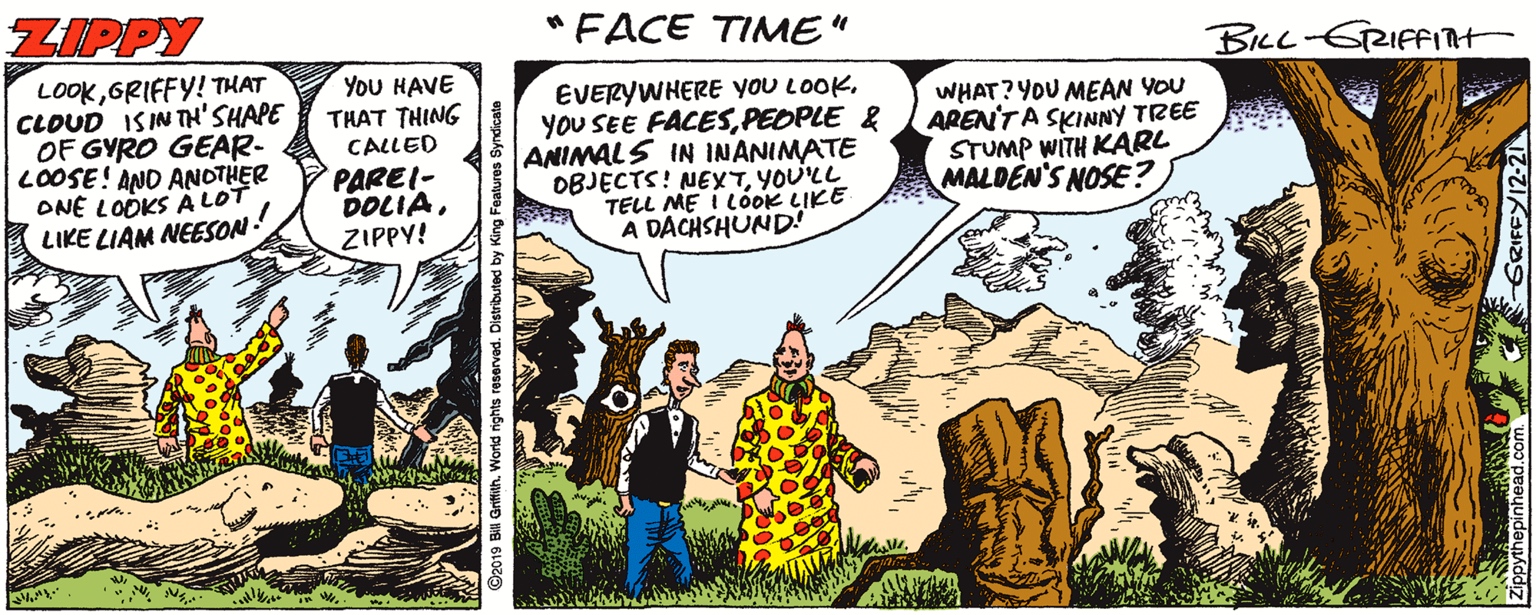
The Zippy from the 21st takes us into a world where hidden identities surround us everywhere:


(#1) Griffy gives the definition, and he and Zippy supply examples — in particular Karl Malden’s nose

Notes on pareidolia, on Karl Malden’s nose, and the Kinks’ “Destroyer”.

(more…)