Archive for the ‘People’ Category

Today’s eccentric character

April 28, 2025

If this blog were the New Yorker, this posting would be a Talk of the Town piece (after the first one, which is an editorial), a sketch of some intriguing person. Today’s eccentric character on this blog (other than me) is Mark Saltveit. In brief, from Wikipedia, much extended:

Mark Saltveit (born 1961 [Harvard ’83]) is a Vermont-based [but Oregon native] stand-up comedian, palindromist and writer, known for being the first World Palindrome Champion [AZ: also chronicler of the San Francisco 49ers (that’s American football, for my readers around the world) and scholar of Daoism (aka Taoism); and, he now — 4/28 — tells me he’s also interested in ancient coins].


MS (photo from him)

In more detail, from his WiX site:

Staff writer, NinersNation.com (leading San Francisco 49ers website)
Professional standup comedian, since 1999
Editor, The Palindromist Magazine
The first ever World Palindrome Champion (2012-2017)
Editor, Taoish.org (a website of contemporary, secular Daoism)

But why, you wonder, am I writing about him today? Because he wrote me yesterday about the TG/TB (“That’s Good” / “That’s Bad”) joke routine that I first talked about here in a 7/22/19 posting “Oh that’s good” — citing an ancient Chinese forebear of the routine. So: TG/TB back in the mists of time, though it came up on this blog through the American tv show Hee Haw.

(more…)

Hats off to the vampires!

January 19, 2025

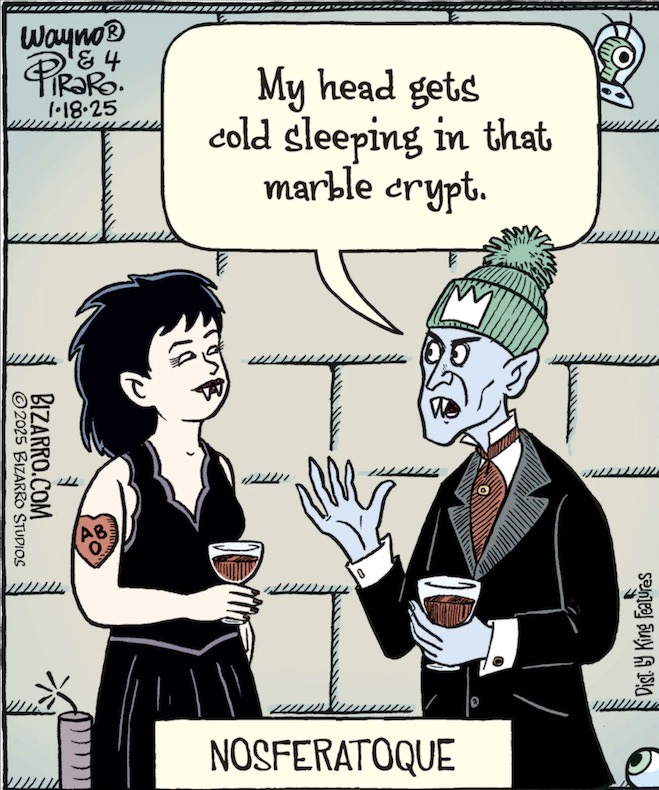
For yesterday, 1/18, in Bizarro, the 6th and I suppose last Waynoratu Nosferamanteau:


The male nosferatu (holding a wineglass of what is presumably blood, and chatting with his young female companion at some sort of vampiric meet-and-greet) seems to be wearing a Canadian toque (= tuque), with pom-pom, to warm his head during the cold dark nights in his coffin (yes, it’s very silly) (if you’re puzzled by the odd symbols in the cartoon — Wayno says there are 4 in this strip — see this Page)

The nosferamanteau is Nosferatoque = Nosferatu + toque. As for the hat, from NOAD:

noun toque: [a] a woman’s small hat, typically having a narrow, closely turned-up brim. [b] historical a small cap or bonnet having a narrow brim or no brim. [c] Canadian a close-fitting knitted hat, often with a tassel or pom-pom on the crown. [variant of tuque] [d] a tall white hat with a full pouched crown, worn by chefs.

(The heart tattoo with A B O in it, for the blood types A B AB and O, is a nice touch.)

(more…)

Julio Torres

August 11, 2024

In  my e-mail recently, the program for this year’s New Yorker Festival, with some of the interviewees in a display ad:


(#1) No, I don’t know why pink; Cumming, Maddow, and Torres are notably LGBT, but not the other five in this display (maybe 3 out of 8 exceeds some tipping point, but it’s more likely that pink’s just a random color choice, devoid of meaning)

Now, which of these 8 is not like the others? Well, that’s an odd photo of singer-songwriter Sara Bareilles, but it’s an atypical one. Otherwise, Julio Torres’s photo does stand, or leap, out, and for him it’s fairly restrained; his pictures show him with a wide variety of hair colors (sometimes involving henna red or bright blue) and bodily adornments, and sometimes in drag. Meanwhile, he’s young, adorable, outrageous, smart, and dead series about creating comedy in a variety of forms.

(more…)

Guest morning name: Venn

April 11, 2017

A morning name contributed by John Wells:

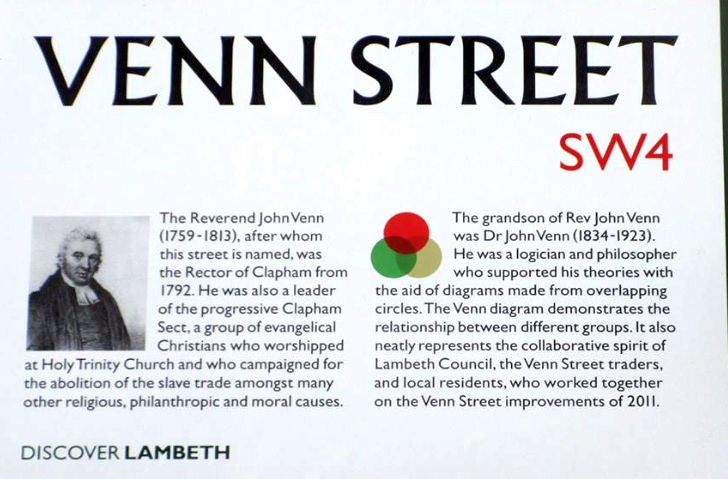
(#1)

Says John,

Venn St in Clapham [district of London], commemorating two bearers of the surname: the campaigner against the slave trade, and the inventor of Venn diagrams. Who knew they were related?

(more…)

At the art museum

March 4, 2017

In collecting material for blog postings on recent exhibitions at the Cantor/Anderson galleries at Stanford, I came across a staff page with an excellent photo of Matthew Tiews, Associate Vice President for the Arts at Stanford:

I first knew Matthew as the Associate Director of the Stanford Humanities Center, a position that calls for a serious scholar who is generally knowledgeable about the humanities, social sciences, and the arts, and is also an able administrator, good at working with people, and (very important) with a solid sense of humor. Now Matthew oversees the arts programs and the arts complex at Stanford, which has developed into an entire campus neighborhood, or zone (three museums, a very spiffy concert hall, and more).

So I wrote Matthew about my Stanford art museum postings (which I thought might interest his staff), and now I’m reporting all this to you.

(more…)

The way we were

February 25, 2017

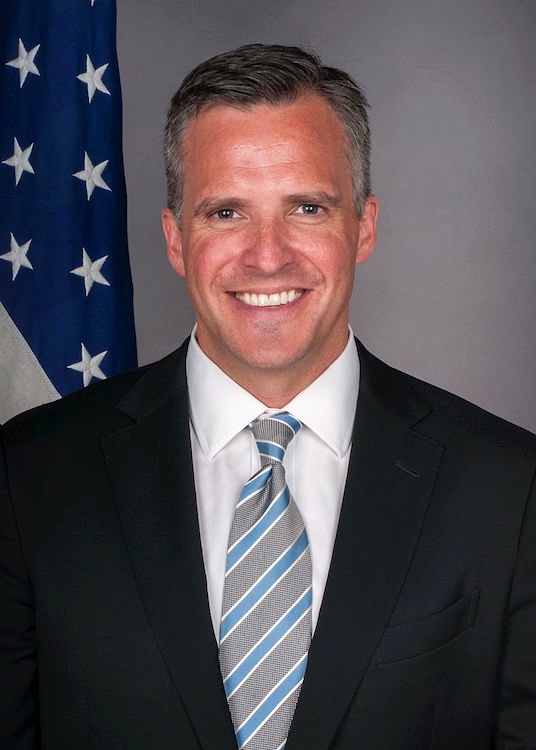
A news item that’s been in my posting queue since last October: in the October 2016 issue of The Atlantic, “Big in Denmark: The U.S. Ambassador” by Amy Weiss-Meyer, beginning:

When Rufus Gifford, the U.S. ambassador to Denmark, won a Danish television award for his reality show, he ran onto the stage, beaming. “Oh man,” he said, surprised. “Wow.” The show, Jeg Er Ambassadøren fra Amerika (or I Am the Ambassador From America), was renewed for a second season (and will come to U.S. viewers this fall via Netflix [I am watching it as I write this]). A Danish biography of Gifford was a best seller. At a music festival in June, the chart-topping Danish pop band Lukas Graham dedicated its song “Nice Guy” to him.

“Rufus Gifford is a rock star,” Nicolai Wammen, a Danish MP and a friend of Gifford’s, told me. As an appointee of President Obama’s, Gifford is likely nearing the end of his diplomatic stint, though Danes frequently ask him to stay. His biographer, Stéphanie Surrugue, remembers walking alongside Gifford at a political gathering and noticing that he was getting as much attention as the nearby prime minister. “People were shouting ‘Rufus!’ as they were shouting ‘Lars’ after the prime minister.” It was, she says, “a little bit crazy.”

(#1)

(more…)

Demented p.r. pitches, absurd ad copy

February 24, 2017

Recently the admirable Margalit Fox has been posting on Facebook a series “Demented P.R. Pitch of the Day” (Margalit seems to read more of her nonsense mail than I do). I’ll give the two most recent examples and then turn to some long-standing advertising themes in my own postings: absurd ad copy for premium men’s underwear and for gay porn. (So, yes, in the second case there will be some incidental sex talk.)

(more…)

Odds and ends 8/16/13

August 16, 2013

Some more short takes, on a notable person, avoidance of non-taboo words, wordless instructions, typefaces, and a libfix.

(more…)

Gimme shelter

March 2, 2010

I’ve been reading Terry Castle’s new book The Professor: And Other Writing, (from the dust jacket) a “collection of penetrating autobiographical essays” (and more: wit and humor, observations on literature, art, culture, and sexuality). There are any number of short quotable bits in the book; here I want to pick out just one, from the essay “Home Alone”, about magazines devoted to interior decoration, domestic architecture, home furnishings, landscape design, etc. — what she calls “shelter mags” and “shelter lit”, using both the clippings mag for magazine and lit for literature and also the coyly pretentious term shelter that many of these magazines themselves use. (She also calls this material “house porn”, using the snowclonelet X porn discussed, with others, here.)

“Home Alone” has come up in Language Log (I read it when it came out in the Atlantic a while back), since in it Terry notes the occurrence of the revolt-against-mother formula “not your mother’s X” all over these magazines. This is a special case of the larger snowclone “not your R’s X”, where R is a kin term (discussion here, including the perhaps most famous instance of the snowclone, “not your uncle’s Oldsmobile”).

[Terry is a distinguished colleague of mine at Stanford, in the English department. We became acquainted through the Stanford Humanities Center.

The NYT Magazine of January 17 has an entertaining interview with Terry by Deborah Solomon, which ends with this wonderful exchange:

[Castle] The smartest literary scholars right now are interested in evolutionary psychology and brain science — how we may be hard-wired for fiction-making, aesthetic appreciation and the like.

[Solomon] Is that a good development? How do you feel about seeing the adventure of life reduced to a function of DNA?
[Castle] I guess I’m down with it because I’ve always felt, for instance, that my own lesbianism was genetic. My cousin, whom I was just visiting in London, we have the same DNA, and we’re both big, old dykes.

[Solomon] Surely you can find a more graceful way to describe yourself.
[Castle] Svelte, coltish and effortlessly alluring? Cate Blanchett, please call me.]

Finally, the quote. This comes in a discussion of the now-defunct shelter mag nest, which was “louche, sly, sexy, so dark and downtown in sensibility it was funny — an interiors rag for John Waters.” She summarizes:

The magazine was quite stupendously mannered — redolent of Ronald Firbank trawling for hunky handymen at Home Depot.

I wish I’d written that.

Alfred Ayres

February 13, 2010

Over on his blog Motivated Grammar (subtitled Prescriptivism Must Die!), Gabe Doyle attacks the idea that healthy is incorrect with the meaning ‘promoting good health, healthful’. Where does this come from? Gabe:

MWDEU says that the whole notion that something’s wrong with that usage can be traced back to 1881, when a fellow named Alfred Ayers declared it so in a book called The Verbalist. (Google Books has the 1909 edition online.) The trouble with Ayres’s declaration is that it spit in the face of at least 330 years of usage; the OED’s first citation for healthy, in 1552, defines the two words identically, and both meanings for healthy are attested all the way up to Ayres’s book’s publication.

… Both meanings have been attested for 450 years, and the claim against the latter was an unjustified assertion from 1881 by a prescriptivist otherwise lost to the sands of history.

I objected to “a prescriptivist otherwise lost to the sands of history”. As I said a few years ago in a note on complaints about blame it on, Ayres was,

with Richard Grant White, one of the great American grammar/usage ranters of the 19th century.

Language Log had two postings on blame it on someone (versus blame someone for it), both mentioning Ayres: this one and an earlier one here. Plus a posting on objections to people ‘persons’, with Ayres as a prominent objector. As you can tell, he had something of a talent for picking the losing side in these usage disputes.