Archive for the ‘Names’ Category

Batmanic birthday presents

November 18, 2024

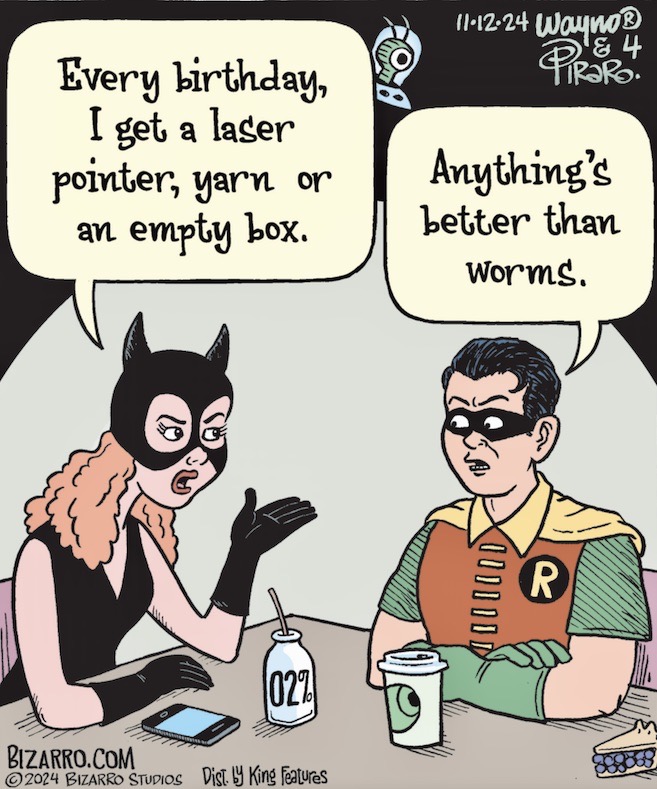
The Bizarro of 11/11, about birthday presents in Batworld: Selina Kaye (in her alter ego as Catwoman, where she is both woman and cat) and Dick Grayson (in his alter ego as Robin, where he’s a boy named Robin, and not a bird) grouse about the presents they receive — probably from Bruce Wayne (in his alter ego as Batman) — by virtue of their creature-name aliases:


(#1) Selina gets cat presents, but at least her alter ego is a hybrid of cat and woman; but Dick gets worms (because the bird the robin is famously fond of eating them) even though there’s nothing avian about his alter ego (not even his name, which is a diminutive of the name Robert), so he is no doubt doubly pissed off — Wayno’s title for the strip is the ironic “Thanks a lot, Bruce” (if you’re puzzled by the odd symbols in the cartoon — Wayno says there are 4 in this strip — see this Page)

As it happens, the proper name Robin is historically not unconnected to the common noun robin, but the connection runs the wrong way: the noun robin comes from the name Robin. As far as modern English is concerned, robin and Robin are just unrelated homophones, so giving Robin birthday worms because of his name is like giving Peter and Dick birthday condoms because of their names; it embodies a (crude) pun.

(more…)

The Austria ostrich

November 15, 2024

Very briefly noted.

Passed on back on 11/9 by Michael Palmer on Facebook, this fine reworking of the map of Austria as an ostrich:


MP came across it on the Language Nerds Facebook site, but I don’t know who created the image in the first place

In English, Austria (a Latinization of the German name Österreich ‘eastern realm’) and ostrich (from a compound of the Latin avi- stem meaning ‘bird’ and the Greek struth– stem meaning ‘ostrich, big sparrow’) have only medial /str/ as clearly shared material, so are very distant puns, if they count as puns at all. Much the same is true of Spanish Austria and avestruz.  Things are even more distant in Italian (Austria and struzzo) and of course German (Österreich and Strauß).

But in French, as I pointed out on Facebook, by the accidents of phonological change, Latinized Austria > Autriche and the avi– + struth– compound > autruche, yielding a truly fine pun: Autriche is an autruche!

So Austria not only looks like an ostrich, in French it sounds like one too. This makes me happy.


Dizzy Zippy zigs at Zzyzx

November 9, 2024

… and, instead of taking the Zzyzx exit, catches a ride with a guy in a SYZYGY car to the end of the road, where one-point perspective takes you (so we are both out in the desert in San Bernardino County CA; and also in the artist’s meta-world, where perspective lines converge in a vanishing point, and that is truly the end of the road). All this in yesterday’s Zippy strip, which is rich in Z, Y, ZY / ZI, and ZYG. plus the occasional antic X:


(#1) Three things: Zzyzx Road; one-point perspective; and the word SYZYGY (the ZYG of which took my mind to the word ZYGOTE; while the concept of syzygy took me to A Midsummer Night’s Dream, which is a wedding-feast of syzygy — of counterparts, contrasts, conflicts, and oppositions)

And then there’s zig; from NOAD:

noun zig: a sharp change of direction in a zigzag course: he went round and round in zigs and zags.

(which can then be verbed to yield to zig ‘to take a zig’, as in my title)

(more…)

Hexagonal French

November 7, 2024

In an on-line notice of a journal article, a language name that I don’t recall having come across before, but one I understood after a moment’s thought: Hexagonal French, the French spoken in the hexagon of France — that is, Metropolitan French, or more plainly, the French of France, France French, French French (occasionally referred to as European French or Continental French, but those terms would take in Belgian French and Swiss French, which are outside the hexagon). Meaning, of course, the standard, Paris-based, varieties of this language; there are plenty of provincial varieties in the country, plus other Romance languages related to French, and, even further afield, non-Romance languages within the hexagon, like the Celtic language Breton in Brittany.

From Wikipedia:

French of France is the predominant variety of the French language in France, Andorra and Monaco, in its formal and informal registers. It has, for a long time, been associated with Standard French. It is now seen as a variety of French alongside Acadian French [in the Maritimes], Belgian French, Quebec French, Swiss French, etc.

Lots to unpack here, starting with the hexagon. Which will lead immediately to names of regions, including those that constitute the land masses of political entities. including countries like France.

(more…)

Briefly noted: the halls of ivy

October 28, 2024

From Nathan Sanders on Facebook on 10/26:


(#1) [NS:] I love when ivy changes colours! — at University of Toronto.

— AZ to NS: That is indeed lovely. It’s Parthenocissus tricuspidata, so-called “Boston ivy”, a vining plant in the grape family closely related to Virginia creeper, and not related at all to English, or common, ivy, Hedera helix (which I have growing all over my little patio). English ivy is evergreen; Boston ivy is deciduous, its leaves turning color gorgeously in the fall before dropping off.

(more…)

Briefly noted: the new Caligula

October 25, 2024

Posted to Facebook yesterday. I had been recalling Albert Camus’s play Caligula (adapted into English by Justin O’Brien), which I happened to see in February 1960, during its famously brief — one month long — run at the 54th Street Theatre in NYC — which led me to investigate Wikipedia’s long and intricate entry on

Gaius Caesar Augustus Germanicus (31 August 12 – 24 January 41), better known by his nickname Caligula …, Roman emperor from AD 37 until his assassination in AD 41.

and then to write on FB:

Was just musing on TFG as the new Caligula (vengeful, unclear on the separation of his personal fortune and the state’s coffers, declaring himself a god, etc.) when I thought to look for parallel uses in the press. I bring you

the Daily Beast in 2011, Benjamin Netanyahu as the new Caligula; the Times (of London) in 2015, Jeremy Corbyn, the new Caligula; the Irish Times in 2016, [Helmut Grabpussy], the new Caligula?; POLITICO.eu in 2020, Boris Johnson the new Caligula

(there are probably more)

(more…)

Namesakes and surnamesakes

October 12, 2024

This is going to take us surprising places. Our guide will be the distinguished Slavist Wayles Browne, in (edited) excerpts from e-mail he sent me on 10/9:

I discovered your blog when [WB’s Cornell colleague] Michael Weiss wrote about early attestations of the term ruki rule [in Sanskrit and elsewhere: see the 4/22/24 posting “On the transmission of ideas: RUKI gets around”]. Since then I’ve been looking at older postings as well as your day-to-day ones. On 1/9/14 [in the posting “A recent birthday”, on the birthday of Nikolai Marr], you wrote, after quoting this from Wikipedia:

Marr earned a reputation as a maverick genius with his Japhetic theory, postulating the common origin of Caucasian, Semitic-Hamitic, and Basque languages. In 1924, he went even further and proclaimed that all the languages of the world descended from a single proto-language which had consisted of four “diffused exclamations”: sal, ber, yon, rosh.

that

Marr eventually fell out of favor with Stalin.

Quite true, and there’s more to the story than that. After Marr died, his follower Ivan Meščaninov and others managed to get Marrism accepted as the official Marxist approach to linguistics, but finally in 1950 a Georgian linguist went to his fellow-Georgian Stalin and persuaded him that it was all fatuous and bad for the whole science of linguistics. Stalin then published an article in Pravda with essentially common-sense views of language. The name of the Georgian linguist? He was a namesake of yours: Arnold Chikobava.

In Bosnian, Croatian and Serbian, the language(s) that I work on the most, ‘name’ is ime, ‘namesake’ is imenjak, ‘surname’ is prezime, and a person you share a surname with is, quite logically, prezimenjak. It would be nice to introduce surnamesake into English too.

So we start in Ithaca NY (with the Cornell Indo-Europeanist scholar Michael Weiss), pass through Ancient India (and the Sanskrit language, which was the topic of my PhD dissertation, back in the Cretaceous Period) on our way to the Soviet Union under Stalin, where we encounter the nutcase linguist Nikolai Marr, who takes us to Soviet Georgia (in the Caucasus) and the linguist Arnold Chikobava, whose name, coupled with mine, reminds WB that the Slavic language(s) BCS (in the Balkans) have the eminently useful term prezimenjak ‘surnamesake’. In this is concealed a good bit of complexity in the notion of namesake (which I have, in fact, posted on, so we’ll get to that eventually), plus a wonderfully sly choice of wording in WB’s reference to BCS as

the language(s) Bosnian, Croatian and Serbian

(which will require some explanation for readers who are not entirely up to date on the linguistic situation in the Balkans).

(more…)
When X means yes

October 9, 2024

… in one sense / use of yes: ‘yes, I select this one’. Which came up yesterday as I was ordering an Original Italian Sub from the Jersey Mike’s Subs in Mountain View CA, just south of Palo Alto (they’re a huge national chain, offering a wide range of submarine sandwiches that are, in my experience, excellent examples of their kind — and Grubhub delivers from them); it turns out that their on-line menu software involves this positive selection-X, which took me a moment to get used to, especially since I’d posted not long ago on associations of the letter X, which included the X of NO — of prohibitions, bans, and denials — but not the X of YES. Well, X is a symbol, it’s just stuff (as I say) and can accumulate any number of uses, even ones that look contradictory.

The Jersey Mike X is the X of election ballots: an alternative to a check-mark ✓ or a plus-sign + in a box or circle (or to filling in an oval) to indicate selecting an item.  In a use that was initially confusing to me, since the JM X is in contrast with the JM +, which turns out to convey something like ‘this is one of the available choices’; I eventually figured out how JM deploys X and + through a certain amount of trial-and-error fiddling with the menus. Yes, I’ll illustrate all of this in a little while.

But first, one more groaner penguin-pun joke, on the occasion of my consuming, at lunch today, the last of my birthday McVitie’s Penguin bars.

(more…)

Hot autumn morning

October 6, 2024

The torrid unpleasantness continues. Back on 10/2 the local temperature reached a brutal 102F; since then, it’s dropped into the 90s, but not by a whole lot. 96 yesterday, 96 today, 96 tomorrow, then maybe actual autumn.

So as soon as there was enough light, I was out on my patio watering the plants, in the containers and in the garden strip, and spray-washing the ivy on the walls of the patio, all while it was still under 70F. When I came back inside and went to work at my computer, I got a treat: a two-act show by the local creatures, squirrels in Act 1, hummingbird in Act 2.

But to appreciate the show, you’ll need to sit through the prologue, a brief September song in three parts.

(more…)

Once, twice, six times Marengo

October 5, 2024

My morning name from Thursday, 10/3: MARENGO. Which is:

1 an Italian place name
2 the name of a Napoleonic battle fought (near) there

And then from that:

3 the name of Napoleon’s horse
4 any one of various place names in Canada and the US
5 the French dish chicken Marengo
6 any of various colors in the black, dark blue, dark brown, and gray or blue-gray spectrum

As if that weren’t complex enough already, the name MARENGO brought with it a torrent of name associations, from MANDINGO to NINTENDO, which I’ll sample below.

(more…)