Archive for the ‘Names’ Category

Resonant twanginess

May 13, 2025

… or, maybe, twangy resonance. In any case, the sound of a family of stringed musical instruments of varying appearance, but united by the quality of the sound they produce. Two of them historically situated in the old Austro-Hungarian Empire, one in the Appalachian region of the US.

Together they are the topic of the remaining section of my 5/11 posting “Zimbalist, accompanied by Satie”. That first part was about the occupation noun zimbalist ‘player of a cimbalom / cimbal‘ (an instrument especially associated with Hungary and its capital Budapest, and the most muscularly twangy of the three instruments). The second part, yesterday’s posting “Zimbalistics”, was about the artistic family the Zimbalists (none of whom actually played any of these instruments, despite their family name). Today, I’m onto that instrument (also known as the hammer(ed) dulcimer) and its relatives the seriously twangy zither (especially associated with Austria and its capital Vienna) and the mid-twangy Appalachian / mountain dulcimer (not now associated with central or eastern Europe, whatever its ultimate origins might have been).

These three instruments then tail off into the more sonorous or plinky fiddle (as a folk instrument), banjo, and guitar. As a linguist I’m inclined to think of the twangy instruments as analogous to affricates and the sonorous / plinky instruments as analogous to fricatives (sonorous ones voiced, plinky ones voiceless), though I realize that these comparisons — a kind of synesthesia — might just confound many of you. (Ok, for me, cimbalom music is deep purple, zither music is bright orange, and mountain dulcimer music is a dark yellow. Your colors might vary.)

In any case today you’ll get YouTube videos that show you the instruments and let you listen to their wonderful twangs. I have a sentimental attachment to cimbaloms and zithers, from pleasant times spent in Vienna in years long gone; I’ve had to restrain myself from bombarding you with endless cimbal and zither performances. In fact, today’s presentation will be (again) compressed, under pressure of time.
(more…)

Zimbalist, accompanied by Satie

May 11, 2025

Today’s morning name was Zimbalist, which came to me at 4:10 am to the accompaniment of the delicious, very French, piano music of Erik Satie (to which it has no associations I can think of). I understood the name to refer to Stephanie Zimbalist, most famously (with Pierce Brosnan and Doris Roberts) a star of the American tv show Remington Steele. But then the topic branched wildly in many directions, in a way I couldn’t imagine organizing into a single posting. So, today, just one piece of that network of topics, the surname Zimbalist.

Zimbalist looks like zimbal + ist, an association surname, possibly an association to an occupation, and so it is: it’s a Slavic Jewish surname meaning ‘cimbalom / cimbal player’ (so it’s parallel to the common nouns pianist, violinist, accordionist, trombonist, clarinetist, etc.).

(The initial letter c of cimbalom represents a voiceless dental affricate [ts], spelled with a c in Russian, a z in German; because of the spelling with c, the name cimbalom is pronounced in English with an [s], and because of the spelling with Z, the name Zimbalist is pronounced in English with a [z] — yes, this is a multilingual, multiorthographic mess, but don’t blame me, I’m just the reporter.)

Now, briefly, to the instrument.

(more…)

Invasion of the superb birds

May 9, 2025

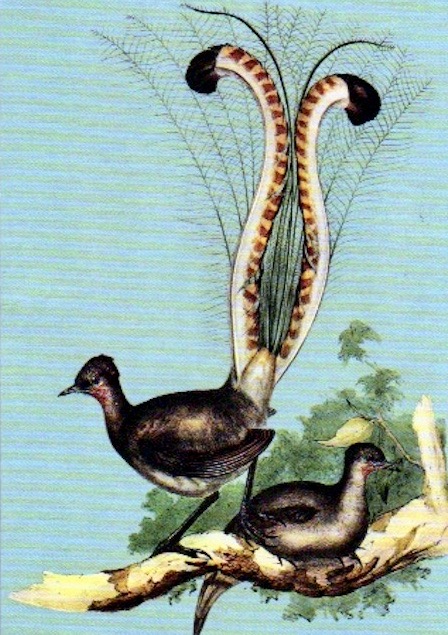
Yesterday, a greeting card from Ann Burlingham, written on 5/5 in Pittsburgh (mostly about the University of Pittsburgh graduation on 5/3, featuring graduate Opal Armstrong Zwicky among the crowd of about 5,000), arrived in Palo Alto on 5/8, with a note beginning:

Another Superb Bird! How many can Australia have?


(#1) [from the Ikonink cards website:] Original Artwork: Superb Lyrebird (Menura superba), illustrated by Elizabeth Gould for John Gould’s Birds of Australia (1840-1848). Currently displayed at the Australian Museum.

(more…)

Suzerains of sheldrake

April 26, 2025

Today’s (4/26) morning names: sheldrake (or Sheldrake) and suzerainty. I have no idea how the gorgeous big duck (or the parapsychologist) got into my head; suzerainty might have popped up because of its prominent medial /z/ — I am ever Z-alert — though I don’t recall having seen it in print recently (I don’t think I’ve ever heard it spoken), so it might have come to me just for its oddness. The workings of my mind are often mysterious.

(The music playing at the time — well into a performance of Handel’s Messiah — provides no obvious source for any of these words.)

(more…)

Oblong man eats Normal salad

April 17, 2025

From Emily Menon Bender on Facebook today, with a bit of the menu at the restaurant Medici in Normal, in Normal IL:


[with EMB’s comment:] I’d keep making these puns too if I lived here

This following on a passing reference in my posting yesterday “Me lookee, no findee” to Kutztown State Normal School (as it was when I was a child), a state-supported teachers college in Kutztown PA, now Kutztown State University (that’s Kutz rhyming with puts, by the way; if you pronounce it to rhyme with putts, then in Pa. Dutch English, you’re talking about Barftown)

And with #1 echoing a famous headline announcing:

Oblong Man Marries Normal Woman

Oblong is a village in Crawford County IL. And Normal (as in #1) is a town in McLean County IL.

(more…)

Me lookee, no findee

April 16, 2025

A follow-up to yesterday’s posting “One of these things is not like the others”, in which my (now AI-enhanced) Google search for

“African American linguists”

produced a display of 9 people (plus a further display of 4 others) which was instantly remarkable because the person in the position of pre-eminence in the first display, Walt Wolfram, was not (unlike all the others) African American / Black, but notably German American / white. WW is an amazing, prolific scholar of African American English and its uses and of African American communities, and he is a champion of those communities, certainly deserving of huzzahs and celebratory parades and official recognitions with laurel wreaths and gold-embossed certificates and all that stuff, but he’s unquestionably white — as, in fact, the photo accompanying his name in that display makes clear. (I’ll add that he doesn’t “talk Black” either. His everyday variety of English is working-class white Philadelphia, tenaciously maintained throughout years of formal education; it’s one of his badges of identity.)

(more…)

Foxes, camels, and Jeff the Tongue

April 5, 2025

From Jeffrey Golderg the Linguist (not Jeffrey Goldberg the Journalist — Jeff the Tongue, not Jeff the Pen) on April 3, passing on a Facebook posting with an old Soviet joke, along with monitory commentary from On Tyranny author Timothy Snyder the Historian:

(News note: Snyder, his historian wife Marci Shore, and his philosophy colleague Jason Stanley are all leaving Yale to move to the University of Toronto in the fall)

I’ll comment here briefly on two things: old Soviet jokes, some of them now startlingly applicable to life in the Soviet States of America under President Putinitsa and her sidekick Evilon; and the naming convention in Jeffrey Goldberg the Journalist and Jeff the Tongue.

(more…)

Hybrid portmanteaus

March 31, 2025

🐅 🐅 🐅 three tigers for ultimate March, the day on which the tigers eat the lambs that the month proverbially goes out as; my posting for this morning begins with tigers, but only so I can slide into the real topic:

the hybrid portmanteau ‘a portmanteau (name) for a hybrid (creature)’ — as in the names liger (lion + tiger) ‘hybrid of a male lion with a tigress’ and tigon (tiger + lion) ‘hybrid of a male tiger with a lioness’, as opposed to unmixed names for hybrids, like mule ‘hybrid of a male donkey and female horse’ and hinny ‘hybrid of a male horse and a female donkey’. Hybrid portmanteaus are iconically satisfying: intimate name-melding (through the combination of word-parts) signifies intimate creature-melding (through mating).

From this beginning, I will rapidly descend to the hybrid portmanteau triceradoodle (the creature is a preposterous hybrid of a triceratops and a poodle) and eventually to the double hybrid portmanteau composite Gerberian Shepsky (an actual dog breed, a hybrid of a German shepherd and a Siberian husky)

(more…)

Fortuitous soup

March 16, 2025

This is a third Kharkiv Opera posting, about a pleasant, playful, joyous event staged in the face of terrible times. Previously on this blog:

— on 3/9, “The dandelion caper”, about the enjoyment of the plants and flowers around us

— on 3/11, “Music of the night, about the enjoyment of music

Today, it’s about the enjoyment of food, in particular a 2/17 soup* I contrived from things I happened to have in the house — leftovers from a Chinese food delivery; some leftover crunchy salad greens; rice sticks (maifun), which are staple household supplies in my kitchen cupboard; beef broth in a carton, ditto; and some fine chili power that I got as a gift a while back.  The result was fabulous, and there was enough for three meals. Amazing Wok duet mushroom beef, Taylor Farms Mediterranean crunch salad, Dynasty rice vermicelli, and Penzey’s medium hot chili powder: I salute you.

[*The mills of the mammoth grind exceedingly slowly.]

(more…)

Bari soup

March 16, 2025

Elsewhere, in my queues for posting, there’s one in the Kharkiv Opera series on a fortuitous soup, a delicious invention I will probably never have the ingredients for again. Today I write about a soup made from leftovers, but one I have every time I order the base dish, Bari pasta from the restaurant Crepevine in Mountain View CA.

As I was making the soup yesterday, it occurred to me to wonder about the name of the dish (the dish is fettuccine with a fresh salmon, spinach and Parmesan cream sauce — to which I have shrimp and salmon fillets added). I was aware that Bari was a city in Italy, but had no idea whether it had any connection with fettuccine or with salmon and spinach cream sauce; for all I knew, the name was chosen purely for its sound — it sounds crisp and Euro-trendy — or because someone at the restaurant had family from the city Bari (restaurants and their dishes are often named that way) or in honor of someone named Bari (that happens too), or specifically in honor of someone from Bari whose signature dish this was.

(more…)