The One Big Happy from 12/30/18:
 (#1)
(#1)
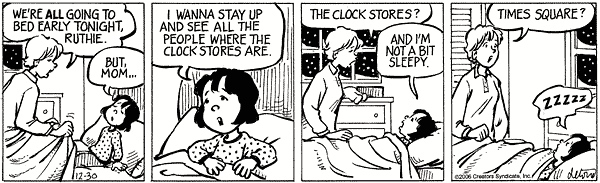
Ruthie has heard that huge numbers of people gather in Times Square on New Year’s Eve. But why is it called Times Square? Obviously ’cause that’s where you go to tell time — where the clock stores are.
The One Big Happy from 12/30/18:
(#1)
Ruthie has heard that huge numbers of people gather in Times Square on New Year’s Eve. But why is it called Times Square? Obviously ’cause that’s where you go to tell time — where the clock stores are.
Keep X In AXB, Put X (Back) In(to) AXB, Take X Out of AXB
(where X is a word included in a larger word AXB — included in pronunciation (exactly or approximately) or spelling or both)
I’ll start with one of the most complicated examples, the seasonally apropos slogan with KEEP:

(#1) An outdoor vinyl banner from ChurchSupplier.com
then go on to a seasonal example with TAKE, and end with the great mass of examples, with PUT.
(Warning: tons of dirty words for the holidays.)
The title of the Scenes From a Mutiverse cartoon on the 23rd (here), in which two (gender-marked) alien creatures reflect on the horrid year that is coming to an end and announce extraordinary resolutions for the new year: he resolves to stop storing personal possessions inside his body, she resolves to eat bees, that sort of thing. But my focus here is on his first two words: a foul oath, a compound expletive, interjection, or exclamation. Which will lead us to the excesses of punk rock in Scotland.
A juxtaposition of two sets of greetings for the season, each expressing thanks for the recipient’s work.
Item A, two pieces of e-mail to Emily Menon Bender, from completely unfamiliar organizations, thanking her for her publications in computational linguistics: some new cross between holiday cards from commercial associates (maintaining the business relationship) and what Margalit Fox calls “demented p.r. releases”, what amount to cold calls (by electronic means or ordinary mail) soliciting the recipient’s business.
Item B, a brief e-mail to me from a complete stranger thanking me for my blog postings. Thanks to the fact that the sender has a name even rarer than mine, I was able to verify that he was not only a real person but a very interesting scholar — and the note moved me far more than he could have imagined, coming after a long dispiriting week. (What’s more, it turned out to latch onto my morning name from the 18th, (Lady) Ottoline Morrell.)
It began with a plant at the Gamble Garden in Palo Alto, a plant that reminded me of a cedar shrub, with scale-like leaves. This turned out to be Fabiana imbricata violacea (or Chilean heather — it was in the central Chile section of the garden, in fact), in the Solanaceae, the nightshade family (also including tomatos, potatoes, tobacco, petunias, and much more). Then in the South Africa section, a rather similar shrub, with scale-like leaves; this turned out to be a variety of Coleonema pulchellum (or confetti bush), in the Rutaceae, the rue or citrus family (which generally have broad leaves).
The coleonema was growing together with some (broad-leaved) plants with interestingly contrasting foliage: some scented geraniums and some Martin’s spurges. Bringing in two more plant families — respectively, the Gerianaceae (or geranium family) and the Euphorbiaceae (or spurge family).
All this led me to Calluna vulgaris, or heather (given that I already had “Chilean heather”), in still another plant family (the Ericaceae, the heath or heather family), with needle-like or scale-like leaves. And of course to cedars, with their scale-like leaves. Well, the cedars I first thought of were “Japanese cedars” — Cryptomeria japonica, in the Cupressaceae (or cypress family). But wait! The well-known cedar trees, the cedars of Lebanon, are Cedrus libani — with needle-like leaves, in the Pinaceae (or pine family).
Ah, needle-like leaves — not just in (some) conifers, like the fir tree (in the Pinaceae), but also in other families: for example, in rosemary, in the Lamiaceae (the labiate or mint family, otherwise mostly broad-leaved).
Two themes here: leaf types (broad, needle-like, scale-like) and plant families (including a number not already in my inventory, even though the plants in them are very familiar). Plus, of course, the familiar agony about common names (think about those heathers, and those cedars). Details follow.
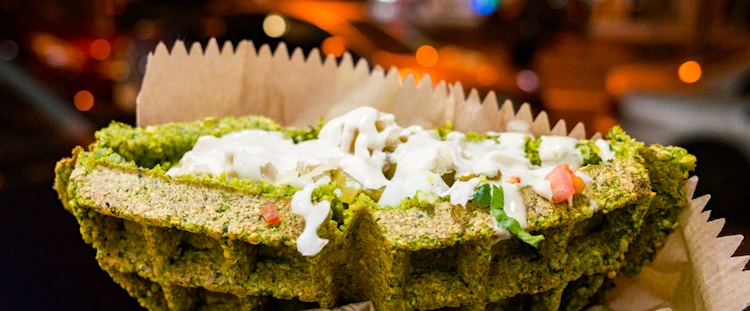
Better together: Belgian waffles and Israeli falafel. From several Facebook friends, a pointer to Tablet magazine ‘s “The Belgian Falafel Waffle: An edible miracle of modern science takes off in Rishon LeZion” by Flora Tsapovsky on 12/18/18:
 (#1)
(#1)
Einstein was born in Germany and lived there as a child. By the time he died, he’d renounced his German citizenship and acquired two other citizenships, first Swiss and then American, which he kept throughout his life. So it’s not at all easy to describe his nationality. (I’m on this case because of the Swiss part of the story, of course.)
From Wikipedia:
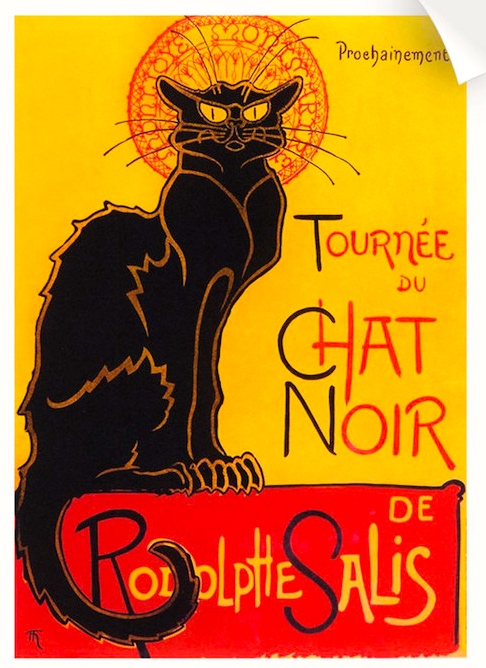
(#1) Steinlen poster of 1896 advertising the Montmartre cabaret Le Chat Noir
Théophile Alexandre Steinlen (November 10, 1859 – December 13, 1923), was a Swiss-born French Art Nouveau painter and printmaker. Born in Lausanne [in Canton Vaud in Francophone Switzerland], Steinlen studied at the University of Lausanne before taking a job as a designer trainee at a textile mill in Mulhouse in eastern France.
He then found his spot, the place that suited him in life: the Montmartre district of Paris.
And became Swiss French (in the narrow sense): a French person who emigrated from Switzerland. Narrowly Swiss French, in the way that distinguished 19th-century scientist Louis Agassiz was narrowly Swiss American: from my 2/7/13 posting “Swiss American”:
Agassiz was Swiss American in the narrow sense; he emigrated from Neuchâtel (in Francophone Switzerland) to Boston and took American citizenship.
My pursuit of Swiss X, for various nouns X, continues with four Swiss roll chapters, starting with a cake roulade and going on to a rolled hair style; roll short for bread roll; and roll short for roll-up (referring to a bread roulade).
Bonus: the cake roulade is appropriate to the season, since a Yule log or bûche de Noël is one, just dressed up for Christmas.
It started at the Peninsula Creamery in Palo Alto at breakfast (with Elizabeth Daingerfield Zwicky) this morning, quickly led to a chocolate beverage from northern New Jersey (and to manner-of-speaking verbs) and after a whirlwind worldwide beverage tour ended up with an echt-Swiss dairy soft drink from Canton Aargau, Switzerland (up north, on the flatlands near the Rhine).
The impetus for all this, a vintage advertising poster on the wall at the Creamery:
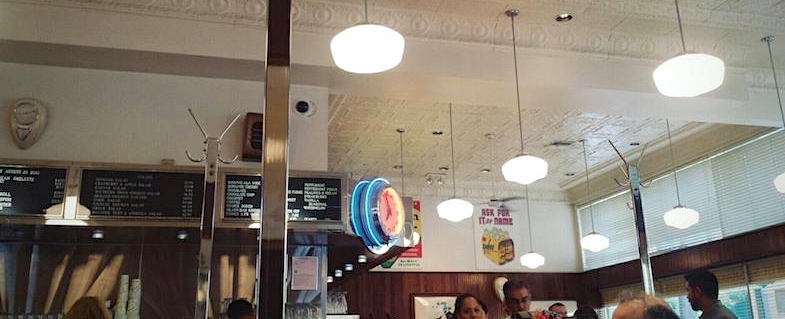
(#1) ASK FOR IT by NAME: Yoo-hoo