Archive for the ‘Morphology’ Category

Aged anchovy salt

December 27, 2024

🎁 Boxing Day 🎁 — also St. Stephen, with his feets uneven — coming a day late, because life has been very difficult for me, and postings have piled up so high I’m not sure I can ever get to them, so I’ve picked something I know I can get done, so that this dark, rainy, and excruciatingly painful low-air-pressure day will not be a total loss

I bring you an e-mail message from Victor Steinbok on 12/25, about this ad for Spice Tribe (website here), a San Francisco-based on-line spice store dedicated to mindful cooking:


(#1) VS wrote: Facebook has offered another example of what I used to refer to as parenthetical ambiguity. Is it [aged anchovy] [salt] or [aged] [anchovy salt]. From a culinary perspective, the latter makes no sense (aging salt doesn’t change it). But that doesn’t mean there’s no built-in ambiguity.

(more…)

Doctor The Who

December 18, 2024

For today’s Bizarro, a portmanteau title — Doctor Who + The Who = Doctor The Who [with the overlapping material underlined] — for a hybrid cartoon character, who is simultaneously Tom Baker’s 4th Doctor Who and also the leaping, jumping Pete Townshend of the rock band The Who:


(#1) Wayno’s character is, in appearance and dress, Baker’s Doctor Who; but this character is also, in action, Townshend’s hyperactive guitarist in The Who (if you’re puzzled by the odd symbols in the cartoon — Wayno says there are 3 in this strip — see this Page)

(more…)

The Chapel Hill messiah

December 16, 2024

An invitation on Facebook on 12/13 from linguist Jennifer Arnold, performing her musical role (crucial phrase underlined):

If you like to sing, come to the Chapel Hill Messiah open sing tomorrow evening! I’ll be in the viola section.

My response:

I had a confused moment when I thought you’d be singing the praises of the Messiah of Chapel Hill (whoever he is; I’m woefully out of touch with things, and thought I must have missed the rise of a Prince of Peace in the New South).

(more…)

Welsh days

December 10, 2024

More remembrance of times past, recollections triggered by e-mail exchanges between Waynes Browne (at Cornell) and me (at Stanford). The story comes in three parts:

— my 10/12/24 posting “Namesakes and surnamesakes”, which reported on e-mail from WB, the first half of which I riffed on in that posting

— the second half of that e-mail, all about Welsh (recalling our Welsh days at MIT 64 years ago)

— the product of years of my work on the description of Welsh syntax and morphophonology, from only 40 years ago (in a 1984 Chicago Linguistic Society paper)

(more…)

Slip into a plush penguin

November 26, 2024

From Chris Ambidge (one of the Wardens of the Spheniscid Zarchives) on Facebook this morning:


(#1) [CA > AZ:] Arnold! Have you considered … penguin slippers? Keeping Feathers McGraw underfoot might be the best way to make sure he doesn’t get into mischief

From the Coddies website:

CoddiesÂŽ Wallace & Gromit Feathers McGraw slippers:

Silent but villainous, Feathers McGraw is the ultimate plush slipper icon!

Slip into the soft embrace of Wallace & Gromit’s Feathers McGraw himself with Coddies’ new plush slippers, designed to capture the essence of Aardman’s criminal mastermind. They fit like a glove – not unlike the red rubber glove perched atop Feathers’ head – a disguise so brilliant in its simplicity that it once outwitted Wallace and even the local law enforcement.

(more…)

Sweatless in the poolside sun

November 24, 2024

(There will be mentions — in vernacular but not actually vulgar terms — of male-male sexual practices that some will find icky, so this posting will not be to everyone’s taste; and it might stretch some kids’ horizons a bit, so a gentle warning)

From back on 10/30, e-mail from Gadi Niram, with a video gift for me, saying: I found this video (and the young man in it) to be quite a pleasant diversion:


(#1) Screen shot from the video, which you can view here

A shirtless young man in ripped denim shorts playing the 3rd movement of Beethoven’s “Moonlight” Sonata (Piano Sonata No. 14 in C-sharp minor, Op. 27 No.2) on a fancy grand piano (with a mirrored fallboard, as in the finest piano lounges). alongside the pool at at what looks like a tropical oceanside resort. (For a bit of extra sexiness, those shorts are down far enough in the back to expose the waistband of his black Calvins; here the girls and the gay boys swoon.)

(more…)

The Austria ostrich

November 15, 2024

Very briefly noted.

Passed on back on 11/9 by Michael Palmer on Facebook, this fine reworking of the map of Austria as an ostrich:


MP came across it on the Language Nerds Facebook site, but I don’t know who created the image in the first place

In English, Austria (a Latinization of the German name Österreich ‘eastern realm’) and ostrich (from a compound of the Latin avi- stem meaning ‘bird’ and the Greek struth– stem meaning ‘ostrich, big sparrow’) have only medial /str/ as clearly shared material, so are very distant puns, if they count as puns at all. Much the same is true of Spanish Austria and avestruz.  Things are even more distant in Italian (Austria and struzzo) and of course German (Österreich and Strauß).

But in French, as I pointed out on Facebook, by the accidents of phonological change, Latinized Austria > Autriche and the avi– + struth– compound > autruche, yielding a truly fine pun: Autriche is an autruche!

So Austria not only looks like an ostrich, in French it sounds like one too. This makes me happy.


The helicopterodactyl

November 15, 2024

From Season Devereux this morning, this excellent image on Threads, from the poster linguisticdiscovery:


Two flying entities, the helicopter and the pterodactyl, are about to hybridize, to merge into a single thing, which will then obviously be denoted by the portmanteau helicopterodactyl — Is it a plane? (not exactly, though it’s a kind of aircraft) Is it a bird? (not exactly, though it has wings) It’s Superfly!

(more…)

Swim Meat, the video

October 30, 2024

(Publicity for a gay porn video, entertaining in its way but absolutely off-limits for kids and the sexually modest)

🎃 🎃 🎃 three jack-o’-lanterns for penultimate October, Halloween Eve (that is, the day before the day before the day of the dead) — in my house, the day when the pussyboys go out to seek their phallic prey

Into this scene comes this morning’s e-mail from the Falcon | NakedSword Store, offering:

Hot House movie download discounts — full movies $11.95 each

With, right at the top, the crudely pun-titled video Swim Meat and its cover illustration, offering four fine pieces of swim meat, one (Johnny V’s) just barely concealed by his swimwear; plus three proudly jutting tubesteaks that I’ve had to suppress for WordPress modesty (but here you can view the uncensored cover, along with the publicity text):

(more…)

striking language

October 19, 2024

From Ellen Kaisse in e-mail to me on 10/4 (yes, the blog mill grinds very very slowly on Ramona St.): a nice ambiguity from the Seattle Times, in the first sentence of the story:
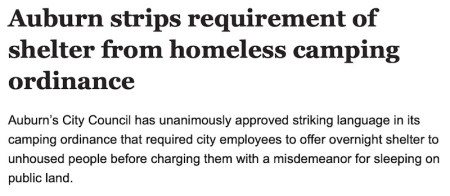

[what EK wrote, with some bracketed amendments by me:] I read striking as an adjective meaning ‘notable’ and modifying language rather than the intended reading where striking is [the nominalization of] a verb with language as its direct object [AZ: the nominalization (together with language and a very long relative clause modifying language) is itself the direct object of the verb approved]. It was only the headline that alerted me that my first reading was the opposite of what was actually approved.

Now if you ask an ordinary person what’s gong on with that sentence, they’ll tell you that it’s ambiguous, and they’ll provide some attempt at a paraphrase (as a sufficient account of the ambiguity), but they’ll simplify things somewhat by disregarding that long relative cause and, in effect, localizing the source of the ambiguity in the expression striking language, telling you that in the Auburn City Council sentence this expression means two different things, ‘notable language’ or ‘removing language’ (from something), and maybe they’ll go on to localize the source even further in the word striking, saying that striking in striking language can mean either ‘notable’ or ‘removing’ (from something).

Ask a linguist, like Ellen or me, and even our briefest answer will go immediately to localizing the ambiguity in specific words that are the crux of the matter. We’ll identify the lexical items involved and supply some relevant properties of the words — what syntactic category they belong to (EK refers explicitly to adjective (Adj) and verb (V) and implicitly to noun (N)); perhaps what derivational and inflectional categories they belong to (implicit in our references to nominalization). And then, especially, we’ll tell you something about the syntactic constructions in which the words are related to one another (we’ll refer to modifying / attributive adjectives, to verbs with direct objects, and so on). Our very brief comments are laden with allusions to the structure of English — its morphology and syntax — as well as to its lexicon.

The linguists’ view is that the lexicon, morphology, and syntax of the language work together in such a way that a stretch of phonological material can convey two different meanings; when we confront an ambiguous expression, we see it not as a brute fact (as if people somehow memorize how phonological substance and semantics are paired with one another, expression by expression), but as the consequence of the system of the language. Surprise! There are two ways you can end up with striking language, two ways the expression can be analyzed. (There are, in fact, more than two; but there are at least the two EK told us about.)

Now I’m going to wade hip-deep into the system of English involved in striking language (and some similar expressions). Not to tell you everything, but to tell you just enough to show you that the system is both big and complex. Therefore, challenging. And therefore, wonderful to figure out. Contemplating stuff like this makes me happy.

(more…)