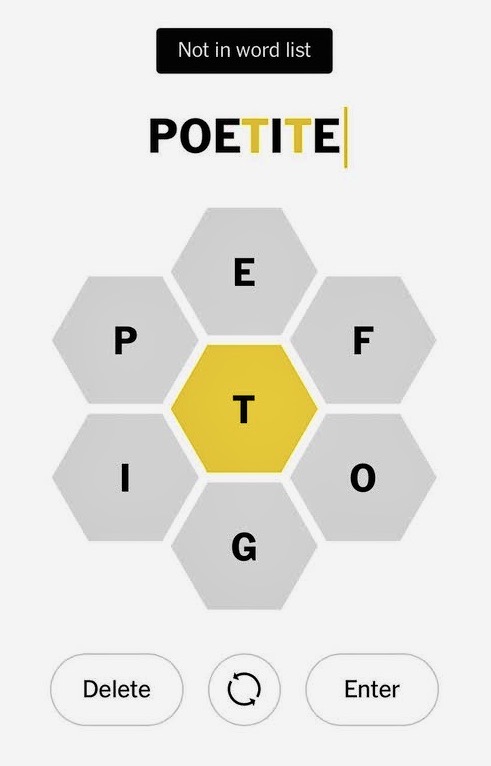
Faced with this judgment on Facebook today about the Spelling Bee puzzle from the New York Times,
Dennis Baron owlishly protested with word play incorporating a pun on concrete:
It’s the stuff concrete poems are made from.
Well played, Dennis!
Faced with this judgment on Facebook today about the Spelling Bee puzzle from the New York Times,
Dennis Baron owlishly protested with word play incorporating a pun on concrete:
It’s the stuff concrete poems are made from.
Well played, Dennis!
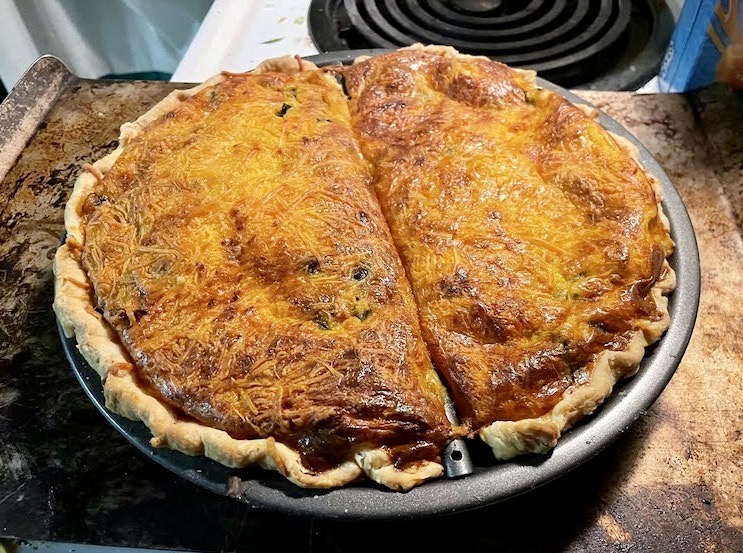
Gretel Cunningham Young (of Columbus OH, where she grew up, with my daughter Elizabeth, many years ago) on Facebook yesterday:
— GY: My goal was to make a half-vegetarian, half-carnivorous quiche, so I ordered this divided pan
Noting her reference to carnivorous quiche, plus an odd quirk in way English vegetarian is used, I reacted to her statement with some alarm (my response in an expanded and improved form here):
— AZ: But I don’t think I want to get near a carnivorous (‘meat-eating’) quiche, lest I be devoured by it. vegetarian quiche has the adjective vegetarian ‘(of food or diet), plant-based, excluding meat’, not the noun vegetarian ‘(of people) a vegevore, someone who eats only plant-based food; a non-carnivore, someone who does not eat meat’. A quiche that’s a vegetarian would not be a threat to me (as a being made of meat), but it would nevertheless be creepy, in a cannibalistic sort of way. The meaty correspondent to vegetarian quiche ‘quiche for vegetarians’ would be quiche for carnivores.
An Ellis Rosen cartoon that came by on Facebook recently:
(#1) The hybrid creature the pomeranian-nimbus, being taken for a walk, on a leash, by its owner — so being presented as an extraordinary dog, a cloud canine; note that the woman’s dog recognizes the p-n as a dog, and appears to want to play with it (see the wagging tail)
(The name of the dog breed is standardly capitalized, because it’s a proper name denoting a creature originating in the geographical region of Pomerania, and I’ll use Pomeranian from here on.)
The compound Pomeranian-nimbus is a copulative N1 + N2 compound (like Swiss-American or hunter-gatherer), denoting a thing or things of both the N1 type and the N2 type. But in fact the creature is not just a mix of Pomeranian dog and nimbus cloud, but is actually a nimbus Pomeranian ‘Pomeranian dog that is (also) a nimbus cloud’ (your standard N + N compound in English is semantically modifier + head) — rather than a Pomeranian nimbus ‘nimbus cloud that is also, or at least resembles, a Pomeranian dog’. A nimbus Pomeranian, or, more compactly, a nimbopomeranian, a nimpom for short.
From Benjamin Dreyer on Facebook yesterday:
It’s once again been brought to my attention that many people seem not to grasp that Ice Capades is a play on words and that they are not in fact capades on ice.
(I myself learned this at a rather advanced age, but: earlier than today.)
Well, Ice Capades originated as a play on words, but that doesn’t mean it still is (only) a play on words. History is not destiny. BD tells us, in fact, that many people — I would say almost all of us — don’t appreciate that it originated as a play on words. Which is to say that for all these people it is not a play on words, but an odd compound of ice and capades. Just as, for almost everyone these days, the name of SRI International (a Silicon Valley R&D nonprofit institute) is just a string of letter names, not an abbreviation for anything, despite the fact that the organization began its life as the Stanford Research Institute (I know this, but I’m a very old man, 6 years older than the Stanford Research Institute); SRI is now an orphan initialism.
So now, a lot of facts.
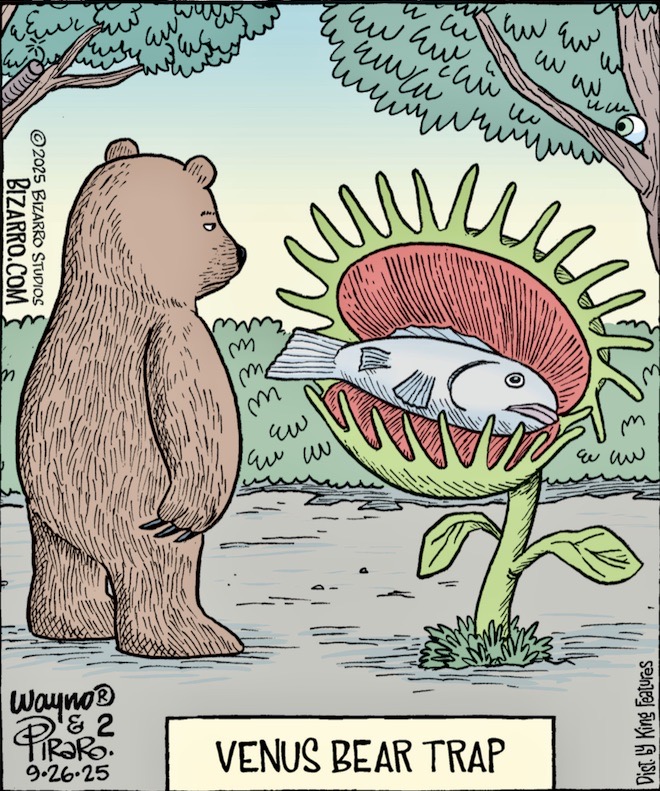
In today’s Bizarro cartoon, a hybrid portmanteau, a portmanteau name for one kind of hybrid referent, a referent with an assortment of features drawn from the referents of the contributing expressions; think of triceradoodle (referring to a hybrid of a triceratops and a poodle cross) = triceratops + doodle ‘a poodle cross’ (to be illustrated below):
(#1) Venus flytrap + bear trap = Venus bear trap: the appearance of a giant Venus flytrap leaf, with the bait of a foothold bear trap (if you’re puzzled by the odd symbols in the cartoon — Wayno says there are only 2 in this strip — see this Page)
To come: details about the two contributing referents, the Venus flytrap and the (foothold) bear trap; then a factor that makes this portmanteau especially rich and satisfying, in contrast to the less complex (but far more preposterous) triceradoodle.
In human beings, the mouth is the only bodypart that comes equipped with teeth. Well, there are fables of the fearsome vagina dentata and even — top men, beware! — of the occasional anus dentatus. Now the wonderful world of prehistoric nature brings us a penis dentatus. Or so we learn from the latest WIRED.
From WIRED Science, “An Ancient Penis Worm With Rings of Sharp Teeth Has Been Discovered in the Grand Canyon: The 500-million-year-old fossil, containing a species named in honor of the krayt dragons in Star Wars, is a much larger ancestor of phallic marine worms that can be found on the seabed today” by Marta Abba on 8/19/25:
Penis worms are marine creatures with a distinctly phallic appearance. There are more than 20 known species living across the world’s oceans today, as well as a number of extinct ones, like this new discovery. The researcher who made the find was searching for fossils in the Grand Canyon and named the species Kraytdraco spectatus in honor of the huge burrowing krayt dragons that appear in the Star Wars universe. Details of the discovery were published in the journal Science Advances.
E-mail today from Luis Casillas to me and Luc Baronian (it’s a Stanford connection), with his header:
Apparently English “n’t” is trulyn’t an inflectional affix after all
(intending to convey ‘truly not an inflectional affix after all’) and then the comment:
Seen on Twitter:
In memoriam John Robert Ross (May 7, 1938 to May 13, 2025). The news of Haj’s death came in my morning e-mail on Wednesday 5/14, right next to a Bizarro cartoon with a cowboy joke / restaurant joke, turning on an absurd pun on ranch dressing that Haj (who was a walking library of jokes) would have appreciated, and so with a synchronicity that Haj would have delighted in.
J.R. Ross was an outsized figure in linguistics, whose ideas (beginning with his 1967 MIT dissertation, Constraints on Variables in Syntax) altered the field. Haj Ross was a literally outsized person physically, a large, blocky man (he really did play football for Yale as an undergraduate) with a big presence. And Haj, no surname needed, had an outsized personality — endlessly imaginative, enormously funny, astonishingly empathetic and gentle, “big and sparkly” (me on Facebook), with “an amazing facility for the intricacies of English” (John Beavers on FB) and “an innocent sense of wonder about language, poetry, and the world” (Susan Fischer on FB). And resolutely counter-cultural (often barefooted, and rarely standing on ceremony), also attuned to all the Zen-inflected frequencies on your radio dial.
He was a good friend of mine, and an inspiration to me, from 1963 on. So this posting is hard to write. I will collect myself and pick out some facts, some assortment of outrageous anecdotes, a small selection of his poetry and artwork, and even (since, like Haj, I’m hopelessly a linguist) a note about a neglected feature of his work on syntax that I think is important in the intellectual history of the field. I will do all that in another posting, I hope tomorrow.
Today I’ll start the way Haj often started his public presentations. With a joke, that Bizarro cartoon (remember the cartoon?). From which a Google AI Overview search then led me, goofily, into a strange dusty canyon of verse, Jim Ross’s self-published Pull Up a Chair: Cowboy Poetry. Truly, Haj would have loved that.
Today’s morning name was Zimbalist, which came to me at 4:10 am to the accompaniment of the delicious, very French, piano music of Erik Satie (to which it has no associations I can think of). I understood the name to refer to Stephanie Zimbalist, most famously (with Pierce Brosnan and Doris Roberts) a star of the American tv show Remington Steele. But then the topic branched wildly in many directions, in a way I couldn’t imagine organizing into a single posting. So, today, just one piece of that network of topics, the surname Zimbalist.
Zimbalist looks like zimbal + ist, an association surname, possibly an association to an occupation, and so it is: it’s a Slavic Jewish surname meaning ‘cimbalom / cimbal player’ (so it’s parallel to the common nouns pianist, violinist, accordionist, trombonist, clarinetist, etc.).
(The initial letter c of cimbalom represents a voiceless dental affricate [ts], spelled with a c in Russian, a z in German; because of the spelling with c, the name cimbalom is pronounced in English with an [s], and because of the spelling with Z, the name Zimbalist is pronounced in English with a [z] — yes, this is a multilingual, multiorthographic mess, but don’t blame me, I’m just the reporter.)
Now, briefly, to the instrument.