Archive for the ‘Inflection’ Category

-core music

August 9, 2012

So, it starts with coverage of the latest crowd gunning-down (James Dao and Serge F. Kovaleski, “Music Style Is Called Supremacist Recruiting Tool”, NYT yesterday):

… the shootings [at a Sikh temple in suburban Milwaukee] also shined a light on an obscure cultural scene that is helping keep the movement energized and providing it with a powerful tool for recruiting the young and disaffected: white power music, widely known as “hatecore.”

Yes, hatecore.

(more…)

Excrescent ‘s

June 8, 2012

Back on May 21st, Victor Steinbok posted an example from a comment on Google+:

(1) Does anyone see what’s the tactic is?

noting that such things were common in comments and in speech, and observing that (1) could be seen as a blend of

(2a) … what’s the tactic?

(2b) … what the tactic is?

(If you’re dubious about (2a), hold that thought for a moment.)

Searching for more examples of the form {“what’s the * is”} was pretty much hopeless, thanks to the flexibility of Google searches, but I did pull up a large number of examples of the form:

 what’s the Expletive is

and then, more generally:

what’s/who’s the Expletive FormOfBE

and also

what’s the Expletive FormOfDO

which have no natural analysis as blends. Instead, the expletive examples look like they have an excrescent ‘s, reinforcing or emphasizing the WH interrogative word — as in non-standard how’s about, how’s come, what’s about, etc. mentioned here (section 11).

(more…)

Manly superlatives

May 17, 2012

Posted by Kirk Phillips on his BrandSTOKE site on April 26th,”Is Mr. Peanut man enough?”:

Let’s say you want to sell more nuts to men.

Let’s say you obtained a rare Men’s Health endorsement.

Let’s say you are Planters.

What do you do with your fop of a spokes-character? You know, that cane-twirling, white-gloved, top-hatted dandy?

What Planters did was introduce him to a rough crowd (a pistachio and an almond) to toughen up his image. The three comprise Planters NUT-rition Men’s Health Recommended Mix, “the  manliest mix we’ve ever assembled.”

The tv ad can be viewed here. A sample:

(more…)

Redundancy vs. simplicity

April 4, 2012

From David Parkinson on Facebook, an expression of his frustration in his German class:

If your language (like English) doesn’t have much inflectional morphology, then learning a language with a respectable amount of it (like German) can be a chore: you have to learn to mark all sorts of distinctions in grammatical categories that don’t come naturally to you.

Many of these inflectional marks are, at least in part, redundant (in a technical sense); they reinforce category distinctions that are marked in other ways. Marks of agreement are like this. So, in German, the definite article agrees in case, gender, and number with its head noun.

Speaking very crudely, these redundant marks are helpful to the hearer, by giving extra cues to relationships among the parts of phrases and clauses. They aid comprehension.

On the other hand, these redundant marks require effort on the part of the speaker, in planning language production and and accessing the appropriate inflectional forms. They work against simplicity.

There are trade-offs here. Redundancy is good. But simplicity is good too.


Fiction rule of thumb

January 23, 2012

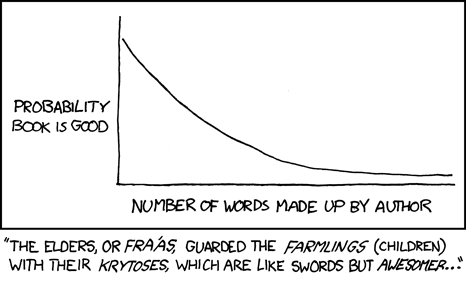
One more cartoon, and then I have to get on with the rest of my life. This xkcd is from a comment by Army1987 on the Language Log posting “Create a language, go to jail” (here):

A lot of invented vocabulary is certainly a barrier to literary appreciation — and so is a lot of foreign-language vocabulary. Conlang or natural language, lots of unfamiliar vocabulary puts readers off.

(I’m not sure about Randall Munroe’s attitude towards the inflected comparative awesomer; it’s easy to find examples, but many of them are jocular and Munroe might be treating them as non-standard innovations.)

re-up

October 6, 2011

Once internal vs. external inflection came up on ADS-L (originally with respect to double downed instead of doubled down; discussion here), people began looking at other interesting cases of inflection in composite expressions, including in the odd verb re-up ‘re-enlist’. Wilson Gray reminisced about his army days, reporting

the conflict in the barracks, back in the day, between the supporters of re-ing up and the backers of re-upping.

Naturally, each side thought that the other side was seriously compromised in its control of derivation in English.

(more…)

Externalization of verbal inflection

October 5, 2011

A little while ago, Wilson Gray reported an occurrence of double downed as the PST form of the verb + particle idiom double down; doubled down is the standard PST form, so in this usage the inflection has been “externalized”, moved from the head (the verb double) to the edge.

(more…)

getting your money worth

September 7, 2011

From an NPR Morning Edition story about Hulu this morning:

He better be, or you’re not getting your money worth.

Getting your money’s worth is the standard idiom, but here the possessive inflection has been truncated — by a speaker who gave no indication of being a speaker of AAVE (in which unmarked possessives are reasonably frequent).

And it’s most unlikely to be a slip, an inadvertent error.

(more…)

Portmanteau cleverness, plus drama kings

August 2, 2011

Recent portmanteaus that were intended to be clever: Ocularpation, male-odrama.

(more…)

muskox(en)

July 28, 2011

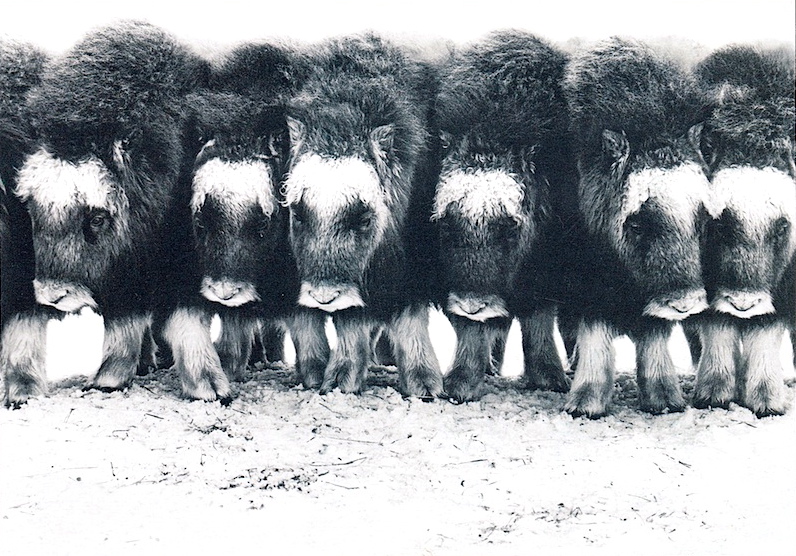
From Chris Waigl (in Fairbanks AK), two photos of Arctic ruminants:

LARS is the Large Animal Research Station at the University of Alaska, Fairbanks. Photo by Chris.

This photo is on a card from Greatland Graphics in Anchorage. The linguistic hook comes in the text on the card:

(more…)