Archive for the ‘Nouning’ Category

Forensics

June 9, 2011

In conversation with Elizabeth Daingerfield Zwicky a few weeks ago, the topic of what to call what she does at Yahoo! (essentially, finding solutions to ill-defined problems involving networks) came up. She and some of the people she works with were inclined to refer to it as network forensics or simply forensics. This puzzled me, since I didn’t see how legal matters came into it.

And then I recalled a different non-legal use of forensic reported to me some years ago: as a noun referring to a gathering with a formal program, such as a speech or a film.

So, two different semantic extensions of forensic(s).
(more…)

Seltzer aperient

February 28, 2011

Another 19th-century trade card that came by me today:

(more…)

Data points: nouning 2/27/11

February 27, 2011

Harper’s Magazine, Feb. 2011, in “An ad creative’s glossary” (box in “A Superbowl Spot for Uncle Sam: Can Madison Avenue make us love our government”, a forum with creative officers at four ad firms, moderated by Thomas Frank and Donovan Hohn):

BUY: the purchase of advertising time or space, e.g.. “a $3 million network-television buy”

Examples in context throughout the piece.

The verb buy has been being nouned for around 130 years. From OED2:

orig. U.S. A purchase; best buy, the most worth-while purchase or bargain. Also fig. Phr. on the buy: actively buying.

with cites from 1879 (the best buy), 1890 (biggest buy), 1903 (my new buy), 1911 (a good buy), 1929 (on the buy), 1952 (the best buys), etc.

The adperson’s buy is more specific than purchase and briefer than purchase of advertising time or space, so it has a lot going for it, in the appropriate context, of course (on specificity and brevity as motivations for category conversions, see here).


scoot(er)ing

February 25, 2011

From two weeks ago, this report from Elizabeth Daingerfield Zwicky on an exchange between her and her daughter, Opal:

Me: Now you can just scoot down the block!

Opal: Mom! You said ‘scoot’!

Me: Yes?

Opal: You didn’t say ‘scooter down the block’, you said ‘scoot down the block’!

Me: Isn’t that what you do on a scooter? Scoot?

Opal: No! You scooter on a scooter! You scoot on a scoot. (rides off, singing ‘Scooter on a scooter! Scoot on a scoo-ooot!”)

Elizabeth was treating the noun scooter as a derivative in –er from the verb scoot ‘move swiftly’, while Opal (not seeing the verb as connected to scooter — in the way she fails, not unreasonably, to connect sweat and sweater) creates a verb scooter ‘use a scooter’ by verbing the noun directly.

“You scoot on a scoot” looks like it has a nouning of the verb scoot, though I’m not sure what sort of object Opal thinks a scoot is; maybe it’s just the result of morphological reasoning-by-analogy.

(more…)

Power postcard

February 16, 2011

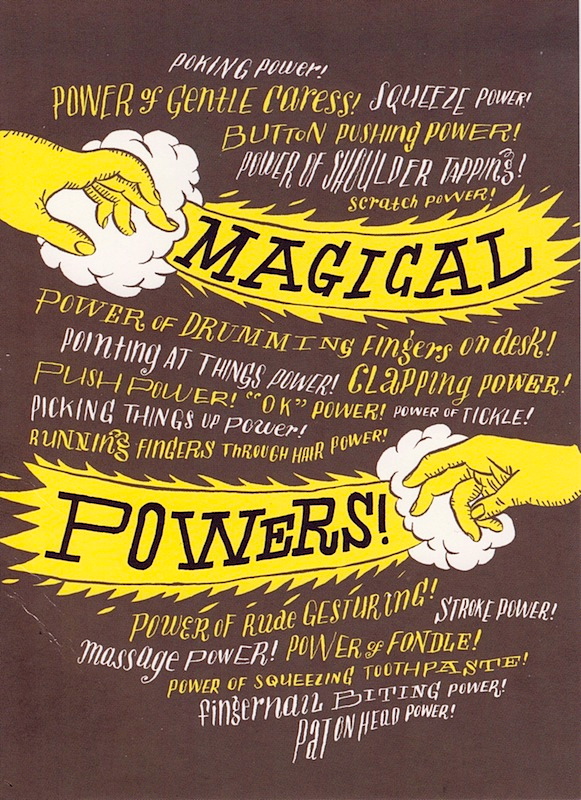
From Ray Fenwick‘s Hi: 30 Postcards, this powerful item:

What first caught my eye were the nounings in power of tickle and power of fondle. But there are also what might be V + N compounds, although some or all of them could be N + N, given a pervasive V/N ambiguity in English: squeeze power, scratch powerpush power, stroke power, massage power. (On some V + N compounds, see this posting on cry face and its relatives and this mention of fish house, wash house, and the like.)

Otherwise, the power expressions are either compounds with nominal first elements (poking power, button pushing power), many of them with phrasal first elements (picking things up power, running fingers through hair power), or else phrases with postnominal PPs in of (power of drumming fingers on desk, power of rude gesturing, power of squeezing toothpaste). These are the two most common ways of combining a nominal dependent with a noun head in English.

More annals of nouning

February 9, 2011

Although it’s hard to judge these things, my impression is that nonce nouning has become a feature of vernacular speech and writing; for some recent examples, see my discussion of Ryan North’s (of Dinosaur Comics) writing style, here, and of the nouning of horny in Scenes From at Multiverse, here.

Now, in the tv series Supernatural, one of the two main characters asks someone about recent events in town, even strange things, adding:

We’ve had a lot of experience with strange.

(more…)

Annals of nouning

January 27, 2011

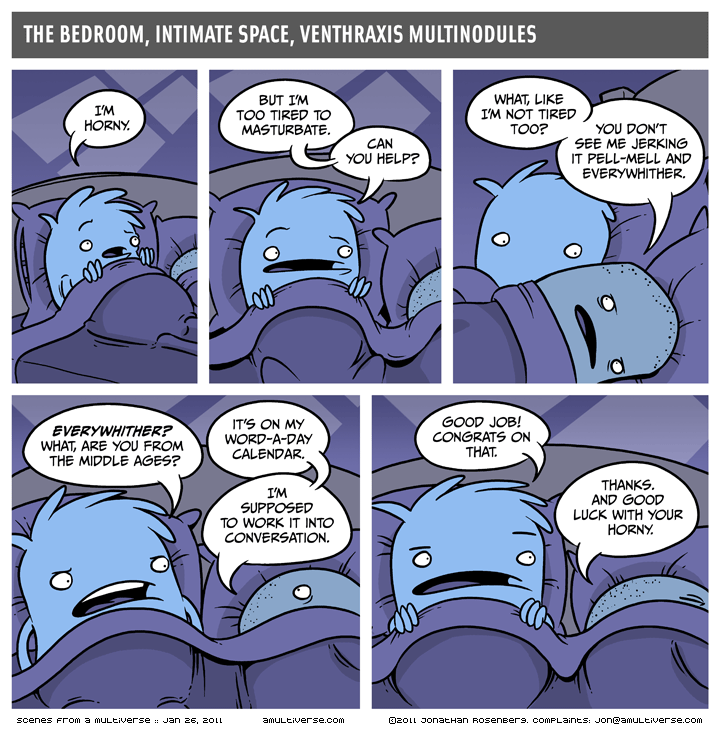
Today’s Scenes From a Multiverse:

Cute nouning of horny (along with everywhither and, in fact, pell-mell, plus the colloquial clipping congrats), to mean ‘horniness’, or possibly ‘sexual arousal’. (And, yes, OED2 has everywhither, with cites from 1398, 1851, and 1888. And in OED3 (August 2010), pell-mell in the sense ‘in disordered haste; headlong, in a rush; at reckless or breakneck speed’, frequently referring to the action of a single person, with cites from 1584 through 1986. And in OED2, congrats for congratulations, with cites from 1884 through 1962.)


Comparative swearology

January 20, 2011

From Out magazine, February 2011, p. 17, on MTV’s racy new teen series Skins, adapted from the wildly popular UK version by the creator and producer of the UK version, Bryan Elsley:

Despite variations in characters and plot, Elsley says teen angst is universal no matter the side of the pond—with one exception: “Americans use fewer swear words than British people. We have about 25 swears at our beck and call, and you have four. It’s really quite strange.”

Two points here.

(more…)

Morning wood on AZBlogX

January 4, 2011

A few notes on morning wood ‘erection upon awakening’, on my X blog because of the accompanying image: here.


Enjoy the Go

November 10, 2010

From Nancy Friedman (who writes on “names, brands, writing, and the quirks of the English language”), passed on by Ben Zimmer, this site for a recent campaign for Charmin brand toilet paper: the Charmin Go Nation, with the slogan (apparently first floated in 2009) “Enjoy the Go”.

(more…)