Archive for the ‘Understanding comics’ Category
August 22, 2025
In the New Yorker issue of 8/25/25, a typically goofy-clever cartoon by Sam Gross, offering SG’s proposal for how Jesus walked on the Sea of Galilee:

(#1) No miracle! But, wait! SG’s account relies on a different kind of miracle — the Octopus of God, gliding supportively underwater, foot to foot, carrying Christ across the sea; that’s the goofy part, God’s really mysterious ways, as the fish have it
(I especially admire SG’s depiction of Jesus as a magical Jew, deep in thought as he navigates.)
Now, for background, the account of Jesus’s aquambulation in the Christian Bible, a collection of texts Christians think of as the New Testament. (I note that SG, a Jew, assumed his readers would be familiar with the story, as part of the common culture of our society; for this, no one involved here has to believe anything.)
(more…)
Posted in Cartoonists, Language and religion, Linguistics in the comics, Understanding comics | 3 Comments »
August 21, 2025
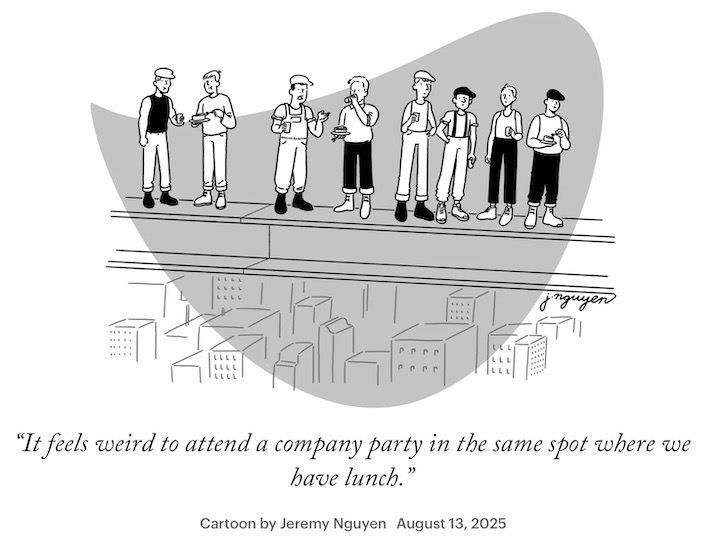
In the latest (8/25/25) New Yorker, a Jeremy Nguyen cartoon in which some construction workers party in the sky:

(#1) A play on the well-known “Lunch atop a Skyscraper” photo originally taken in New York in 1932 (which I have labeled Skylunch 1; it was followed by a series of Skylunch variants)
Nguyen has 8 men, grouped 2, 2, 2, 1, 1; they are working-class guys in casual dress (caps rather than hard hats, no harnesses), standing (rather than sitting) around with simple party fare (rather than lunch boxes) in their hands. What guy #3 finds remarkable is not that they are standing on a girder suspended far above the city streets, but that they’re getting their little party in what is for them their lunch spot. This is elephantlessness: missing the elephant — in this case, the floating girder — in the situation.
(more…)
Posted in Clothing, Humor, Language and food, Linguistics in the comics, Photography, Social class, Social life, Sociocultural conventions, Understanding comics | 3 Comments »
August 1, 2025
🐇 🐇 🐇 rabbit rabbit rabbit for August — and 🇨🇭 Swiss National Day 🇨🇭 (I am of course wearing my Swiss flag gym shorts — with a bright red FAGGOT tank top, to be sure, but I am sporting the flag of my forefathers)
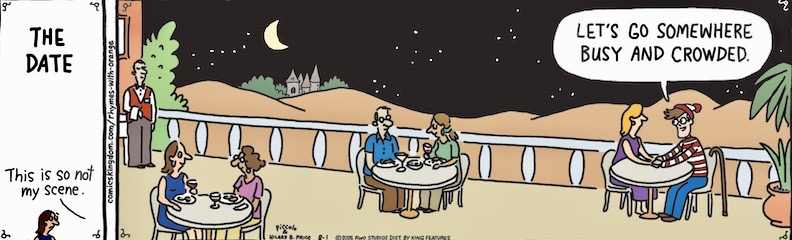
Today’s (Piccolo & Price) Rhymes With Orange strip depends on the viewer identifying the main character, the one who says he wants to go someplace busy and crowded, as a pop-cultural figure known for losing himself in crowds:

British Wally / American Waldo, uncomfortable out in the open, with only one other person close to him
My 8/3/13 posting “The Weinerfest rolls on” has a section on the Where’s Wally / Waldo? books, with this Wikipedia note:
The books consist of a series of detailed double-page spread illustrations depicting dozens or more people doing a variety of amusing things at a given location. Readers are challenged to find a character named Wally hidden in the group. Wally’s distinctive red-and-white-striped shirt, bobble hat, and glasses make him slightly easier to recognise, but many illustrations contain “red herrings” involving deceptive use of red-and-white striped objects.
So of course he’s uneasy, sitting in such an exposed spot.
Thanks to his distinctive garb, Waldo is a frequent subject of cartoons. My 2/17/18 posting “Tell them you haven’t seen him” has a sampling of 4 of them.
Posted in Books, Events and occasions, Linguistics in the comics, Pop culture, Understanding comics | Leave a Comment »
July 27, 2025
Rina Piccolo’s Rhymes With Orange strip of 7/21 presents us with a dog that can read — not just converting text to sound (speaking written or printed matter aloud), but, crucially for the strip, converting text to meaning (‘looking at and comprehending the meaning of written or printed matter by mentally interpreting the characters or symbols of which it is composed’ (a definition adapted from NOAD)):

(#1) Panel 1: happy dog, in a state of innocence; panel 2, where all the action happens: dog sees sign, recognizes that it is a sign, reads it, understands that the sign says that its reader should beware of some dog in the sign’s surroundings (specifically, in the yard the sign is posted in), and recognizes that it is a dog in that yard, consequently concluding that it is the dog the sign’s reader is supposed to beware of, and unpacks the meaning of imperative beware as a warning, about the potential danger of this dog, therefore concluding that it has a reputation as a dangerous animal; panel 3, dog exhibits ferocity fitting to its reputation, by growling at passers-by
So that is one astoundingly clever dog. with an understanding of English and a ton of culture-specific information (about keeping dogs as pets and confining them in enclosed yards, about issuing warnings, and about the interpretation of material printed on signs, not to mention self-recognition, the knowledge that he is a dog). Why, you might think that dog was human — an American, in fact.
Now, some earlier postings (from 2015 and 2021), and notes from 2018 for one that never got posted, because it had started to branch into an essay on everything there is to say about signage– so here you’ll get the notes.
(more…)
Posted in Context, Language and animals, Linguistics in the comics, Pragmatics, Reading, Signage, Sociocultural conventions, Speech acts, Understanding comics | Leave a Comment »
July 26, 2025
A new intricately playful Bizarro series (by Wayno) began on 7/14, with two word boxes, a supertitle Now Playing on A.I. Radio and a regular title; the regular title is a play on the name of a musical group that you might hear on the radio, but with the name altered as if it had been retrieved by a somewhat loopy associative AI program; and with an image that illustrates the goofy name. And then Wayno supplies a further jokey title that’s a play on a further name or title connected in some way with the cartoon. The series, with all of these moving parts, was still going today, 7/26.
Here I bring you the second and third strips, from 7/15 (Wu-Tang Clam) and 7/16 (Bob Marley and a Whaler). Today it’s The Mamas and the Pupas, and I’m one happy cartumer (ok, ok, cartoon consumer).
(more…)
Posted in Language play, Linguistics in the comics, Music, Understanding comics | Leave a Comment »
April 1, 2025
[I wrote this while watching Cory Booker speak on the floor of the US Senate for a record of over 25 hours straight, passionately speaking against the wickedness of the president and his sidekick and in favor of (among other things) diversity, equity, and inclusion; calling repeatedly on my hero John Lewis; and cleansing the nastiness of the previous record-holder, Strom Thurmond, who was filibustering against the Voting Rights Act of 1957. I wept, I cheered, I was moved to hope, at least for a few moments.]
Two triggers for this posting:
— the Zippy strip for 9/30 (so, something close to hot news) in which Zippy and Zerbina reminisce about their fabulous vacation at the Diet of Worms in 1521 (yes, Martin Luther is involved)
— 2022 e-mail from my old friend and linguistics colleague Elizabeth Closs Traugott (who’s a year older than I am but in vastly better shape), about a trip for pleasure she was about to take to (the) Pinnacles, south of here, which reminded me of a similar trip my guy Jacques made years ago. Which then took me to a vacation J and I took together. (Yes, this topic has been simmering on my desktop for three years; I have a prodigious backlog.)
(more…)
Posted in Academic life, Art, German, Language and religion, Linguistics in the comics, My life, Understanding comics | Leave a Comment »
March 22, 2025
… and call it Cochon de lait rôti. Put a mouth on that green apple and call it Le fils de l’homme. Mash them together in a nightmare and you get today’s Bizarro strip, a Wayno Psychiatrist cartoon that’s a re-play of an earlier Bizarro, but with the dream figure of William Tell’s son (with an apple on his head) replaced by a roasted wild boar (with an apple in its mouth):

(#1) Surrealist René Magritte’s Son of Man on the therapist’s couch (if you’re puzzled by the odd symbols in the cartoon — Wayno says there are 5 in this strip — see this Page)
Two things here: apples in the mouths of roasted pigs (as in the patient’s nightmare); and the previous Bizarro strip (from 2022), with the same patient and the same therapist (a caricature of the artist Magritte), positioned differently in the strip, and suffering from dramatically different nightmares.
(more…)
Posted in Allusion, Art, Comic conventions, French, Language and animals, Language and food, Language and the body, Language of sex, Linguistics in the comics, Metaphor, Quotations, Surrealism, Switzerland and Swiss things, Understanding comics | 2 Comments »
March 13, 2025
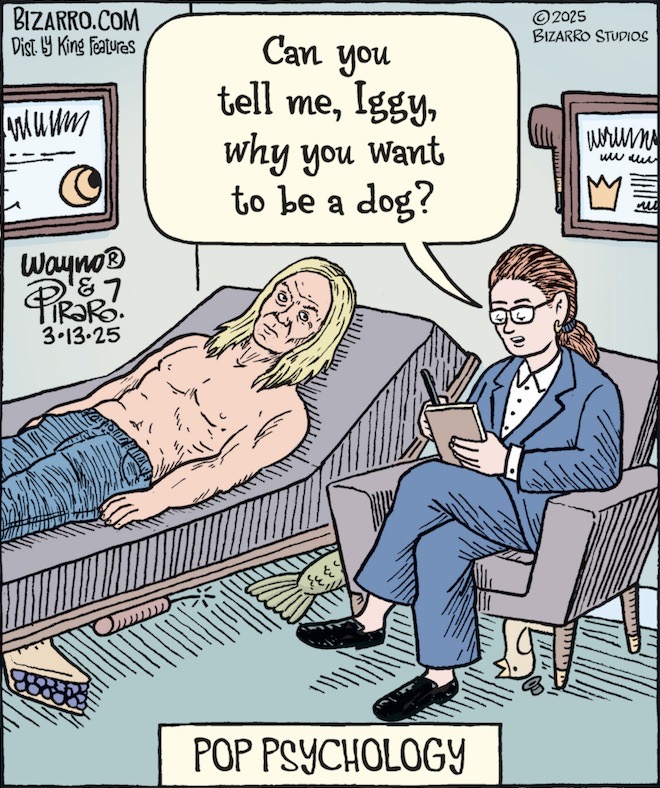
The title of today’s Bizarro cartoon — a Psychiatrist cartoon, which will be incomprehensible to anyone who’s not up on American punk music, with a bare-chested, long-haired patient being asked by the therapist, “Can you tell me. Iggy, why you want to be a dog?”, a question that makes no sense unless you’re up on the lyrics of particular punk-rock songs; Wayno’s title for the cartoon is “Bark Therapy”, which is entertaining but not actually informative:

(#1) You really have to know about Iggy Pop (pictured on the couch) and his 1969 recording of “I Wanna Be Your Dog” (if you’re puzzled by the odd symbols in the cartoon — Wayno says there are 7 in this strip — see this Page)
Iggy Pop has put in a brief appearance on this blog — in my 1/24/16 posting “Morning name: John Varvatos”, in a section on the proto-punk band Iggy and the Stooges (with a reference to “I Wanna Be Your Dog”), But now it’s time to say more.
(more…)
Posted in Comic conventions, Linguistics in the comics, Music, Pop culture, Understanding comics | Leave a Comment »
November 28, 2024
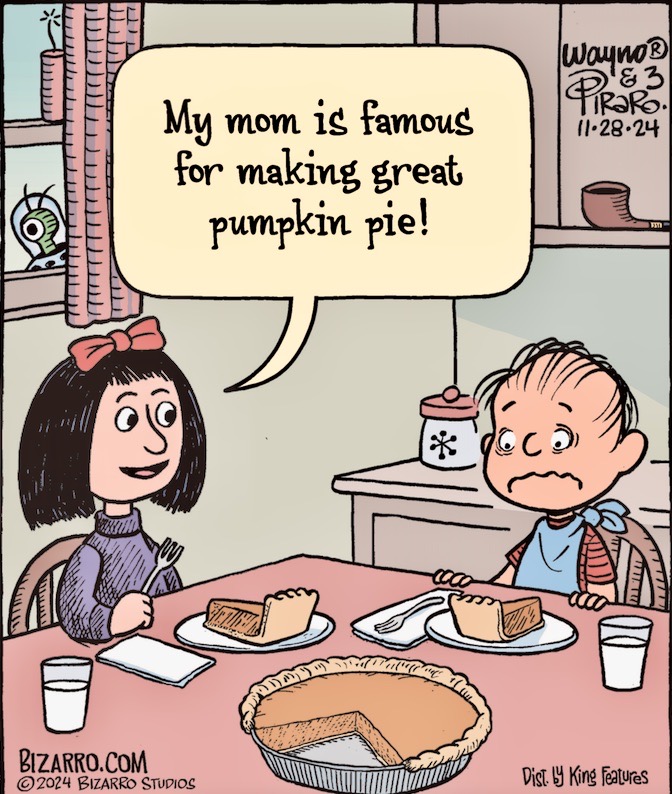
The Wayno Bizarro for today, 11/28, is an exercise in cartoon understanding:

(#1) Wayno’s title: “Horrifyingly Tasty”; I would have suggested the more bloodthirsty “Eat Your Gods” (if you’re puzzled by the odd symbols in the cartoon — Wayno says there are 3 in this strip — see this Page)
But it’s all totally baffling unless you recognize the references to Charles Schulz’s comic strip Peanuts; you really have to know about Linus and the Great Pumpkin. (Meanwhile, your appreciation of the strip will be enriched if you know that today is US Thanksgiving, a harvest festival for which the traditional foods include pumpkin pie for dessert.)
And while we’re talking festivals, the cartoon is a festival of ambiguities in English, structural and lexical.
(more…)
Posted in Ambiguity, Common & proper, Grammatical categories, Holidays, Language and food, Lexical semantics, Linguistics in the comics, Parsing, Understanding comics | 2 Comments »
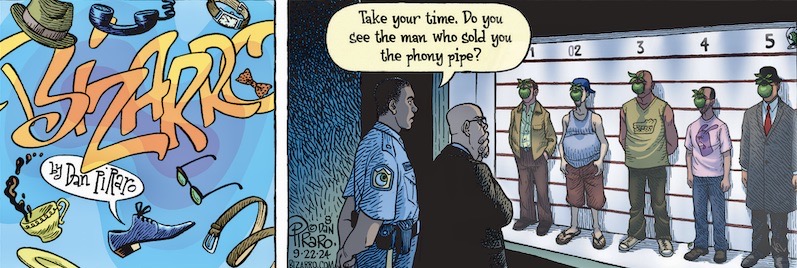
September 22, 2024
A Sunday Dan Piraro Bizarro, a little René Magritte festival that doesn’t actually mention the Belgian surrealist, but just assumes everyone recognizes the three paintings the cartoon alludes to:

Framed as a police lineup to identity a malefactor (if you’re puzzled by the odd symbols in the cartoon — Dan Piraro says there are 8 in this strip — see this Page)
(more…)
Posted in Art, Linguistics in the comics, Understanding comics | Leave a Comment »