Paul Noth in the April 30th New Yorker:
 (#1) “Et tu, Little Caesar?”
Two contributing factors that intersect in the name Caesar.
Paul Noth in the April 30th New Yorker:
(#1) “Et tu, Little Caesar?”
Two contributing factors that intersect in the name Caesar.
One bit of language play (requiring some food knowledge) and one cartoon photograph (rather than drawing) on the Therapist cartoon meme, with the Easter Bunny folded in:

(#1) Poppin’ Fresh the Pillsbury Doughboy meets the Matzo Man
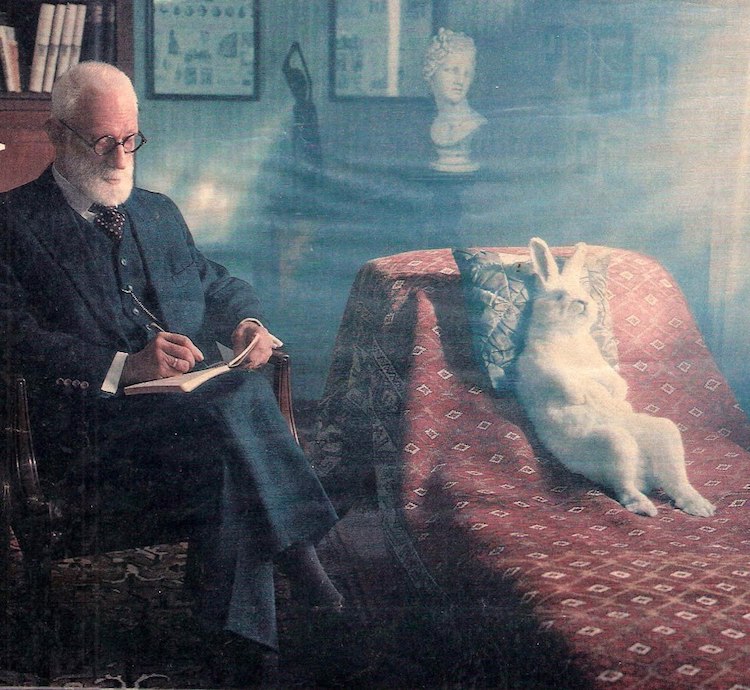
(#2) “I don’t know where the eggs come from, and I have no idea why I feel compelled to hide them.”
… and betting on baldness.
Through the Australasian Association of Philosophy’s Facebook page, this To φ Or Not To φ (Daily Nous Philosophy Comic) by Tanya Kostochka:
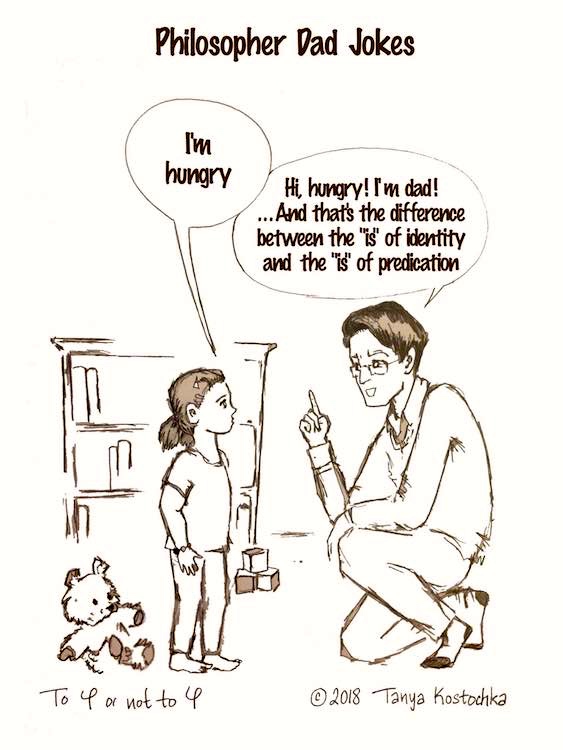 (#1) And that’s just the beginning: cf. I’m Louise with I’m your daughter
The cartoon caption contest drawing in the most recent New Yorker:
 (#1) Drawing by Michael Maslin, Contest #609, March 26, 2018
What elements do you need to recognize to compose a caption?
Brought to my attention on Facebook by Chris Hansen, this grotesque Bizarro from 2013:
 (#1)
(#1)
A real test in cartoon understanding, this one. Some readers on Facebook never got it, many (including me) took a few moments to figure it out.
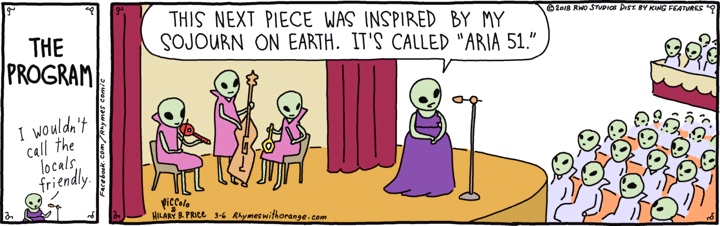
Yesterday’s Rhymes With Orange, with a challenge to cartoon understanding:
 (#1)
(#1)
For basic appreciation of the cartoon, you need to recognize that the event in it is a stage performance by a singer with accompanying trio; to recognize that all the figures in the cartoon are conventional space aliens from popular culture; to know that an aria is a song in an opera; and to know that Area 51 is a highly classified area in Nevada associated in popular culture with the investigation of extraterrestrials.
Then you can groan at the aria vs. area pun.
Your appreciation might then be heightened by knowing about the scifi movie The Fifth Element and the alien opera singer Diva Plavalaguna in it.
From several sources on the net (with no credit to a creator), this outrageous pun in a texty creation:
 (#1)
(#1)
You need to recognize otters (that’s easy) and know that pinochle /pínʌkǝl/ is a card game (slightly more challenging) and (most crucially) recognize the pop culture allusion, to the lyrics of “Escape (The Piña Colada Song)”.
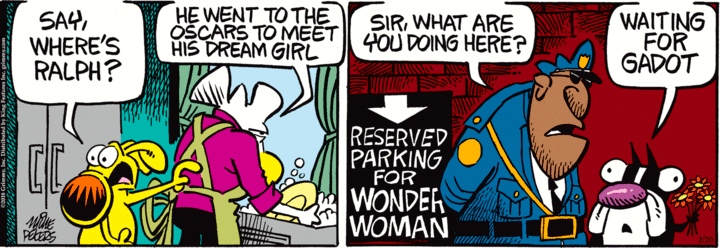
… in yesterday’s Mother Goose and Grimm:
 (#1)
(#1)
The reference to the Oscars (the Academy Awards, to be given out on March 4th) plus the name Gadot might have been enough, but just in case Mike Peters has also provided a reference to Wonder Woman — pointing us to the 2017 movie Wonder Woman, with Gal Gadot in the title role (though the movie got no Academy Award nominations at all), and providing an allusion to the Samuel Beckett play Waiting for Godot.
Today’s Bizarro (another Piraro/Wayno collaboration):
 (#1)
(#1)
(If you’re puzzled by the odd symbols in the cartoon — Dan Piraro says there are 2 in this strip — see this Page.)
To understand the strip, you need to recognize the customer at the bar and know that finding him is a difficult enterprise; and to fully enjoy the strip, you should probably also recognize the cultural trope of the drinker at a bar who has the bartender tell people looking for him — most characteristically, his wife — that he’s not there and they haven’t seen him. (Call it the Toper in Hiding trope. The toper in hiding is a stock figure in jokes, situation comedies, and cartoons.)
Two from the January 29th New Yorker, a recent Bizarro, and yesterday’s Rhymes With Orange, all requiring considerable background knowledge to understand: