Archive for the ‘Linguistics in the comics’ Category

Out of the water and back again

September 19, 2020

In the 9/21 issue of the New Yorker, this Lila Ash cartoon “Evolution of Man”:


(#1) New Yorker description of the cartoon: The evolution of man from a fish to a human throwing their phone in the water, and swimming in to retrieve it.

Yet another variation on the Ascent of Man theme; there have been so many of these on this blog that there’s a Page cataloguing them, here.

(more…)

Tom of Finland at 100

September 15, 2020

(Well, it’s Tom of Finland, so it’s all about men’s bodies and mansex, and not suitable for kids or the sexually modest.)

On the Advocate site on 9/14, “Happy 100 Years: The Tom of Finland Biography”, on a new book on ToF:

(#1)

ToF is flagrantly about huge penises and muscular buttocks, and about intense sex between men, but (more important) also about the emotional relationships beween those men. It’s all extravagant fantasy, but also a celebration of gay male desire and affiliation in all of its forms, and so it has provided reassurance to untold numbers of gay men who scarcely resemble the fantasy sexually heroic figures of ToF — we are, variously, indetectable in the straight world and effeminate and dorky and little-dicked and horse-dicked and insecure and out-and-proud and full of shame — but can find in these figures validation of their desires and practices (notably, receptive anal intercourse: Real Men Take It Up the Ass). Plus, a lot of it is funny.

(more…)

All they will call you will be “escapees”

September 13, 2020

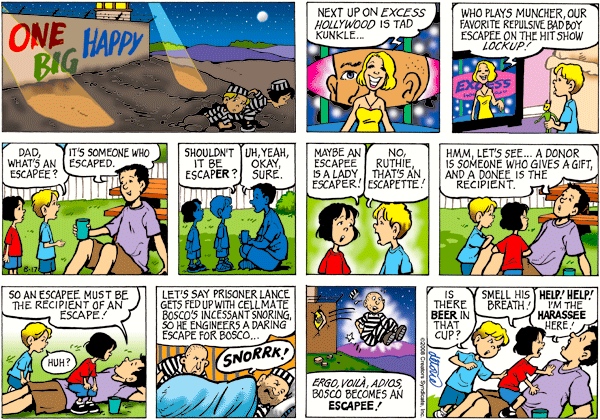
Well, maybe also “escapers”, or even “escapettes”, as in this One Big Happy cartoon from 8/17, which taps into a much-studied phenomenon in English morphology:

(#1)

From my 1/9/15 posting “-ee” (warning: this goes, unavoidably, pretty deep into the technical weeds of syntax and semantics):

The great resource on [the English derivational suffix] –ee is a 1998 paper by Chris Barker in Language (74.695-727), “Episodic -ee in English: A thematic role constraint on new word formation” (stable URL here), which uses a database of “fifteen hundred naturally occurring tokens of some five hundred word types” to analyze the semantics of the suffix; it also has a full bibliography of relevant literature on the subject.

(more…)

The croup

September 12, 2020

The One Big Happy strip from 8/21:

Ruthie, faced with the unfamiliar medical term the croup, does her best to assimilate it to what she knows, namely the ordinary-language term for a physical condition, the creeps. But this time, she guesses that croup is a portmanteau, of group and creeps.

(more…)

Red Löbster Cult

September 9, 2020

The band name in today’s Wayno/Piraro Bizarro, a cute play on Blue Öyster Cult (if you don’t know about Blue Öyster Cult, then the cartoon will be pretty much of a mystery to you):


(#1) (If you’re puzzled by the odd symbols in the cartoon — Dan Piraro says there are 2 in this strip — see this Page.)

A band of lobsters. They have an umlaut. They have cowbell.

It’s all an elaborate play on BÖC.

(more…)

Crossed folk stories

September 9, 2020

Yesterday’s Wayno/Piraro Bizarro cartoon:


(#1) (If you’re puzzled by the odd symbols in the cartoon — Dan Piraro says there are 4 in this strip — see this Page)

The strip explicitly refers to the legend of the Pied Piper of Hamelin, but also alludes to the Piper’s son as having stolen a pig. This is baffling unless you know a particular English nursery rhyme, so we have another exercise in cartoon understanding.

Ok, let’s assume you get that. Then the cartoon is a kind of conceptual portmanteau, a cross between the Piper legend and the Piper’s son nursery rhyme. Then set in a modern law-enforcement context, juxtaposing some (stereotyped) version of the real world with the world of these two folk stories. Cool.

(more…)

cherchez la femme

September 8, 2020

Today’s morning name, a French expression whose literal meaning is straightforward, but whose uses in context are anything but.

From Wikipedia:

Cherchez la femme is a French phrase which literally means ‘look for the woman’. It is a cliche in detective fiction, used to suggest that a mystery can be resolved by identifying a femme fatale or female love interest.

The expression comes from the novel The Mohicans of Paris (Les Mohicans de Paris) published 1854–1859 by Alexandre Dumas (père) [an adventure story, not a detective story]. The phrase is repeated several times in the novel

… The phrase embodies a cliché of detective pulp fiction: no matter what the problem, a woman is often the root cause.

The phrase has thus come to refer to explanations that automatically find the same root cause, no matter the specifics of the problem.

Two plays on the phrase (from among many), below the fold:

(more…)

The soup fly

September 1, 2020

Take a frog to dinner.

The Wayno/Piraro Bizarro for yesterday riffs on a conventional joke:


(#1) (If you’re puzzled by the odd symbols in the cartoon — Dan Piraro says there are 4 in this strip — see this Page.)

(more…)

Synonyphilia

August 31, 2020

(Surprisingly, this posting dips into some hardcore mansex talk — this isn’t Randall Munroe’s point at all, but it happens that I will go there, so later portions of this posting are entirely inappropriate for kids or the sexually modest. Life is complicated.)

A recent xkcd cartoon:

Ah, this is known in the trade as elegant variation. Or thesaurisizing,  Be careful who you give a thesarus to.

(more…)

John Klamik

August 27, 2020

About the gay erotic artist and cartoonist John Klamik, so there wil be references to men’s bodies and mansex, though the hardcore images are off in a posting on AZBlogX. But the topic will obviously not suit every reader.

(This is also a posting from way back in my posting queue, drawing mostly on material collected in 2016.)

The impetus comes from my 4/28/16 posting on this blog, “Gay comics in the 21st century”, with a comment from Billy Britt mentioning Klamik and Tom of Finland.

(more…)