Archive for the ‘Linguistics in the comics’ Category

Eye charts

December 17, 2021

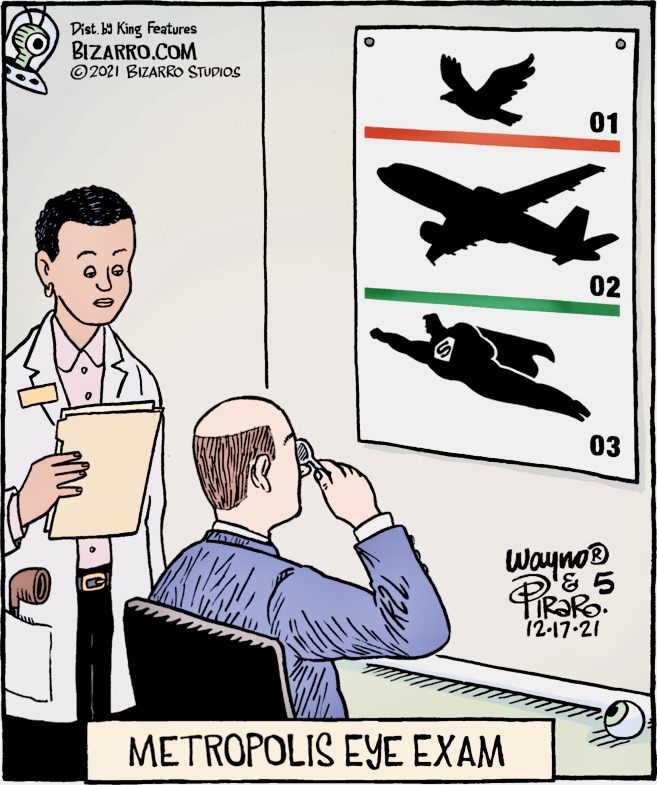
Yet another cartoon meme, the Eye Chart, with an instance in today’s Wayno/Piraro Bizarro, set in the fictive city of Metropolis:


(#1) It’s a bird… It’s a plane… It’s Superman (If you’re puzzled by the odd symbols in the cartoon — Dan Piraro says there are 5 in this strip — see this Page.)

Yes, it’s also an instance of the “It’s a bird” meme. Memes tend to travel together, like elephants, or municipal buses.

(more…)

A collective cry

December 16, 2021

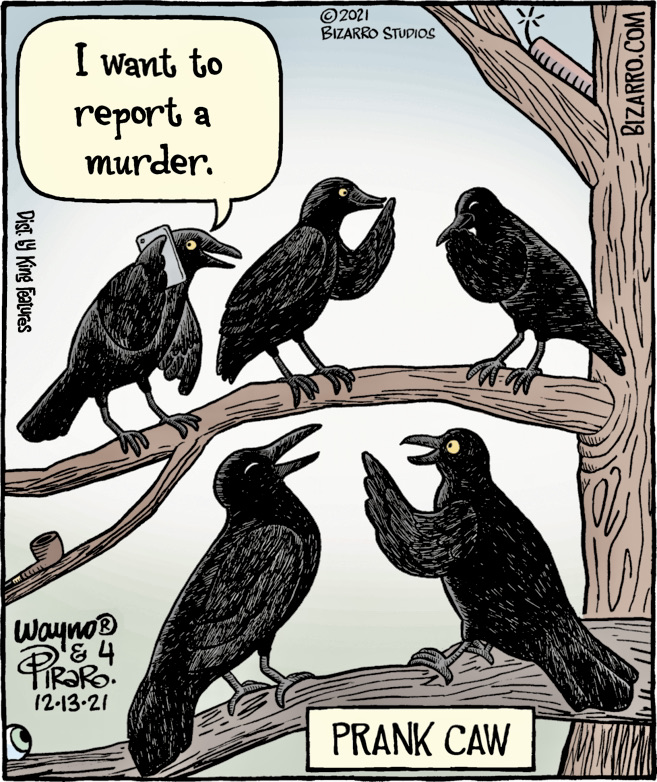
Monday’s (12/13) Wayno/Piraro Bizarro, with five crows — one of them speaking on a cellphone — in conference:


(#1) (If you’re puzzled by the odd symbols in the cartoon — Dan Piraro says there are 4 in this strip — see this Page.)

(more…)

The photoon from Satilla Shores

December 9, 2021

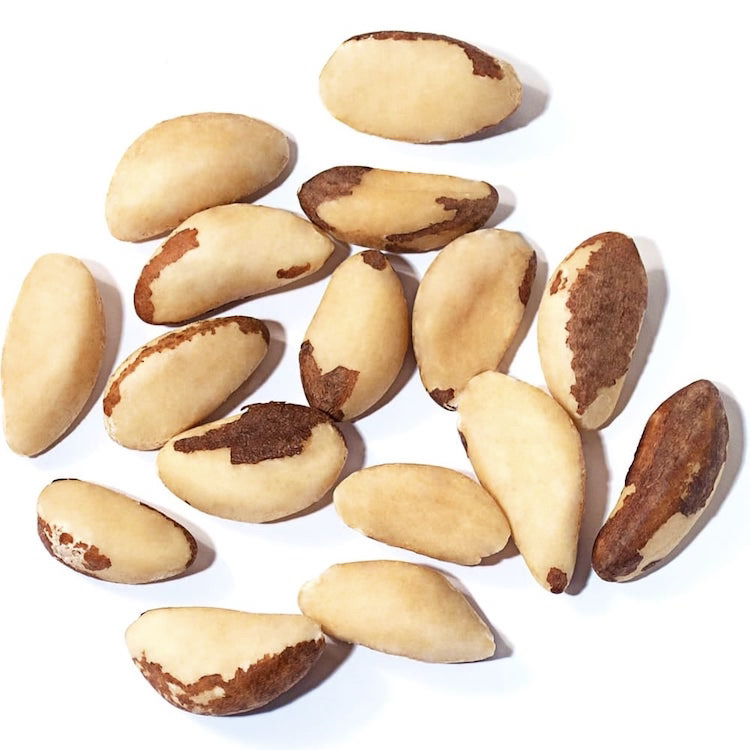
On Facebook on 11/23, Charlie Fulton offered this photoon — a photograph intended as a cartoon — and provided it with a caption, in this case a brief text expressing a personal opinion of his about some event, not depicted in the photoon, without any explicit connection between the event and the photograph. So Charlie’s captioned photoon takes a ton of context and background knowledge to appreciate, but (in my opinion) it’s very cleverly bitter (measured bitterness being a CF specialty).

The photoon, with Charlie’s caption:


(#1) [CF:] Ah, the clever “toenail defense” tactic. I should have seen it coming.

The only really easy part of the comprehension exercise is recognizing the objects in #1 as the edible seeds — known in English as Brazil nuts — of the Bertholletia excelsa tree  (native to South America).

(more…)

What’s on the menu?

December 6, 2021

By Matt Diffee, in today’s (12/6) New Yorker:


(#1) There is a header on the menu that says Breakfast Served All Day, intended as an assertion that all the breakfast items are served all day — but understood by these diners as a label for a category of menu items, or even for a specific menu item, a label similar to Breakfast Special or (Special) Breakfast of the Day (an item whose identity is further specified on the menu or by a server)

(Yes, there is yet another reading, in which the diners are supposing that they can have their particular breakfast order served to them throughout the day, as one monumentally extended meal.)

So a rather complex kind of ambiguity, which might seem unlikely to be significant in real life, until you look at some actual menus without the knowledge that the assertion Breakfast Served All Day is a commonplace on menus at American family-style restaurants (fancy places don’t serve breakfast all day). But even if you’re firmly in possession of that knowledge, some menu designs invite the label understanding.

(more…)

Lumber linguistics

December 4, 2021

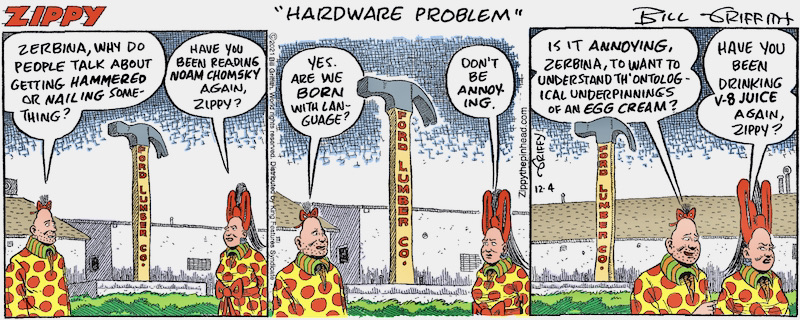
Today’s Zippy strip takes exploits the giant hammer outside the Ford Lumber Co. in Fort Washington MD to skitter over language-related matters — the metaphorical character of many common idioms, the innateness of language (abilities), natural language ontology — to lodge in a fixation on food that Zippy finds intrinsically funny (in this case, egg creams and V-8 juice):


(#1) Zippy’s attributions are a bit wonky — it’s Lakoff, not Chomsky, who hammers on the centrality of metaphor, though linguistic nativism is indeed a Chomskyan preoccupation — but then Zippy’s a surrealistic Pinhead, not a pinhead professor, and anyway, you say linguist, the popular mind thinks Chomsky, so Zippy has his finger on the pulse of the people here (even if ontology pours into egg creams for him and even if he seems to be hammered on V-8)

Meanwhile, there’s the news from Fort Washington MD.

(more…)

Typos are the very devil

December 2, 2021

Tom Gauld in the 11/27 New Scientist (on-line on 11/24):


(#1) (on the New Scientist site:) “Tom Gauld makes a deal with the devil, with a soupy twist”

Three things: the Faustian bargain; versions of the story (tons of them); and the typo.

(more…)

Break, break, break

December 1, 2021

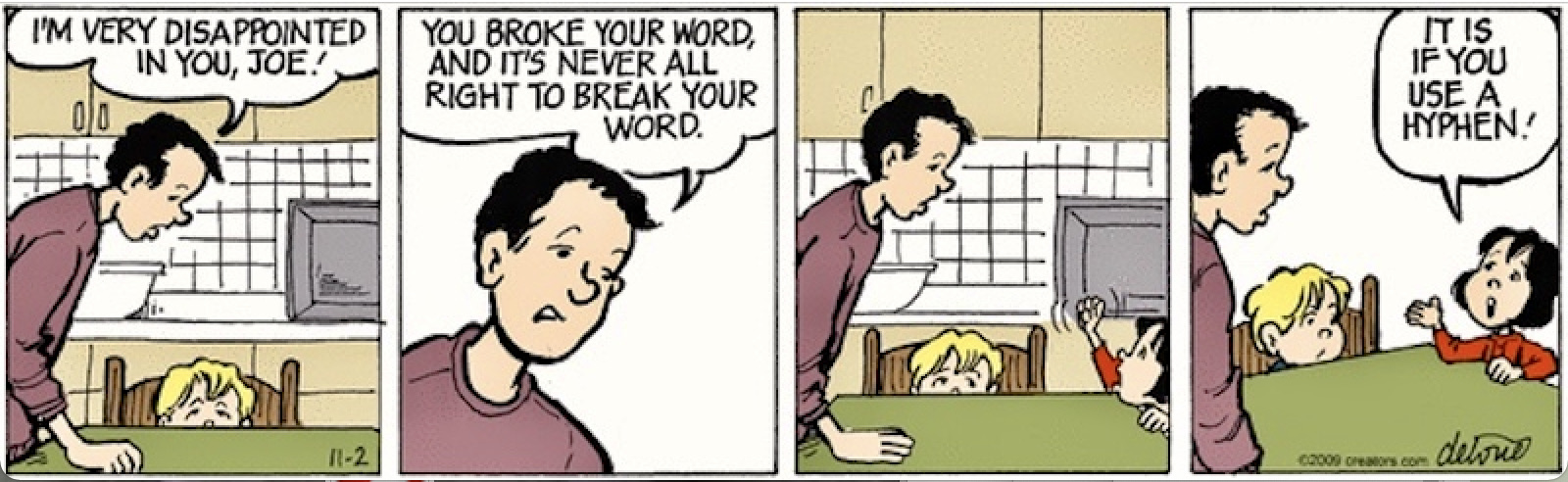
🐇 🐇 🐇 In the 11/2 One Big Happy, Joe fails to honor a promise, which of course makes Ruthie think about hyphenating printed text:

(#1)

NOAD on the verb break (Joe: sense 3a; Ruthie: sense 1a) and the noun word (Joe: sense 3b; Ruthie: sense 1a):

verb break:

1 [a] separate or cause to separate into pieces …

… 3 [with object] [a] fail to observe (a law, regulation, or agreement)

noun word:

1 [a] a single distinct meaningful element of speech or writing, used with others (or sometimes alone) to form a sentence and typically shown with a space on either side when written or printed

… 3 (one’s word) [a] one’s account of the truth, especially when it differs from that of another person: in court it would have been his word against mine. [b] a promise or assurance: everything will be taken care of — you have my word. …

(more…)

Paisley weather

November 29, 2021

Today’s Wayno/Piraro Bizarro, with weather forecasting in action:


(If you’re puzzled by the odd symbols in the cartoon — Dan Piraro says there are 3 in this strip — see this Page.)

Ah, a bit of word play: a pun on pattern.

(more…)

The shirt and the scent

November 28, 2021

Today’s Wayno/Piraro Bizarro takes us to the Men’s Department, where a salesman of extraordinary style purveys clothing, shoes, accessories, and men’s fragrances:


(#1) The striped shirt is a marinière, and the two scents are jokey takeoffs on men’s fragrances (If you’re puzzled by the odd symbols in the cartoon — Dan Piraro says there are 3 in this strip — see this Page.)

From my 2/16/21 posting “Hello, sailor”, this description of

la marinière, the cotton long-sleeved shirt with horizontal blue and white stripes; characteristically worn by seamen in the French Navy, it has become a common part of the stereotypical image of a French person

More on the shirt below. Meanwhile, the cologne Horse Soccer (from Barf Lauren) is a play on Polo (from Ralph Lauren); the source of the name Royal Whiff for the other cologne is still a mystery to me, but no doubt an enlightened reader will explain the joke to me (though Royal Whiff would be an entertaining name even if it has no direct model).

(more…)

Who’s a good boy?

November 26, 2021

Today’s Wayno/Piraro Bizarro, combining two cartoon memes: the familiar Psychiatrist, plus Good Doggie, a meme that is extraordinarily popular but, I believe, has appeared on this blog only once before:


(#1) Who’s a good boy? Who’s a good doggie? (If you’re puzzled by the odd symbols in the cartoon — Dan Piraro says there are 5 in this strip — see this Page.)

Conventional ways of rewarding dogs by praising them, and so training them in whatever behavior they are being rewarded for. Just the tone of voice can be very satisfying to a dog, even more satisfying than a food reward.

But there’s still a puzzle here. Who’s a good boy? and Who’s a good doggie? are WH-questions, which in English have final falling intonation, the same as strong assertions, like You’re a good boy! and You’re a good doggie!; and the same as exclamations, like WhatSuch a good boy! and WhatSuch a good doggie!. All can be delivered with higher than normal pitch overall,  even higher pitch maxima than normal, and “warm” vocal qualities — in the “talking to dogs” voice.

So why use the who-question form, with its self-supplied answer You are! Yes, you are!? Where does this convention of language use come from? The assertions and exclamations are available anytime, off the shelf, as it were, but the who-questions are indirect in their effect and presumably have to be learned as conventional schemes for rewarding dogs with praise. Somewhere, sometime, there had to be first users of the schemes. However, as far as I know, no one has investigated the rise and propagation of these notable ways of talking to dogs.

(more…)