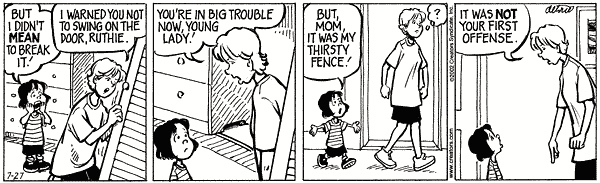
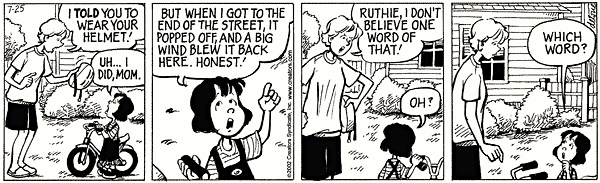
A One Big Happy (dated 7/27) in my comics feed today: once again, Ruthie re-shapes an unfamiliar expression, in this case the legal-tinged word offense (‘a breach of a law or rule; an illegal act’ — NOAD2), in the phrase first offense:

with first offense re-shaped as thirsty fence, a phrase that doesn’t make sense, but at least has the familiar word fence in it (and is very very close phonetically to first offense: initial f vs. 𝛉, unaccented ǝ vs. i or I).
I suppose it’s possible that at some point before the time of the strip, Ruthie heard first offense, didn’t understand it, and re-shaped it But what the substitution really looks like is an old mishearing of first offense; mishearings very often don’t make sense, but do have parts that are recognizable words.
At this point, you’d really want to look at errors made by real, rather than cartoon, kids, in context.
 (#1)
(#1) (#2)
(#2)