Archive for the ‘Lexicography’ Category
April 8, 2022
(There will be a few excursions in passing about men’s bodies and man-on-man sex. If you can manage an appearance or two of the sexual verb fuck, you’ll be ok.)
From Ann Burlingham a couple days ago, a greeting card with a photo from the 2020 Australian Firefighters calendar, showing a man and his dog:

(#1) How to read the man, how to read the dog, and how to read the relationship between them
It turns out that there’s an amazing amount of content packed into this photo — I’ll try to reveal a bit of it here — and the photo leads to much more, including andirons, Dalmatians, lexicography, and the cartoonist George Booth.
(more…)
Posted in Cartoonists, Eggcorns, Facial expression and gesture, Gay porn, Gaze, Gender and sexuality, Language and animals, Language and the body, Lexicography, Linguistics in the comics, Masculinity, Metaphor | 3 Comments »
November 21, 2021
Grant Barrett (of the Barnette-Barrett radio show A Way with Words — and a real lexicographer, one of the lexicographers I sometimes hang out with, even though I’m not of that tribe) tried to post this as a comment on my posting yesterday, “Now we’re cooking with carrots”, but it appears to have been indigestible to WordPress, so I’m publishing it here as a guest posting. Remember: what follows below the line is Grant, all Grant, not me (except for some formatting).
(more…)
Posted in Formulaic language, Language of advertising, Lexicography, Pop culture, Slogans, Snowclones | 2 Comments »
April 25, 2021
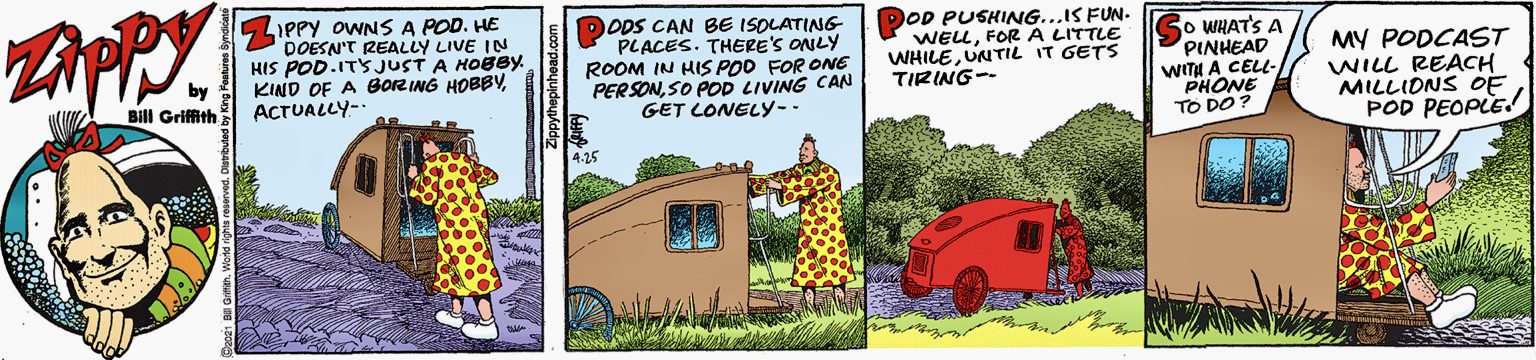
In today’s (4/25) Zippy strip, our Pinhead — no podophile ‘foot fetishist’ — instead celebrates the linguistic formative pod — as a word, in one of its many meanings (here, its ‘small building’ sense); as part of a fixed expression pod people (using pod referring to a plant part); and as piece of the word podcast (where it’s a piece of the proper name iPod, and that takes it back to a functional unit on an aircraft or spacecraft):
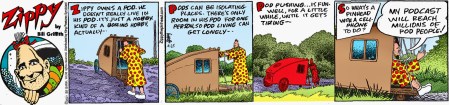
(#1) There’s more, lots more, but the pods here are all trace back.in metaphorical flourishes, to the plant parts
(more…)
Posted in Lexicography, Linguistics in the comics, Metaphor, Movies and tv, Portmanteaus | Leave a Comment »
April 24, 2021
In “When I was a lad”, from Gilbert & Sullivan’s HMS Pinafore (1878), Sir Joseph Porter, the First Lord of the Admiralty, sings:
Of legal knowledge I acquired such a grip
That they took me into the partnership.
And that junior partnership, I ween,
Was the only ship that I ever had seen.

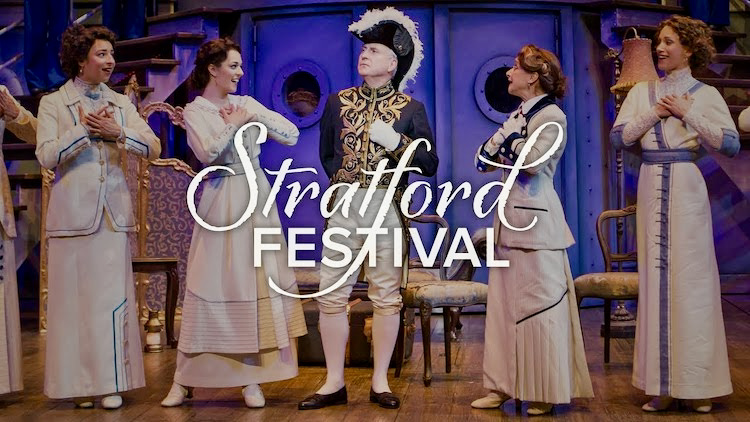
A still from the 2017 Stratford Festival performance of this song; you can watch a YouTube video of the this performance here
It came by on my iTunes a couple days ago, causing me to realize that the only occurrences of the verb ween — meaning, to judge from the context, something like ‘think, believe’ — that I can recall having experienced were in parenthetical I ween in G&S operetttas. Notably, in Pinafore, which I’ve been listening to (or watching, or assisting in productions of) for over 60 years, but also in this couplet in “Kind sir, you cannot have the heart”, from The Gondoliers, so memorable to me because of its potential for queer wordplay:
Oh, ’tis a glorious thing, I ween,
To be a regular Royal Queen
But what of this strange, stilted-sounding verb that seems to occur only in parenthetical I ween?
(more…)
Posted in Formulaic expressions, Lexicography, Music, Style and register | 3 Comments »
July 13, 2019
The text for today, a piece from the NPR Kitchen Window site (“A weekly peek into the kitchen with tasty tales and recipes”), “What’s in a Name? The Avocado Story” by Howard Yoon, from 7/19/06: a monstrous tapestry of confusion, error, and fabrication, tracing the English food name avocado to a 1914 coinage by California farmers who became the California Avocado Association (an organization that was probably the source of most of the balled-up fantasy below).
(more…)
Posted in Etymology, Etymythology, Language and food, Lexicography, Semantics, Subsectivity | 4 Comments »
May 25, 2019
(After the cartoons and the lexicography, John Rechy will take this posting into the world of mansex, in some detail and in very plain talk; that section is not for kids or the sexually modest, but I’ll warn you when it’s looming on the horizon.)
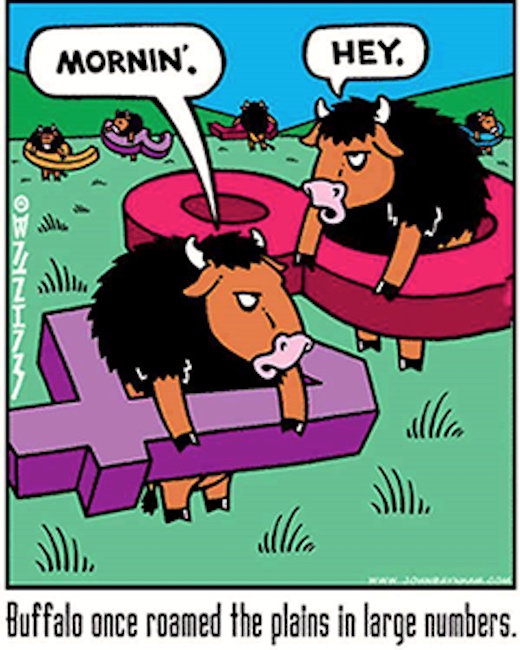
Two bison greet each other in a John Baynham cartoon with a wonderful pun:
 (#1)
(#1)
That’s numbers (roughly ‘amount’, but as a PL C noun) — and indeed large numbers of buffalo did once roam the plains of North America — vs. numbers referring to physical models, or simulacra, of symbols for certain abstract mathematical entities — in this case, the natural numbers. Such physical models are also familiar: think of the letters in the HOLLYWOOD sign, or the numbers on the building at 666 Fifth Ave. in NYC (with its own kind of fame as a Jared Kushner property). But people don’t walk around with, much less inside, giant versions of such models. That’s deliciously absurd.
Looking at the lexical items involved will take us deep into the lexicographic weeds and then to the secret places of mansex, starting with the dim recesses of Griffith Park in Los Angeles.
(more…)
Posted in Books, Homosexuality, Language and animals, Language of sex, Lexical semantics, Lexicography, Linguistics in the comics, Metonymy, Porn actors, Puns, Slang | Leave a Comment »
March 27, 2019
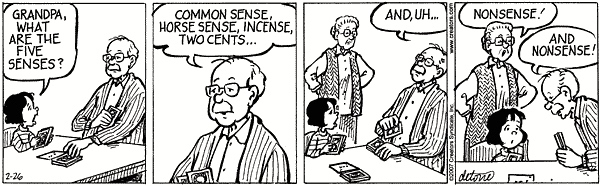
The 2/26 One Big Happy, riffing on /sɛns/, in idioms with sense (common sense, horse sense, nonsense), in incense, and in cents (also in an idiom, two cents):
 (#1)
(#1)
Which, of course, leads us inevitably to the psychedelic days of 1967, with their whiff of incense and peppermints (plus some pot).
(more…)
Posted in Dialects, Idioms, Language and culture, Lexicography, Linguistics in the comics, Music, Phonetics, Phonology, Rhyme | 5 Comments »
March 20, 2019
Announced yesterday on Language Log, in a piece by Ben Zimmer entitled: “Frequency illusion” in the OED. It begins:
The latest batch of updates to the online edition of the Oxford English Dictionary includes a term that originated right here on Language Log, in a 2005 post by Arnold Zwicky. The term is frequency illusion, first attested in Arnold’s classic post, “Just Between Dr. Language and I.” Here is the OED treatment, an addition to the main entry for frequency:
frequency illusion n. a quirk of perception whereby a phenomenon to which one is newly alert suddenly seems ubiquitous.
(more…)
Posted in AZ terminology, Illusions, Lexicography, Music, Psychology of language | 3 Comments »
March 3, 2019
It began five months ago, on ADS-L, the American Dialect Society mailing list, with a note from the compiler of the Yale Book of Quotations about a piece he’d recently published:
Fred R. Shapiro, Confessions of the Antedater. Dictionaries: Journal of the Dictionary Society of North America 39.1.23-42 (2018).
An engaging and informative essay about finding earlier and earlier citations for English words and phrases. At the time, ADS-Ler Mark Mandel exclaimed:
At first I saw it as “Confessions of an Anteater”!
and Larry Horn chimed in:
Me too … Indeed, my mailer tells me that when I type “antedater” I really meant “anteater”. Maybe someone should work on a logo
I seconded the suggestion, but then no one did anything until Fred’s piece came up again yesterday, and everybody made the same misreading again — and I came up not with a logo, but with a mascot, an Anteater With a D, the adorable little Silky Anteater didactylus.
(more…)
Posted in Anagrams, Language and animals, Language play, Lexicography, Misreadings, Names | 2 Comments »
October 23, 2018
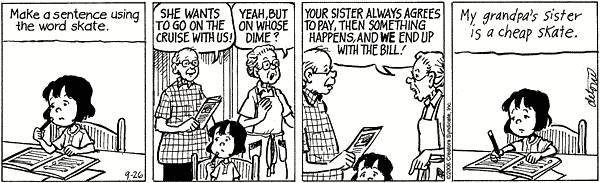
The One Big Happy in today’s comics feed, from 9/26:
 (#1)
(#1)
Ruthie is faced with the task of demonstrating what a word means by using it in a sentence — a task often assigned to children as a test of their understanding of word meanings. But choosing effective example sentences is a challenging art for professional lexicographers, and children are not particularly good at it.
In this case, “the word skate” could be a verb (‘move on ice skates or roller skates in a gliding fashion’ (NOAD)) or any one of several nouns, but, on hearing about her tightwad great-aunt, Ruthie fixes instead on the otherwise opaque /sket/ portion of the compound cheapskate ‘tightwad, miser’ (which she analyzes as a composite nominal cheap skate).
(more…)
Posted in Ambiguity, Etymology, Idioms, Lexicography, Linguistics in the comics, Slang | Leave a Comment »