A Chuck and Beans webcomic from the 16th:

Texting is, of course, the written word. But then there are emoticons.
A Chuck and Beans webcomic from the 16th:
Texting is, of course, the written word. But then there are emoticons.
An xkcd on a theme that comes up in other strips (especially Zits):

When all else fails, send a pigeon.
(Hat tip to Fatemah Abdollahi.)
Today’s Dilbert takes up the definition of technical terms:
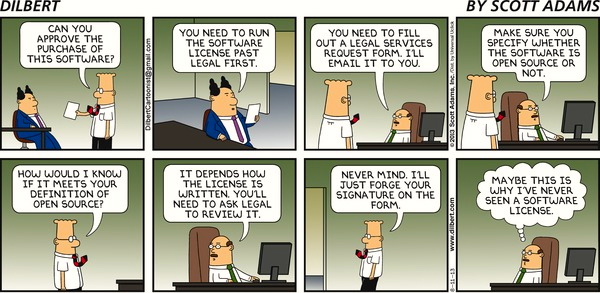
Wikipedia on “open source” will give you some sense of the problem.
My friend (and former student) Tyler Schnoebelen now blogs regularly on the site of the company he works for, idibon (in San Francisco), where he’s Senior Data Scientist. These postings look at matters with a NLP (natural language processing) angle to them, but always with an engaging take on the material and often with an unexpected choice of topic. Four recent postings of this sort:
Today’s Rhymes With Orange:
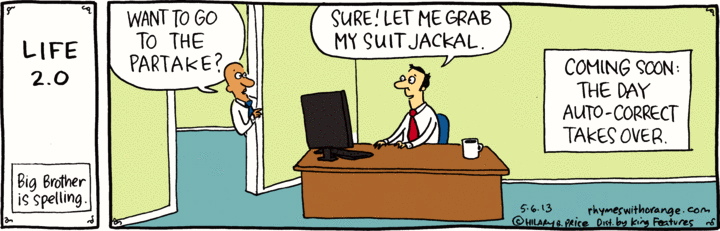
Here’s a particularly silly version of autocorrect — or possibly automatic completion software — one that replaces frequent words (party, jacket) by infrequent ones (partake, jackal), indeed infrequent words that don’t fit the context (partake is a verb, while the context calls for a noun; and suit jacket is a common collocation, while suit jackal is absurd).
From Ann Burlingham on Facebook, a link to this xkcd:
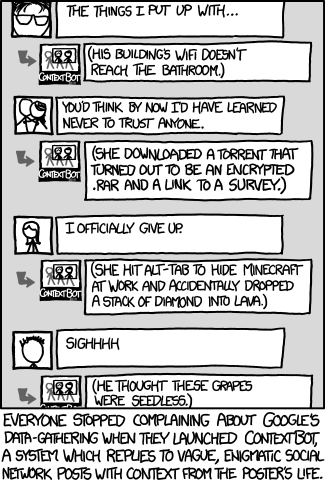
Definitely a cool app, one I’d have a lot of use for. Especially since it has roughly the same effect as reading minds.
The mouseover text:
If you read all vaguebooking/vaguetweeting with the assumption that they’re saying everything they can without revealing classified military information, the internet gets way more exciting.
In my Palo Alto neighborhood, tech companies spring up (and, often, disappear) frequently. Not too long ago, Junyo appeared around the corner from my house, and now the sign on the door has been expanded to
Junyo Learning Analytics
Ah, learning analytics is a technical term, one that I hadn’t encountered before. It’s a N + N compound glossable as ‘analytics having to do with learning’. So that drives things back to analytics.
Back on the 8th, Charlie Doyle posted plaintively to ADS-L about a puzzle in alphabetization:
Yesterday my daughter-in-law called me with a question about my third-grader grandson’s homework. The assignment was to alphabetize a list of words, and the list included the four items girl/girl’s/girls/girls’. (My daughter-in-law made clear than both the academic career of my grandson and the family’s standing in the community were at stake, since the parents of the other third-graders were also depending on my answer.)
I failed. I could tell her that there exist various styles of alphabetizing, that certain traditional “rules” obtain, one of which is “Ignore apostrophes” — but the rules I am aware of don’t fully address the case at hand. I could tell her that if the Microsoft Corporation is asked to “sort” the words alphabetically, they will appear in the order in which I have listed them above, which seems reasonable — but not, as far as I can determine, “authoritative.”
Any suggestions? (I don’t recall that third grade used to be this hard!)
Two issues here: one, why is the question being asked? and two, what’s the answer?