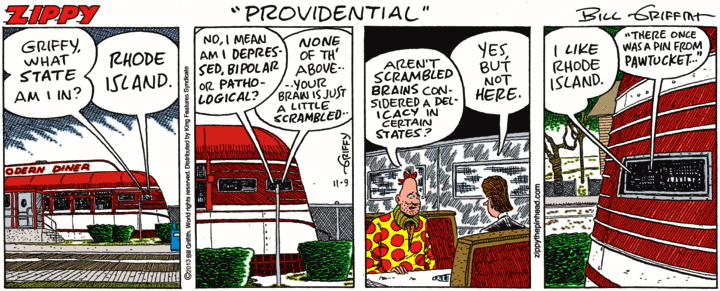
Today’s Zippy, with yet another diner:
 (#1)
(#1)
That’s the Modern Diner in Pawtucket. Then there’s the allusion to the limerick beginning “There once was a man from Nantucket”.
Today’s Zippy, with yet another diner:
(#1)
That’s the Modern Diner in Pawtucket. Then there’s the allusion to the limerick beginning “There once was a man from Nantucket”.
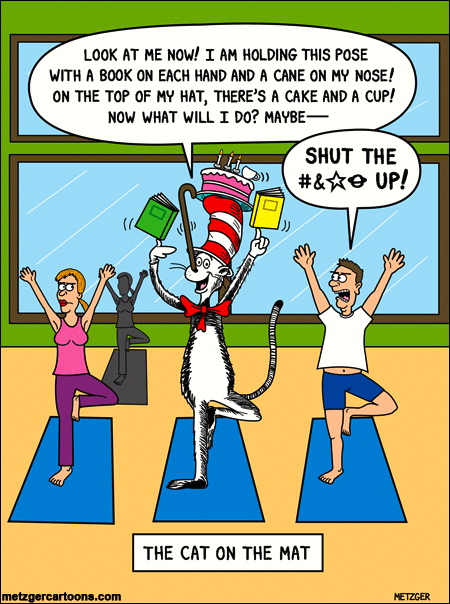
A Bent Pinky cartoon by Scott Metzger, sent to me by Tom Limoncelli:
 (#1)
(#1)
A play on The Cat in the Hat, with the nice final rhyme:
… a cake and a cup / … shut the fuck up!
(but with fuck disguised by obscenicons).
(Not a lot about language, but mostly about music, sexuality, and the display of men’s bodies.)
[Note 7/10/14: at the request of the photographer (see comments), most of the images have been removed from this posting. As far as I know, they can all still be accessed by Google image searches on Steve Grand, DNA, or Timoteo.]
This is about the country musician Steve Grand, the cover musician Steve Starchild, and the underwear models Steve Chatham and Finn Diesel — who are all the same young man, now getting wild media attention through a music video. From Wikipedia:
Steve Grand [born 1990] is a country music performer from Lemont, Illinois. He was acclaimed as the first openly gay male country singer after the music video of his song “All-American Boy” went viral on YouTube in less than a week.
“All-American Boy” is a sweet song of unrequited love, between the gay singer and his straight best buddy. It’s notable for including a kiss between the men that passes without eliciting “gay panic”, either in the buddy or in most of the video’s many viewers. Grand is also a strong singer with an attractive voice (hence Starchild’s career as a cover singer) and a very attractive body as well (hence Grand’s career as an underwear model, under various names).
Today’s Pearls Before Swine:

Pig sets up a preposterous rhyme chain, origami salami tsunami. And then, as in the word avalanche strip posted here (ending with “Does the word shame mean anything to you?”), Rat upbraids the cartoonist in the final meta-panel.
I was moved yesterday to wonder about the whoopee cushion, its history, and the various names for it. In particular, I mused that there would be no good way to predict what the thing is called in English, given a description of it; fart cushion would be the obvious candidate.
Today’s Rhymes With Orange:
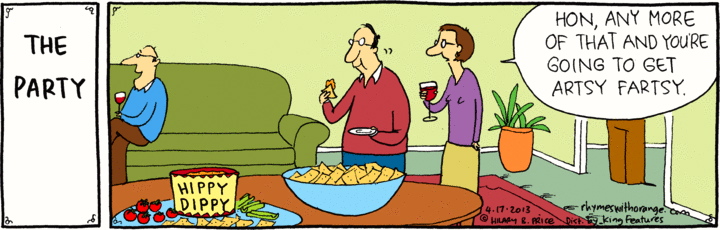
Hippy-dippy, artsy-fartsy. Compound-like combinations with parts that aren’t semantically independent but are related phonologically, in this case by rhyme. In addition to rhyming reduplication (as in these cases), there’s also exact reduplication (yada yada, wee wee, chi chi; see this posting for the clever punning invention tako–taco) and ablaut reduplication (chitchat, dilly-dally, tittle-tattle), with the accented vowel varied but the remainder of the components remaining the same. Many reduplicative compounds are negative in tone, as hippy-dippy and artsy-fartsy are in ordinary usage. For hippy dippy in the cartoon, more is going on, since there’s a pun on dip involved.
Today’s Zits has Jeremy boxing himself into a corner:
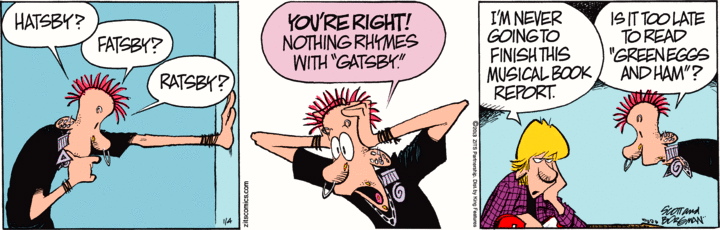
Oh my, a musical book report. On The Great Gatsby. Jeremy should have thought ahead.
Popular belief is that words without (perfect) rhymes are extraordinary, but in fact they’re pretty common, as Mark Liberman noted on Language Log several years ago.
Woke up this morning — Solstice Day — to the distinctive sound of Tom Waits‘s voice singing his own “Ol ’55”, with the haunting chorus:
Now the sun’s coming up,
I’m riding with Lady Luck,
Freeway cars and trucks,
Stars beginning to fade,
And I lead the parade.
Words that seem to suggest all sorts of interpretive possibilities, but certainly begin with a kind of pocket reference guide to types of half-rhyme: the first three lines, rhyming up, luck, and trucks, illustrate feature rhyme (up vs. luck, with /p/ vs. /k/, two voiceless stops differing only in the feature of point of articulation and so “sounding alike”) and subsequence rhyme (luck vs. trucks, with /k/ vs. /ks/, the first being a subsequence of the second and so, again, “sounding alike”).