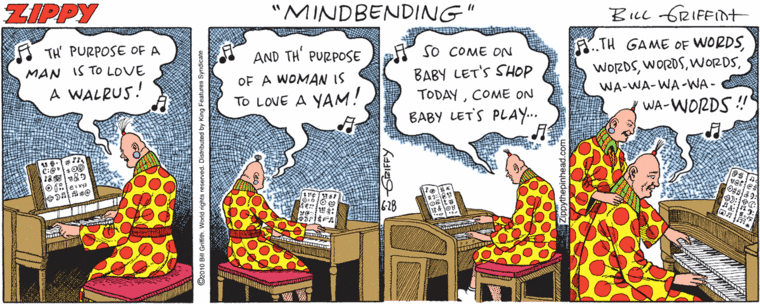
Come on baby let’s play th game of words:

Note little pun on play, as in “play a game” vs. “play music”; both senses are conveyed at the same time. And the score for the song, which seems to be set in glyphs, without either words or musical notation. And of course the nonsense of the words Zippy is singing, vaguely reminiscent in content of a truncated version of the X Without Y snowclone (X without Y is like Z without W: “Potato salad without eggs is like scrambled eggs without ketchup”). What’s conveyed by X Without Y is that Y is an essential part of or accompaniment to X, just as W is to Z.
[X Without Y is one of a family of simile snowclones, among them The Y of Z (X is the Y of Z, discussed in several Language Log postings; for the particular variant “X is the Barry White of Y”, see Mark Peters) and the absurdly popular The New Y (X is the new Y, done to exhaustion in Language Log and elsewhere). All of these are specialized variants of Proportional Analogy, or X:Y=Z:Q (a Zippy from 2006, with Griffy looking at a diner: “Th’ fifties are to the 21st century what th’ 1890s were to th’ 20th!”).]
In fact, it looks to me like Zippy’s lyrics “The purpose of X is to love Y” are related to reverse-simile versions of X Without Y, in which W is not in fact an essential accompaniment to Z, implicating that Y is not an essential accompaniment to X, or in which W is an actual impediment to Z, implicating that Y should not accompany X. The prototype of reversed-simile X Without Y is “A woman without a man is like a fish without a bicycle” (widely attributed to Gloria Steinem, though it might have appeared first as an anonymous graffito); there are examples all over the place.
(More on simile snowclones on another occasion.)
Then again, Zippy’s lyrics also evoke the child world of purposes, as in Ruth Krauss’s 1952 A Hole Is to Dig: A First Book of First Definitions (with illustrations by Maurice Sendak; Sendak also illustrated the charming What Do You Say, Dear? A Book of Manners for all Occasions by Sesyle Joslin).