A recent Zippy, in which Griffy is fascinated:

Don’t know about carving words into animal bones in England, but sheep’s knuckle bones were used as paving stones, devices for divination, and dice-like pieces in games.
A recent Zippy, in which Griffy is fascinated:
Don’t know about carving words into animal bones in England, but sheep’s knuckle bones were used as paving stones, devices for divination, and dice-like pieces in games.
Three Calvin and Hobbes strips (by Bill Watterson), from Melissa Carvell, all on language-related topics (this from the man who gave us “Verbing weirds language”):
In the account of the band Here We Go’s encounter with John Waters, here, we find:
But the truth is we actually picked him up hitchhiking. It was a complete and utter coincident.
with coincident for coincidence. This is far from an isolated example, so we have to conclude that this is a reanalysis, perhaps an eggcornish one based on the existing word coincident and encouraged by the possibility of final cluster simplification in English (in this case, the simplification of final [ts] to [t]).
Via Paul Armstrong, this wry observation on the way English takes things from other languages:
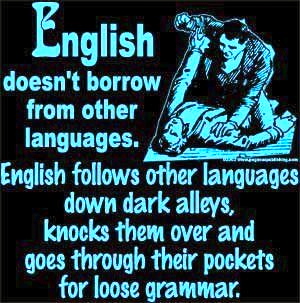
Where does this come from?, you ask. It’s a variant of a longer version that Mark Liberman discussed on Language Log in 2005 (and quoted again in 2007), a version that dates to 1990.
In today’s print NYT Science Times, a piece by Douglas Quenqua entitled “They’re, Like, Way Ahead of the Linguistic Currrrve”, about young women as trendsetters in linguistic change. Featuring a sizable cast of experts, starting with Stanford’s Penny Eckert.
The two main points:
Girls and women in their teens and 20s deserve credit for pioneering vocal trends and popular slang, [linguists] say, adding that young women use these embellishments in much more sophisticated ways than people tend to realize.
And, at the end, two points. One, that a bit of linguistic stuff — vocal fry, uptalk, and the discourse particle like are the three examples the article focuses on — is just a resource, which can be used in many different ways by different groups of speakers (that is, there’s no intrinsic meaning to a resource — as I’ve taken to saying, it’s “just stuff” — but only meanings as expressed by particular groups of speakers and meanings as interpreted by others). And two, that the meanings for speakers and hearers can be seriously at variance:
“language changes very fast,” said Dr. Eckert of Stanford, and most people — particularly adults — who try to divine the meaning of new forms used by young women are “almost sure to get it wrong.”
“What may sound excessively ‘girly’ to me may sound smart, authoritative and strong to my students,” she said.
(The tiniest of postings, put up only because it tickles me.)
Over on ADS-L, Stephen Goranson has antedated the word gazebo from the OED’s 1752:
Unto the painful summit of this height
A gay Gazebo does our Steps invite.
From “An essay on the pleasures and advantages of female literature … and three Poetic Landscapes” by Wetenhall Wilkes (1741). (ADS-Lers are into antedating as a kind of sport.)
I was charmed by the alliterative gay gazebo (with, of course, an older, non-sexual, sense of gay, plus the great word gazebo). The poem continues, less excitingly:
From this, when favour’d with a Cloudless Day,
We fourteen Counties all around survey.
Th’ increasing prospect tires the wandring Eyes:
Hills peep o’er Hills, and mix with distant Skies.
Reported by Ellen Seebacher on Google+ today:
My thirteen-year-old, during a discussion of prescriptive vs. descriptive grammar and constructions on their way out in English:
“So ‘shall’ isn’t exactly packing its bags and walking out the door like ‘whom’, but it’s winding down the conversation and looking at the clock?”
He’s pretty much got it down. Shall and whom will probably be around for a long time, but only in very restricted contexts (“Shall we dance?”, “someone of whom I’ve heard a lot”). So they’ve packed their bags and are sitting in a little corner by the door.
(I was startled to re-read a paper of mine from 1968 a few days ago and was startled to see academese like “We shall show”, where I’d now write “I will show” or “I’ll show”.)
From Michael Palmer on Facebook this morning:
Terry, it depends where you work.
(where I’d usually have depends on, or maybe upon). Historically, this is transitivizing P-drop; the transitive argument structure isn’t in OED2 (1959), and at the time MWDEU (p. 329) remarked:
Many commentators point out that in speech this construction can be followed by a clause with no on or upon intervening, as in “It all depends how many times you’ve seen it” or “It all depend whether it rains.” We have no evidence of these conversational patterns in ordinary prose.
That was then, this is now, and examples of depends + WH-clause are all over the place in “ordinary prose”, in fact in educated prose, like Palmer’s above (trust me on Palmer’s erudition and writing experience).
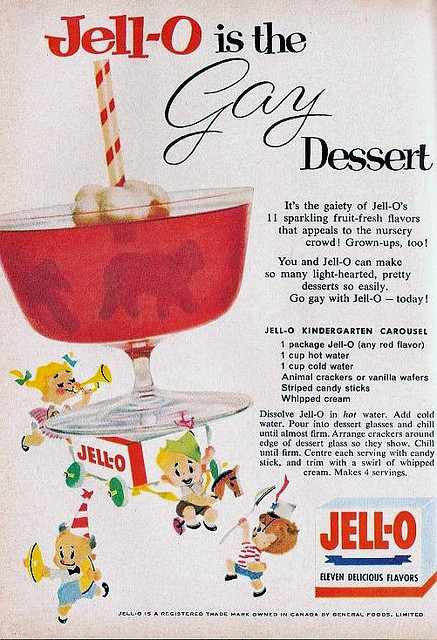
From Chris Ambidge a few days ago, this reproduction of a Jell-O ad from roughly 50 years ago (now in a color version unearthed by Chris Hansen). Go gay with Jell-O today!
Back in 2004, George Thompson reported on ADS-L that he’d heard misnomer ‘misconception’ about ten years earlier from a former colleague, and Jon Lighter replied that he heard it “constantly” on news and talk shows, claiming that misconception seemed “no longer to be used on these programs” and that misnomer had come to be the norm rather than the exception. That’s almost surely an exaggeration, but this use of misnomer is widespread. This morning Lighter reported another sighting:
Yesterday an Ohio State Senator said emphatically that “any connection” between collective bargaining and the state’s budget shortfall is “a complete misnomer.” She used “misnomer” in this way at least twice.