Archive for the ‘Language change’ Category

Taking Goat to lunch

November 15, 2025

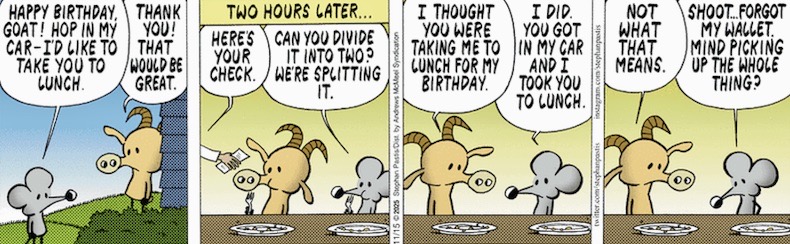
Today’s Pearls Before Swine, in which Rat lives up to his name:


The crucial point: take you to lunch in the context of birthday greetings to Goat — in this context, clearly an instance of the phrasal idiom I’ll label take someone to (‘host someone at (an event), treat someone to (an event)’), and so understood by Goat (and, I think, by all readers of this strip); but then, in a kind of lexicographic bait and switch, Rat maintains that he meant only the caused-motion verb take (‘convey something to (an event at) some place’) and takes no responsibility for paying for the occasion

Then, in an appendix to this main discussion, I expose my bafflement at the treatment of the phrasal idiom take someone to in dictionaries: I can’t find one that lists it (while treat someone to is well covered).

(more…)

Capades on ice

September 28, 2025

From Benjamin Dreyer on Facebook yesterday:

It’s once again been brought to my attention that many people seem not to grasp that Ice Capades is a play on words and that they are not in fact capades on ice.

(I myself learned this at a rather advanced age, but: earlier than today.)

Well, Ice Capades originated as a play on words, but that doesn’t mean it still is (only) a play on words. History is not destiny. BD tells us, in fact, that many people — I would say almost all of us — don’t appreciate that it originated as a play on words. Which is to say that for all these people it is not a play on words, but an odd compound of ice and capades. Just as, for almost everyone these days, the name of SRI International (a Silicon Valley R&D nonprofit institute) is just a string of letter names, not an abbreviation for anything, despite the fact that the organization began its life as the Stanford Research Institute (I know this, but I’m a very old man, 6 years older than the Stanford Research Institute); SRI is now an orphan initialism.

So now, a lot of facts.

(more…)

I also am of the ursine persuasion

September 18, 2025

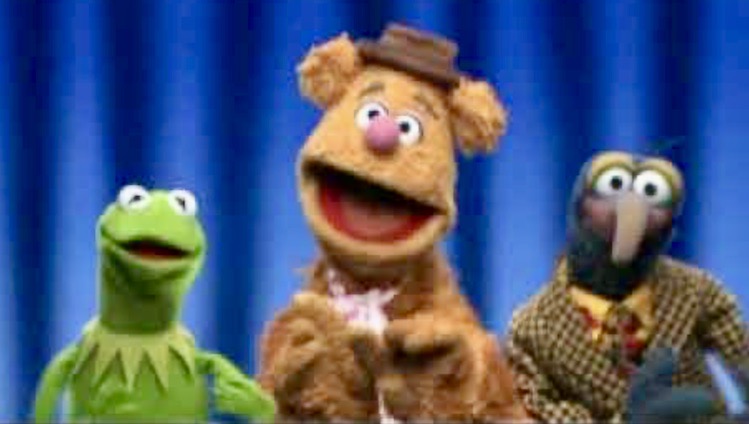
Encountered in going through stuff on Facebook: the episode “Fozzie encounters a bit of a language barrier” from “Rocky Mountain Holiday”, a 1983 Muppet special; in the episode, Fozzie Bear describes himself to Gonzo (a character of ambiguous species) following on reports of a bear in their vicinity:

Have you not noticed that I also am of the ursine persuasion … I’m a bear too and I speak fluent bearish

A huge ferocious bear appears, the main characters flee to Kermit the Frog, and Fozzie explains:

Gonzo! Gonzo! Just a slight dialect problem … she speaks Grizzly and I only speak Paddington

You can watch the episode on YouTube here.

(Nice ellipsis of the BEAR in grizzly bear (the name of a type of bear) and Paddington Bear (the proper name, on the pattern of FN + LN, roughly like Stanford Linguist) of a fictional bear, discovered in London’s Paddington Station), as if they were structurally parallel.

The principal characters:


Kermit, Fozzie, and Gonzo

(more…)

Back-accented nadir 3

February 22, 2025

A second follow-up on back-accented nadir in (American) English, now about the history of the word, whose antecedents in English include both front-accented pronunciations (as is — on the testament of dictionaries for British, American, and Australian English — standard throughout modern English) and back-accented ones (as I reported on in previous postings, with some surprise).

The questions are how English settled on front accent and where the exceptional back accent comes from, and I lack the resources to answer those questions, since the sources I have available to me provide spellings, not pronunciations, and accentuation isn’t marked in English spelling (so we have the homographic front-accented noun PRESENT and back-accented verb PRESENT). What I need is help from people who are familiar with the evidence on the accentuation of Middle French and Middle English (material that’s entirely unavailable to me; I don’t have access to a scholarly library).

(more…)

A dozen (or so) senses of the C-word

November 22, 2024

(Well, consider the title if this posting, which tells you that it’s going to get into some vivid descriptions of sexual parts and sexual acts — plus a photo that’s just barely WordPressable — and you’ll see that it’s not suitable for kids or the sexually modest; and from here on, you’re going to get the C-word raw and unconcealed, but your enthusiasm for this dirty talk will probably be diminished when it turns out that this posting is mostly about lexical semantics)

(more…)

The Austria ostrich

November 15, 2024

Very briefly noted.

Passed on back on 11/9 by Michael Palmer on Facebook, this fine reworking of the map of Austria as an ostrich:


MP came across it on the Language Nerds Facebook site, but I don’t know who created the image in the first place

In English, Austria (a Latinization of the German name Österreich ‘eastern realm’) and ostrich (from a compound of the Latin avi- stem meaning ‘bird’ and the Greek struth– stem meaning ‘ostrich, big sparrow’) have only medial /str/ as clearly shared material, so are very distant puns, if they count as puns at all. Much the same is true of Spanish Austria and avestruz.  Things are even more distant in Italian (Austria and struzzo) and of course German (Österreich and Strauß).

But in French, as I pointed out on Facebook, by the accidents of phonological change, Latinized Austria > Autriche and the avi– + struth– compound > autruche, yielding a truly fine pun: Autriche is an autruche!

So Austria not only looks like an ostrich, in French it sounds like one too. This makes me happy.


“I have a ##”

October 20, 2024

So my caregiver León Hernández Alvarez said to me last Tuesday; ## represents a word I totally failed to recognize, at the most elemental level; I didn’t recognize any of the sounds in the word, though I thought it was probably of the form CV. L then came closer to me and said it again, more slowly: “I have a n#”. Ah, an initial n — a Spanish n (distinct from an English n), but clearly something in the [n] zone, and followed by a vowel.  On the third repetition, I was able to identify the vowel: u — a Spanish u (distinct from an English u), but clearly something in the [u] zone. Apparently, L was telling me that he had a [nu].

I recognized the word phonetically, but still totally failed to recognize the lexical item he was talking about. Surely he didn’t have a GNU. Is there such a thing as a NOO? Ah, finally it dawned on me: L was telling me he had a NEW. Hmm, a new what? And then, finally, the realization that he was telling me that he had a piece of news, that he had reconstructed a singular NEW ‘report of a recent event’ from the word NEWS ‘report of recent events’.  This is clever, but alas mistaken.

(more…)

New preposition in town

July 1, 2024

Posted on the LINGTYP (Linguistic Typology) mailing list today, reproduced in this posting to illustrate one of the ways linguists play around with data and ideas as they try to figure out what’s going on on some specific case — looking for inspiration in (roughly) similar cases in other varieties of language.

If  that’s what you want to do, you want to go where the linguistic typologists hang out. On LT, from Wikipedia (very briefly):

Linguistic typology (or language typology) is a field of linguistics that studies and classifies languages according to their structural features to allow their comparison. Its aim is to describe and explain the structural diversity and the common properties of the world’s languages.

LTists have a society, the Association for Linguistic Typology (webpage here), which organizes meetings, publishes a journal, and sponsors that mailing list, for open discussion of typological matters. Like the one I brought up today:

(more…)

Ditto ditto my song

November 17, 2023

A serenade on my Apple Music in the dark night of 10/13, Danny Kaye singing Gilbert & Sullivan patter songs, with warmth rather than the sharp edges of the D’Oyly Carte patter specialists; at my 2 am whizz break, he had arrived at the Lord Chancellor’s “Nightmare Song”, from G&S’s Iolanthe, with its concluding:

the night has been long —
ditto ditto my song —
and thank goodness
they’re both of them over!

Being (more or less relentlessly) a linguist, I asked myself, not for the first time: What kind of word is ditto? It looks a lot like some kind of adverb here, with the crucial line paraphrasable as (awkward) thus thus my song, or (better) also also my song, or (even better) so too my song. (Although you might argue that ditto‘s a special kind of noun, since it’s paraphrasable as the same.) And, while we’re on the subject: Where on earth does it come from? I entertained speculations about some connection to double, maybe Greek di– ‘two’, or possibly to dot, given ditto marks.

My etymological speculations are provably off-base; the closest English words are diction and dictate, from the Latin stem dict– ‘say’. Meanwhile, my off-the-cuff part-of-speech assignment is flatly contradicted by the authority I look at first, NOAD (a lexicographically respectable dictionary of manageable size, and — unlike AHD or the M-W dictionaries — one accessible directly from my browser). NOAD is based on the resources of the OED, and the OED (which I can access on-line) on ditto classifies the word as a noun — but in an entry from well over a century ago, so we need to look critically at its evidence for this classification. Which shows that in the 18th century the word was incontestably a noun (with a plural dittoes). That usage, however, is long dead. The question is what to say about modern usage, and there my adverb idea has a lot going for it (and is also the classification given in Merriam-Webster’s word history for modern ditto).

So we’re in for a bumpy ride, much like the Lord Chancellor’s, with possibly more questions than answers. Hang on.

(more…)
From the genital junkyard

September 4, 2023

Yesterday in my posting “Manscaping your junk”:

A tv spot ad (only 15 seconds long) for the Gillette Intimate Manscape Kit (Gillette Intimate Pubic Hair Trimmer, Gillette Intimate Pubic Hair Razor, Gillette Intimate Pubic Shave Cream + Cleanser), released at least twice, under different titles:

— ‘It’s Not Junk, so Treat It Right’  [apparently it’s your “pubic region” instead], published 10/31/22

— “Respect Your Junk!”, published 3/11/23

Two matters of linguistic interest here: the noun manscaping and verb manscape; and the noun junk ‘male genitals’. The material I’ve collected on these is extensive enough that I’m not going to try to cram it all into one posting, but will split things in two, in follow-up postings on the noun junk and on the noun manscaping / the verb manscape.

The spot ads play with the claim that referring to your genitals as junk is an insult to them, as if the (mildly) negative content of disposable junk unavoidably carries over to genital junk, contaminating it — an idea I disputed in yesterday’s posting. Beyond that, calling genital junk an insult seriously overestimates the power of its negative affect: far from being an insult, like, say, garbage and shit, it’s just a minimizer, treating the genitals as of little worth, what I referred to as a devaluation in my 9/1 posting “A bulletin from Pejora, the land of derogation and insult”:

The [insulting] slur jerk  [what we might call “assholish jerk“] developed from jerk referring to a fool or incompetent [“foolish jerk“] — what I’ll call a (mere) devaluation, meaning a term that refers to [someone or something] regarded as of little worth.

Now on the lexicography of the noun(s) junk.

(more…)